
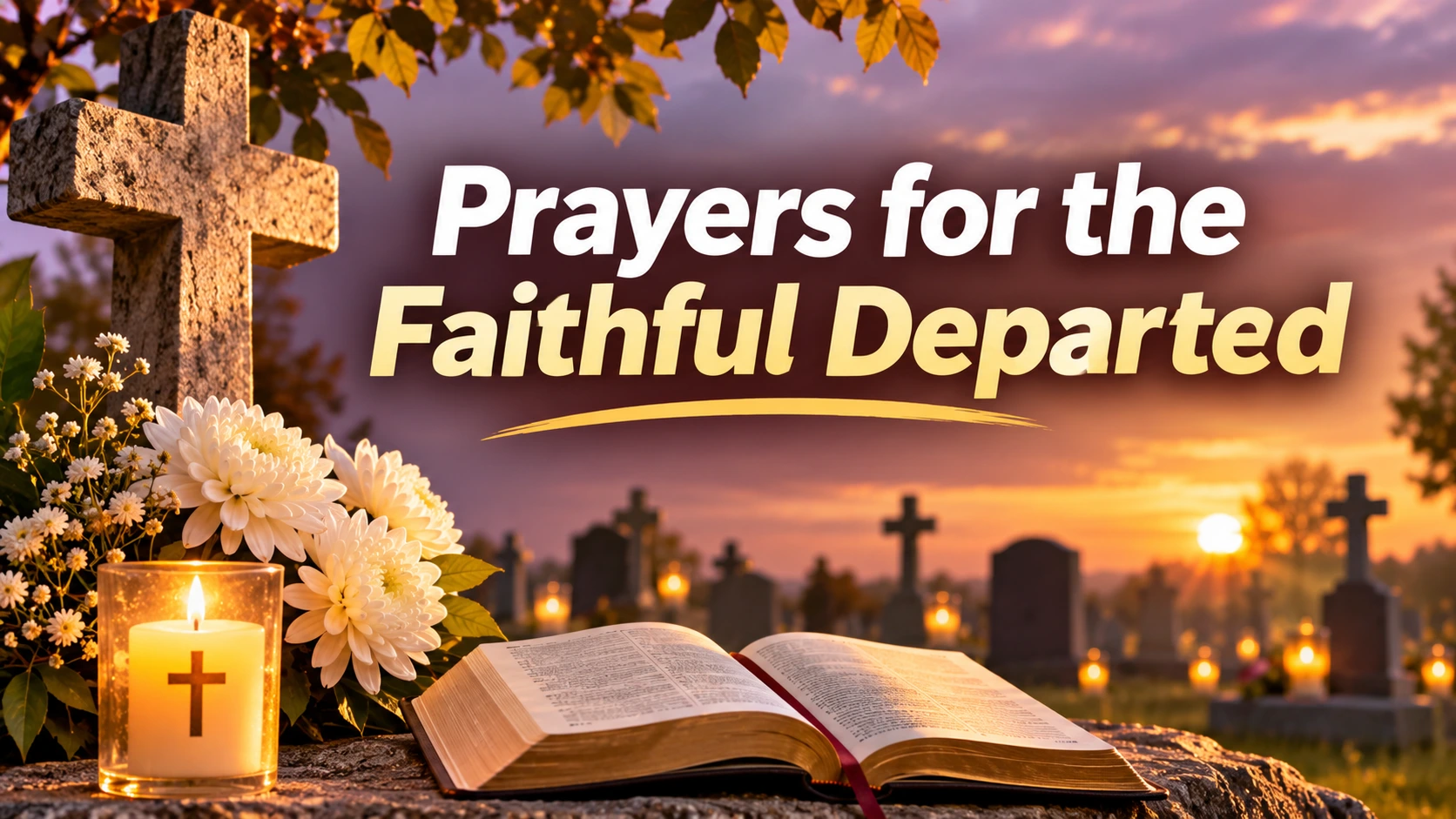

All Souls’ Day, observed on November 2, is a day of prayer for the faithful departed, especially those undergoing final purification before entering heaven. Catholics remember deceased family members, friends and all who have died in God’s friendship, asking the Lord to grant them eternal rest through His mercy.
For many families, this commemoration is deeply personal. The memory of a deceased parent, the absence of a spouse or the loss of someone who once shared everyday family life can make November 2 especially meaningful. All Souls’ Day offers an opportunity to remember those loved ones through prayer while entrusting them to God’s care.
The following prayers can be offered individually or with family members. They include the traditional Eternal Rest prayer, personal prayers for deceased relatives and a complete nine-day novena for the holy souls in purgatory.
A Prayer for All Souls’ Day
The central intention of All Souls’ Day is to ask God to show mercy to those who have died. Catholic tradition particularly emphasizes prayer for the souls undergoing final purification, trusting that their eternal destiny is communion with God.
This prayer can be offered on November 2, during a cemetery visit, after Mass or at home while remembering deceased loved ones.
Prayer for the Faithful Departed
Heavenly Father, source of mercy and everlasting life, I come before You today remembering all the faithful departed. You know every soul by name, every life that has ended and every person whose memory remains precious to those still living.
Through the saving love of Jesus Christ, look with compassion upon those who have departed this world. Forgive their sins, complete the work of purification in those who need it and bring them into the fullness of Your heavenly presence.
I remember especially my departed family members, friends, and all those who once shared their lives with me. Where my understanding ends, I place my trust in Your perfect knowledge, justice and mercy.
Grant eternal rest to the faithful departed and let Your perpetual light shine upon them. May all who are being purified be brought into the joy of heaven, where sorrow and suffering have no place.
Through Jesus Christ our Lord, Amen.
The Traditional Eternal Rest Prayer
One of the most familiar Catholic prayers for the dead is the Eternal Rest prayer, traditionally known by its Latin opening, Requiem aeternam.
It is particularly appropriate for All Souls’ Day because it expresses the Church’s request for God’s mercy and everlasting peace for the departed.
Eternal rest grant unto them, O Lord and let perpetual light shine upon them. May they rest in peace. Amen.
This short prayer can be repeated throughout November or whenever someone remembers a deceased loved one. When praying for an individual, the wording can be changed from “them” to “him” or “her.”
All Souls’ Day Prayers for Deceased Family
Praying for a deceased family member can feel different from offering a general prayer for the faithful departed. Family relationships carry particular memories, gratitude, sorrow and sometimes unresolved feelings that remain after a person’s death.
Catholic prayer does not require someone to know the eternal condition of a deceased relative. Instead, the person is entrusted to God’s mercy, while the living ask that the departed receive whatever purification is needed according to His will.
The following prayers can be personalized by mentioning the deceased person’s name. They may be offered privately, during family gatherings or as part of an All Souls’ Day remembrance.
Prayer for a Deceased Mother or Father
Merciful Father, today I remember my beloved parent, [Name], whose life was part of my own. I thank You for the love, care, sacrifices and memories that continue to remain with me.
I entrust my mother/father to Your infinite mercy. Forgive the sins and weaknesses of their earthly life and if purification is still needed, bring that work to completion through the saving grace of Jesus Christ.
May my parent receive everlasting rest in Your presence. Comfort our family in the sorrow of separation and strengthen our hope in the resurrection and the life to come.
Through Christ our Lord, Amen.
Prayer for a Deceased Husband or Wife
Lord Jesus Christ, You know the love and companionship I shared with my departed husband/wife, [Name]. You also know the emptiness that remains where familiar words, daily routines and shared moments once brought comfort.
Today I place my beloved spouse into Your merciful hands. Remember the goodness of their life, forgive their sins and grant them the fullness of eternal peace according to Your holy will.
Help me carry the memories of our life together with gratitude rather than despair. May the hope of everlasting life strengthen my heart as I continue to remember and pray for the one I love.
Amen.
Prayer for a Deceased Child
The loss of a child can leave parents and families with questions that have no easy answers. Catholic teaching encourages families to entrust deceased children to God’s mercy without presuming that every child undergoes purgatory. The Church particularly entrusts children who die without baptism to God’s mercy, as explained in Catechism paragraph 1261.
This prayer focuses on entrusting the child to God’s loving care and asking for comfort for those who grieve.
Loving Father, I bring before You the memory of my beloved child, [Name]. The sorrow of this loss is greater than words can fully express but I trust that Your compassion reaches beyond the limits of my understanding.
I entrust my child to Your infinite mercy and everlasting love. You know this precious life completely, and I place my hope in Your goodness, Your justice and the saving love of Jesus Christ.
Give our family strength in grief, tenderness in remembering, and peace in placing this precious life into Your hands. May Your everlasting love sustain us until every sorrow is healed in Your presence.
Amen.
Prayer for a Deceased Grandparent or Sibling
Heavenly Father, I remember my beloved [grandparent/sibling], [Name], with gratitude for the place they held in my life. Their presence brought memories, lessons, conversations and moments that remain meaningful even after death.
I ask You to look upon them with mercy and forgive whatever sins and human weaknesses marked their earthly journey. If they are undergoing final purification, may Your grace bring them into the fullness of heavenly joy.
Help our family remember them with love and pray for them with hope. May the bond of Christian charity remind us to entrust those who have departed to Your faithful care.
Through Jesus Christ our Lord, Amen.
Prayer for Someone by Name
Sometimes the most meaningful All Souls’ Day prayer is simply one spoken for a particular person. There is no requirement to use an elaborate formula or explain every detail of the deceased person’s life.
Before beginning, pause and remember the person you wish to commend to God. You may speak their full name aloud or hold it quietly in your heart.
Merciful Lord, I bring before You the soul of [Name], whom I remember with love today. You know their life completely, including the joys, struggles, goodness and failings that no other person can fully understand.
I ask You to receive my prayer for them and show them Your mercy. Forgive their sins, grant whatever purification is needed and lead them into everlasting peace through Jesus Christ.
May Your perpetual light shine upon them and may their soul rest in peace. Amen.
Novena for the Holy Souls in Purgatory
A novena is a devotion offered over nine days, usually for a particular spiritual intention. During the days surrounding All Souls’ Day, Catholics may pray a novena asking God to assist the holy souls undergoing purification.
According to Catholic teaching, purgatory is the final purification of those who have died in God’s grace and friendship but are not yet perfectly purified. Their salvation is assured and the Church offers prayers on their behalf as an expression of spiritual communion and charity.
The following is an original nine-day novena prepared for this prayer guide, not a prescribed liturgical text or a reproduction of a traditional saint’s novena.
You may pray it from October 25 through November 2, concluding on All Souls’ Day or begin on November 2 and continue through November 10. A novena can also be offered at another time of the year.
How to Pray the Novena
Set aside a few quiet minutes each day. Begin with the opening prayer below, offer the intention assigned to that day and conclude with the traditional Eternal Rest prayer.
You can dedicate the entire novena to a deceased family member, pray for all the holy souls in purgatory or remember different people during the nine days. The value of the devotion lies in sincere prayer and trust in God’s mercy, not in completing a formula believed to guarantee a particular result.
Opening Prayer
Merciful Father, I offer this novena for the holy souls in purgatory, especially those who have no one to remember them in prayer. Through the merits of Jesus Christ, look upon them with compassion and bring their final purification to completion.
Receive these nine days of prayer as an expression of love for the faithful departed. Strengthen my own faith in the resurrection and teach me to remember those who have died with hope in Your everlasting mercy.
Through Christ our Lord, Amen.
Nine Daily Prayers
Day 1 — For All the Holy Souls
Heavenly Father, I pray for all the souls undergoing purification before entering heaven. May Your mercy sustain them, and may the saving love of Jesus Christ bring them into the fullness of Your presence.
Remember every soul known perfectly to You, including those whose names are forgotten on earth. May the faithful departed receive everlasting peace through Your infinite mercy. Amen.
Day 2 — For Deceased Parents and Grandparents
Lord of mercy, I remember parents and grandparents who have completed their earthly lives. I thank You for the love, guidance and sacrifices they offered to their families.
Forgive their sins, complete whatever purification remains and welcome them into the joy of Your eternal kingdom. May those who remember them find comfort in the hope of everlasting life. Amen.
Day 3 — For Departed Spouses and Children
Compassionate God, I pray for departed husbands, wives, sons and daughters whose absence is deeply felt by their families. Entrust them to Your merciful care, and bring those who are undergoing purification into everlasting peace.
Comfort the people who continue to grieve and strengthen their hope in Christ’s resurrection. May Your love surround every family carrying the sorrow of separation. Amen.
Day 4 — For Friends and Benefactors
Heavenly Father, I remember the friends, teachers, neighbours and benefactors whose kindness touched the lives of others. Their generosity and companionship remain meaningful to those who knew them.
Reward whatever goodness they offered through Your grace, forgive their human failings and bring the faithful among them into the fullness of Your heavenly presence. May they receive everlasting peace through Christ our Lord. Amen.
Day 5 — For Souls Without Anyone to Pray for Them
Merciful Lord, today I remember the departed whose names are no longer spoken and whose graves may receive no visitors. Though the world may have forgotten them, every life remains known to You.
Look with mercy upon the souls undergoing purification, especially those who have no one to remember them in prayer. Bring them into everlasting rest through Your infinite compassion. Amen.
Day 6 — For Those Who Died Recently
Loving Father, I pray for those who have died in recent days and months, especially those whose families are experiencing fresh sorrow. Their absence is deeply felt by the people who loved them.
Receive the faithful departed into Your merciful care, grant them whatever purification is needed and strengthen those who mourn with the hope of eternal life. May Your peace sustain every grieving family. Amen.
Day 7 — For Victims of Tragedy
Lord Jesus, I remember those who have died through war, violence, accidents, disasters and circumstances of great suffering. Their deaths may have come suddenly, leaving families without the opportunity for farewell.
Entrusting each person to Your justice and mercy, I pray especially for the faithful departed who await the fullness of heavenly peace. Comfort those who grieve their loss and bring them strength through Your compassion. Amen.
Day 8 — For Souls Nearing the End of Purification
Heavenly Father, I pray for the holy souls whose final purification is nearing completion. May Your mercy bring them into the fullness of the joy for which they are being prepared.
Let Your eternal light shine upon them, and welcome them into the everlasting communion of heaven. May their longing for Your presence be fulfilled through the saving love of Jesus Christ. Amen.
Day 9 — For All the Faithful Departed
Eternal Father, on this final day of my novena, I commend to You all the faithful departed, especially my deceased relatives and those for whom I have promised to pray.
Receive these prayers through Jesus Christ, and grant the holy souls the fullness of eternal peace. May their final purification be completed and may they rejoice forever in Your presence. Amen.
Closing the Novena
After the prayer for each day, conclude with the Eternal Rest prayer. You may also mention deceased loved ones by name and offer an Our Father.
The nine days are not understood as a way of measuring or shortening purgatory by a fixed amount of time. Catholic teaching encourages prayer for the departed but does not promise that a particular novena will release a specified number of souls or produce a guaranteed result.
The purpose is to offer loving intercession while leaving the outcome to God’s mercy and wisdom.
How to Observe All Souls’ Day
All Souls’ Day is more than a date for remembering those who have died. In Catholic practice, it is a day when personal remembrance becomes part of the Church’s wider prayer for the faithful departed.
The observance takes place every year on November 2, immediately after All Saints’ Day on November 1. While All Saints’ Day celebrates those who already share in heavenly glory, All Souls’ Day focuses particularly on prayer for the departed, including those undergoing final purification.
Attend Mass for the Departed
One of the most important ways Catholics observe All Souls’ Day is by attending Mass and praying for the deceased.
The Catholic Church teaches that the Eucharistic sacrifice holds a central place among prayers offered for the faithful departed. The faithful may also request that Mass be offered for a deceased relative or another departed person.
If you wish to remember someone specifically, you can contact your parish about submitting their name for prayer or requesting a Mass intention. Parish arrangements vary, so it is best to ask locally rather than assume that every church follows the same procedure.
Visit a Cemetery
Visiting the grave of a loved one is another familiar All Souls’ Day practice. Families may bring flowers, clean the gravesite and spend time praying for those buried there.
The visit need not be elaborate. A short period of silence, the Eternal Rest prayer and a sincere request for God’s mercy are meaningful expressions of remembrance.
Catholic tradition also associates a special indulgence with cemetery visits during the first eight days of November.
From November 1 through November 8, Catholics can obtain a plenary indulgence applicable to the souls in purgatory by devoutly visiting a cemetery and praying for the deceased, provided the Church’s prescribed conditions are fulfilled.
These conditions include sacramental confession, receiving Holy Communion, praying for the Pope’s intentions and being completely detached from sin, including venial sin. The Church also requires the faithful to be properly disposed and to perform the prescribed devotional act.
A plenary indulgence concerns the remission of temporal punishment due to sins already forgiven. It should not be confused with purchasing forgiveness and it does not mean that a cemetery visit automatically guarantees the release of a particular soul.
The Church also provides a separate opportunity for a plenary indulgence applicable to the departed through a devout visit to a church or oratory on All Souls’ Day, with the recitation of the Our Father and the Creed, subject to the usual conditions.
Those interested in these indulgences can ask their parish priest for guidance on the prescribed requirements. Even without seeking an indulgence, visiting a cemetery and praying for the dead remains a meaningful act of Christian remembrance.
Remember the Departed at Home
Not everyone can attend Mass or visit a cemetery on November 2. Distance, illness, work or family circumstances may make it difficult to participate in the usual observances.
Prayer at home remains a meaningful way to commemorate the faithful departed. A family might place photographs of deceased relatives together, light a candle safely as a symbol of remembrance and offer prayers for each person by name.
A family can also read Psalm 130, which expresses a cry for mercy and hope in the Lord. John 11:25–26 offers another fitting passage because Jesus speaks about the resurrection and the life that comes through Him.
These practices direct remembrance toward God rather than attempting to communicate with the deceased. They provide a peaceful setting for remembering loved ones and offering prayers for their eternal rest.
Offer an Act of Charity
Catholic tradition also encourages acts of charity, almsgiving and penance offered with the intention of assisting the faithful departed.
A person might help someone facing hardship, contribute to a charitable cause or perform a quiet act of kindness while remembering a deceased family member.
Such actions are not payments that purchase forgiveness or guarantee a particular soul’s release from purgatory. They are expressions of Christian charity offered in communion with the Church’s prayers.
Why Catholics Pray for the Departed
The prayers associated with All Souls’ Day are grounded in the Catholic understanding that the communion of the faithful extends beyond earthly death.
The Catechism of the Catholic Church, particularly paragraphs 1030–1032, explains that those who die in God’s grace but still need purification undergo that final preparation before entering heaven.
The Catechism also teaches that the Church has long offered prayers for the dead, especially through the Eucharist. These prayers express the continuing spiritual communion between the faithful living on earth and those who have departed in God’s friendship.
This teaching is connected with the Catholic understanding of 2 Maccabees 12:43–46, where an offering is made on behalf of those who have died.
Catholics accept this book as Scripture, while most Protestant traditions do not recognize it as canonical authority for doctrine. Consequently, not all Christians understand prayers for the dead in the same way.
The Orthodox tradition also practices prayer for the departed, although its explanation of the soul’s condition after death differs from the Catholic doctrine of purgatory. Many Protestant churches instead emphasize entrusting the deceased to God’s judgment rather than offering prayers intended to assist them after death.
For readers who wish to examine the biblical arguments more closely, PsalmWisdom’s What Does the Bible Say About Praying for the Dead? considers the relevant passages and differences between Christian traditions.
For the purpose of All Souls’ Day, the practical Catholic understanding remains clear: the living pray to God for the faithful departed, asking that those undergoing purification may enter fully into the joy of heaven.
The prayers are directed to God, not to the souls themselves and they do not presume knowledge of an individual person’s final judgment.
Prayer for Forgotten Souls
All Souls’ Day also extends remembrance beyond familiar names and family relationships. Many people die without surviving relatives, without anyone visiting their graves or without someone publicly remembering their lives.
Catholic prayer for the departed includes these forgotten souls because Christian charity is not limited to people we personally knew. Praying for them reflects the belief that every human life remains known to God, even when forgotten by the world.
Prayer for Souls Without Family or Friends
Merciful Father, today I remember those who have departed this world without anyone remaining to speak their names or offer prayers on their behalf. You know every life, including those forgotten by history, separated from family or buried without recognition.
Look with compassion upon all the faithful departed who have no one to pray for them. Grant Your mercy to those undergoing final purification and bring them into the everlasting light of Your presence.
Teach me to remember that every human life has dignity before You, even when the world no longer remembers its story. May the souls of all the faithful departed, through Your infinite mercy, rest in peace.
Through Jesus Christ our Lord, Amen.
Remembering With Faith and Hope
All Souls’ Day invites Catholics to do something meaningful with the love and grief that remain after a person’s death. Instead of allowing remembrance to end with sorrow, the Church encourages the faithful to turn their memories into prayers offered to God.
A person does not need to know exactly what a deceased loved one experienced at death or where that person stands before God’s judgment. The purpose of prayer is not to claim such knowledge but to entrust the departed to divine mercy.
For families carrying grief, prayer may also become a source of spiritual comfort. The biblical assurance explained in PsalmWisdom’s article on Psalm 34:18 and the brokenhearted speaks meaningfully to those who continue living with the absence of someone they love.
Whether through the traditional Eternal Rest prayer, a personal prayer for deceased family, a nine-day novena or participation in Mass, All Souls’ Day provides an opportunity to remember the faithful departed with Christian hope.
The heart of the commemoration is to remember those who have died, pray for the souls who need purification, and entrust departed loved ones to the mercy and justice of God. Through these prayers, Catholics express their faith in Christ’s resurrection and their hope in the everlasting life He has promised.
