
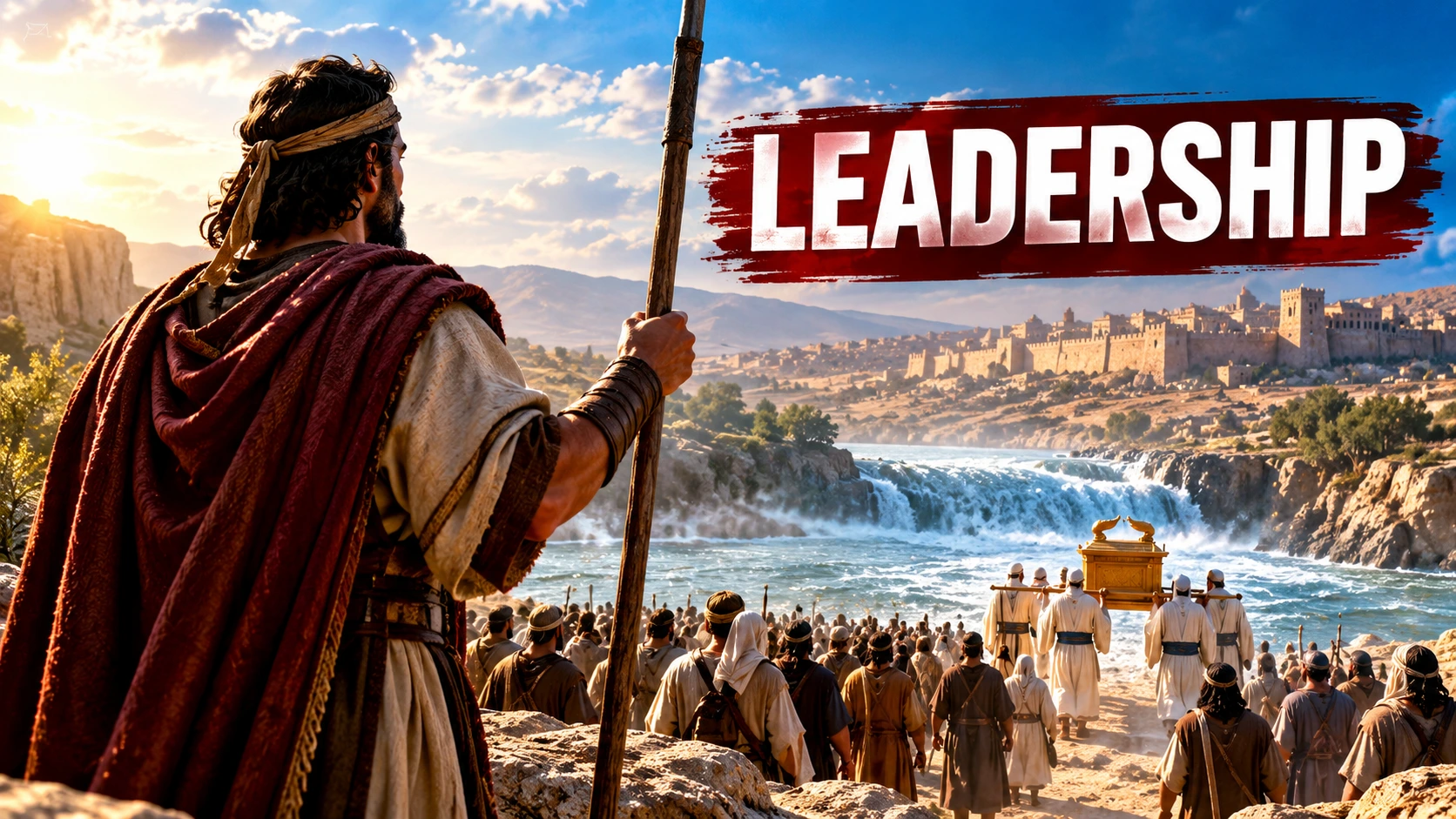

Joshua in the Bible was the leader who succeeded Moses and brought the Israelites into the Promised Land. He guided the nation across the Jordan River, commanded its military campaigns in Canaan and supervised the distribution of land among the tribes. His leadership marked a decisive change in Israel’s history, from decades of wilderness wandering to the beginning of settled life.
Joshua had already served under Moses for years, but leading Israel independently brought responsibilities he had never faced before. The nation needed more than a military commander. Its tribes had to remain united, opposing armies had to be confronted, and the territory gained through military campaigns had to be organized into lasting inheritances.
The most revealing part of Joshua’s story is how his responsibilities changed throughout his life. His victories at Jericho and other cities made him famous but the biblical account also records mistakes, unfinished tasks and difficult decisions that reveal what leading Israel actually required.
How Moses Prepared Joshua for Leadership
Joshua was the son of Nun and belonged to the tribe of Ephraim. Numbers 13:16 records that his original name was Hoshea, which Moses changed to Joshua, a name commonly understood to mean “The Lord saves.”
Long before he succeeded Moses, Joshua had demonstrated his ability to carry substantial responsibility. Exodus 17:8–13 describes him commanding Israel’s soldiers against the Amalekites while Moses watched from a nearby hill.
Joshua directed the fighting, but the narrative connects Israel’s success with Moses’ raised hands and God’s intervention. At this stage, Joshua was an experienced commander acting under another leader’s authority.
Exodus 24:13 also identifies Joshua as Moses’ assistant, showing that their relationship extended beyond the battlefield. Numbers 11:28 similarly describes him serving Moses, placing Joshua close to the leadership of Israel during the wilderness years.
His experience became particularly important when Moses selected twelve men to investigate Canaan.
Numbers 13–14 records that the scouts returned with evidence of the land’s fertility but disagreed about whether Israel should enter it. Ten discouraged the people because of the fortified cities and powerful inhabitants, while Joshua and Caleb urged them to trust the Lord’s promise.
Joshua had seen the same conditions as the other scouts. His disagreement was not based on ignorance of the dangers but on his conviction that Israel should follow the command to enter Canaan.
The people rejected their appeal, and the rebellious generation was prevented from entering the land. Joshua and Caleb were specifically identified as exceptions who would eventually receive their inheritance.
This experience is important because Joshua’s commitment was demonstrated before he possessed national authority. He had already defended the decision to enter Canaan when most of the people opposed it.
Joshua’s Appointment Before Moses Died
Joshua’s succession was established before Moses’ death. Numbers 27:18–23 describes God instructing Moses to commission Joshua publicly before Eleazar the priest and the congregation.
Moses laid his hands upon Joshua and recognized his responsibility before the people. Deuteronomy 31:7–8 records Moses encouraging him to lead Israel into the land promised to its ancestors.
The appointment provided continuity between the two leaders, but their assignments were different. Moses had led Israel out of Egypt, received the covenant law, and guided the people through the wilderness. Joshua would be responsible for leading them across the Jordan and establishing their inheritance in Canaan.
The circumstances surrounding that transition are examined more fully in PsalmWisdom’s account of Moses’ life from Egypt to Mount Nebo. Joshua’s national leadership began where Moses’ journey ended but he was entering a different phase of Israel’s history.
Joshua 1 records God commanding him to be strong and courageous while carefully observing the law given through Moses. The repeated encouragement was connected with a real responsibility rather than merely offering a general message about confidence.
Joshua had to lead a large nation into occupied territory while preserving the obligations established during Moses’ leadership. His first actions demonstrate how he began carrying out that assignment.
Joshua Leads Israel Across the Jordan
After Moses’ death, Joshua instructed Israel’s officers to prepare the people to cross the Jordan River.
He also reminded the tribes of Reuben, Gad and the half-tribe of Manasseh of their earlier agreement. Although these tribes had received land east of the Jordan, their fighting men were still required to accompany the other Israelites into Canaan.
This was an important early test of Joshua’s authority. Israel could not undertake the campaign successfully if some tribes abandoned their responsibilities once their own families had received territory.
Joshua 1:16–18 records the tribes affirming their willingness to obey him. Their response helped establish the cooperation necessary for the next stage of Israel’s journey.
Before the crossing, Joshua sent two spies to Jericho. Joshua 2 describes their encounter with Rahab, who sheltered them and explained that the city’s inhabitants had heard about Israel’s earlier victories.
The spies returned with confidence that the Lord had given the land into Israel’s hands. Their report offered a notable contrast with the fearful majority report Joshua had encountered years earlier.
Jordan Crossing Confirms Joshua’s Leadership
Joshua 3 describes the priests carrying the Ark of the Covenant toward the Jordan. When they stepped into the water, the river stopped flowing downstream, allowing the Israelites to cross on dry ground.
The narrative directly connects this event with Joshua’s recognition as Israel’s leader. In Joshua 3:7, God declares that He will begin to exalt Joshua before the people so they will know He is with him as He had been with Moses.
The comparison with Moses is significant. Moses had led Israel through the sea during the exodus from Egypt, while Joshua now led the nation through the Jordan into Canaan.
Both events involved a decisive crossing, but they marked different stages of Israel’s history. The earlier crossing brought the people out of slavery, while the later crossing began their entrance into the land.
Joshua 4 records the establishment of twelve memorial stones at Gilgal, representing Israel’s tribes. These stones were intended to preserve the memory of the crossing so future generations could understand how the nation entered Canaan.
Joshua 5 then describes Israel observing Passover in the land. Shortly afterward, the manna that had sustained the people during their wilderness journey ceased and they began eating the produce of Canaan.
The sequence reveals how much had changed under Joshua’s leadership. Israel had crossed into the promised territory, but its new circumstances also brought unfamiliar responsibilities and serious opposition.
Joshua’s Victories and Setbacks in Canaan
Joshua’s military leadership is most closely associated with the capture of Jericho. According to Joshua 6, the Israelites followed instructions involving the Ark of the Covenant, priests carrying trumpets, and repeated marches around the fortified city.
On the seventh day, the people shouted, and the walls collapsed. The biblical narrative attributes the victory to God’s intervention rather than conventional siege tactics.
Rahab and her household were spared in accordance with the agreement made with the spies. The remaining account describes Jericho’s destruction as Israel’s first major victory west of the Jordan.
However, the next chapters show that this success did not guarantee an uninterrupted series of victories.
Joshua’s Defeat and Victory at Ai
Joshua 7 records Israel’s failed attack against Ai. After scouts suggested that only a small force would be necessary, the Israelites attacked but were defeated, losing approximately thirty-six men.
Joshua responded with distress and sought an explanation from the Lord. The narrative identifies Achan’s violation of the instructions concerning possessions taken from Jericho as the cause of Israel’s trouble.
Achan had secretly kept prohibited valuables and concealed them beneath his tent. After the violation was exposed and dealt with, Joshua received new instructions for another attack.
Joshua 8 describes Israel capturing Ai through a planned ambush. Unlike the earlier unsuccessful attempt, the new operation involved dividing the forces and drawing the city’s defenders away from their position.
The contrast between the two attacks reveals a practical challenge Joshua faced as commander. He could not assume that a smaller city would require less careful preparation simply because Israel had previously defeated Jericho.
I find this one of the more revealing parts of Joshua’s leadership. The biblical account does not portray his military decisions as automatically successful, even though he had been appointed to lead the nation.
Gibeonite Treaty Created Different Problem
Joshua 9 describes another failure, this time involving diplomacy rather than battle.
The Gibeonites approached Israel pretending to be travelers from a distant country. They carried worn supplies and stale bread to support their claim, hoping to persuade Joshua and the other leaders to make a treaty with them.
Joshua and Israel’s leaders accepted their explanation and entered into an agreement. However, Joshua 9:14 explicitly states that they had not sought the Lord’s counsel before making the decision.
The deception was discovered shortly afterward, but the leaders maintained their oath. Joshua 10 later records Israel defending Gibeon when neighboring kings attacked the city.
This incident reveals that Joshua’s responsibility extended beyond commanding soldiers. He also had to make agreements whose consequences could influence future military operations.
The situations at Ai and Gibeon exposed different difficulties. At Ai, Joshua faced an unexpected military defeat connected with a hidden violation. With the Gibeonites, he accepted misleading evidence and entered into an obligation that could not simply be withdrawn.
Joshua’s courage and previous victories did not make his judgment infallible. The book records him leading Israel through both successful decisions and serious complications.
The campaigns continued against coalitions of kings in southern and northern Canaan. Joshua 10–12 describes these victories and summarizes the rulers defeated during Israel’s advance.
By the end of these campaigns, Joshua had established Israel’s position in substantial areas of Canaan. Yet another responsibility remained, one that required a different kind of leadership.
Joshua Divides the Promised Land
The second half of the book of Joshua places considerable emphasis on the distribution of territory.
Joshua 13–21 describes the inheritances assigned to Israel’s tribes, including boundaries, towns and arrangements for communities living on both sides of the Jordan.
These chapters contain fewer dramatic events than the military campaigns, but they are essential to understanding Joshua’s work. Entering Canaan and defeating opposing armies did not automatically establish where each tribe would live.
Joshua had to help turn the nation’s territorial gains into organized inheritances.
The task was complicated by an important limitation recorded in Joshua 13:1. When Joshua had grown old, God told him that substantial areas of land still remained to be possessed.
This deserves attention because Joshua 11:23 had earlier summarized his campaigns by stating that he took the land and distributed it to Israel.
The passages become clearer when we distinguish major military victories from complete territorial occupation. Joshua had defeated important opposing forces but the book acknowledges that Israel had not gained control of every area associated with its inheritance.
The biblical account therefore presents significant achievements alongside unfinished responsibilities. Describing Joshua as having permanently conquered every part of Canaan would overlook that distinction.
Joshua Assigns Land to the Remaining Tribes
Joshua 18 provides a particularly useful example of Joshua’s leadership after the major campaigns.
Seven tribes had not yet received their allotted territories. Joshua questioned their delay and instructed representatives to survey the remaining land.
The men traveled through the territory, recorded its towns and divisions, and returned to Joshua at Shiloh. The allotments were then made by lot before the Lord.
This situation required coordination rather than military command. Joshua had to address the delay, organize the survey, and oversee decisions affecting where large communities would eventually settle.
Joshua 20 records another responsibility connected with the nation’s settlement. Six cities of refuge were designated according to instructions previously given through Moses.
These cities provided a place where someone accused of causing an unintentional death could seek protection while the case was examined. PsalmWisdom’s separate explanation of the six cities of refuge in the Bible examines the arrangements and their legal purpose in greater detail.
Their designation demonstrates that Joshua’s assignment included organizing important aspects of communal life, not simply distributing land.
Another meaningful detail appears in Joshua 19:49–50. After the tribal inheritances had been assigned, Joshua received his own inheritance at Timnath-serah in the hill country of Ephraim.
The narrative places his personal allotment after the distribution among the tribes. Although it does not explain his private intentions, the sequence reinforces how much of his later leadership was devoted to establishing Israel’s inheritance.
Joshua’s achievements cannot be measured by the number of cities he defeated alone. The later chapters show him overseeing the arrangements necessary for the tribes to begin living in the territory they had entered.
This administrative responsibility distinguished his later years from the military assignments he had carried out under Moses.
Joshua’s Final Appeal at Shechem
Near the end of his life, Joshua gathered Israel’s leaders and reviewed the responsibilities that would remain after his death.
Joshua 23 records him reminding the people of the Lord’s actions on their behalf. He also warned them against adopting the worship practices of surrounding nations and acknowledged that other peoples remained in the land.
The warnings were connected with Israel’s actual circumstances. The tribes had received their inheritances but continued settlement and future decisions would take place without Joshua directing every step.
Joshua 24 describes a larger gathering at Shechem, where he reviewed Israel’s history from its ancestors through the exodus and entrance into Canaan.
He then challenged the people to decide whom they would serve. Joshua 24:15 contains his well-known declaration that he and his household would serve the Lord.
The statement was not simply a personal expression of faith. In its original setting, Joshua was addressing the nation and calling for a renewed commitment to the covenant.
The people responded by declaring their intention to serve the Lord. Joshua established a large stone as a witness to that commitment.
Joshua’s Leadership From Beginning to End
There is a meaningful relationship between Joshua’s first major action after crossing the Jordan and his final gathering at Shechem.
Joshua 4 describes memorial stones established to preserve the memory of Israel’s entrance into Canaan. Joshua 24 records another stone serving as a witness to the people’s covenant commitment.
The stones had different immediate purposes. The first reminded future generations of what had happened during the crossing, while the second witnessed the people’s declared responsibility to remain faithful.
This comparison reveals an important development in Joshua’s leadership.
At the beginning, he was bringing the nation into its inheritance. Near the end, he was preparing the people to continue living there without depending on his authority.
He could organize their entrance, direct their campaigns, and supervise their settlements, but he could not make every future decision on their behalf.
Joshua 24:29 records that Joshua died at the age of 110. He was buried at Timnath-serah, within his inheritance in Ephraim.
The chapter also states that Israel served the Lord during Joshua’s lifetime and throughout the lives of the elders who outlived him and remembered the events of his leadership.
Unlike Moses, Joshua is not followed in the narrative by one clearly identified successor who assumes his entire national role. The book of Judges describes the challenges that emerged during the generations following his death.
Joshua’s final gathering therefore served an important purpose. He had led Israel into Canaan, but the nation’s future would depend on decisions made after his leadership ended.
What Joshua Accomplished After Moses
Joshua’s life in the Bible covers a transition that Moses had prepared Israel to undertake but would not personally complete.
Joshua led the nation across the Jordan, directed its major campaigns in Canaan, and oversaw the division of territory among the tribes. He also faced failures at Ai, a mistaken agreement with the Gibeonites, and the reality that some land remained outside Israel’s control.
These details provide a fuller picture of his leadership than the fall of Jericho alone. His responsibilities changed as Israel moved from entering the land to establishing communities within it.
What stands out in my comparison is that Joshua’s leadership began with an assignment inherited from Moses and ended with a responsibility he could not fulfill for the people himself.
He could guide Israel into Canaan and help organize its inheritance, but he could not guarantee the nation’s continued faithfulness after his death.
Joshua’s lasting importance in the Bible lies in how he guided Israel from wilderness wandering under Moses to the beginning of settled life in the Promised Land. His story includes military victories, difficult decisions, unfinished work, and a final effort to prepare the nation for life without him.
The book remembers Joshua as a faithful leader while also recording the limits of what he accomplished. That combination makes his life more than a story of conquest. It is the account of a man entrusted with leading Israel through one of its most important biblical transitions.
