
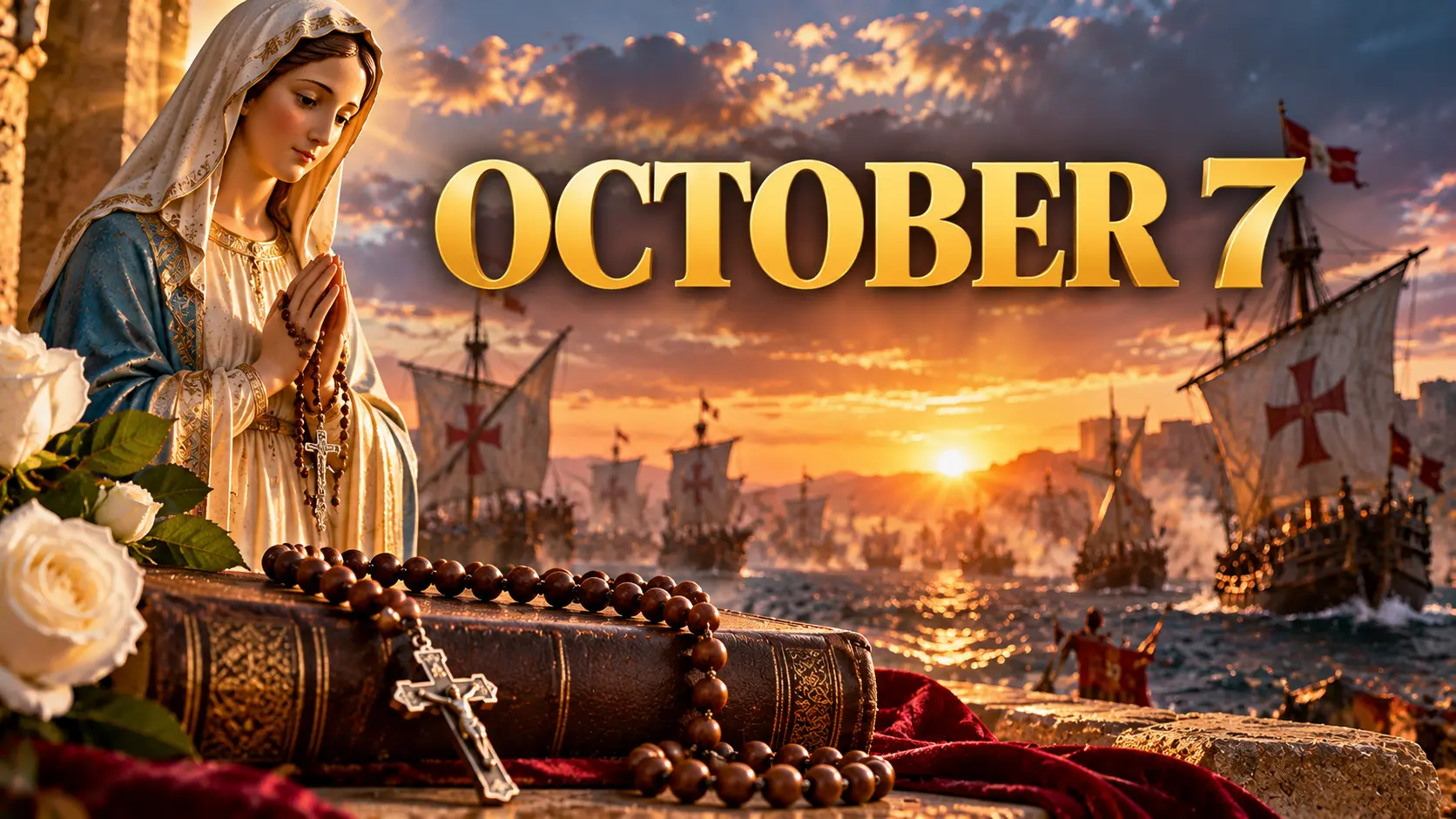

October 7 is observed in the Catholic Church as the Memorial of Our Lady of the Rosary because the date is historically connected with the Battle of Lepanto, fought on October 7, 1571. Pope St. Pius V associated the Christian victory with prayers offered through the Rosary and established a feast of thanksgiving that later developed into the observance known today as Our Lady of the Rosary.
This single feast day is different from the broader tradition of dedicating the entire month of October to the Rosary. October 7 has its own event-centred history, while the month-long devotion developed more fully through later papal encouragement, particularly under Pope Leo XIII. Readers interested in that broader tradition can explore why October is considered the Month of the Rosary separately.
Phase 1: The Date’s Significance
The importance of October 7 begins with one specific historical event. On that date in 1571, the Holy League fought the Ottoman fleet near Lepanto during a period of intense rivalry and military conflict in the Mediterranean.
Pope St. Pius V had supported the formation of the Holy League and encouraged Christians to pray for the forces taking part in the battle. Catholic tradition remembers the Rosary as especially important during this period, with prayers offered for the fleet before and during the conflict.
When news of the victory reached Rome, Pius V interpreted the outcome within a religious framework of thanksgiving and Marian intercession. The anniversary gradually became associated with a feast honouring Mary, creating the foundation for October 7’s lasting place in Catholic devotional history.
Today, October 7 remains the Memorial of Our Lady of the Rosary in the Roman Catholic liturgical calendar.
Phase 2: Chronological Event Timeline
October 7, 1571 — The Battle of Lepanto
The Battle of Lepanto took place against the background of Ottoman expansion in the Mediterranean and continuing conflict involving European powers. A coalition known as the Holy League brought together forces from Spain, Venice, the Papal States, Genoa and other Catholic territories.
Pope St. Pius V played an important role in supporting the alliance. Alongside military preparations, he called for prayer and later Catholic accounts emphasized that Christians who were not participating in the battle were also invoking Mary through the Rosary.
The Holy League won a major naval victory. From a historical perspective, the result depended on leadership, fleet organization, weapons, manpower, geography and tactical decisions, but Catholic tradition also interpreted the victory spiritually.
This distinction is important. Catholics did not preserve October 7 simply as the anniversary of a naval battle; they remembered it as a day of thanksgiving because Pius V and later Catholic tradition associated the victory with prayer and Marian intercession.
1572–1573 — From Our Lady of Victory to the Holy Rosary
After Lepanto, Pope St. Pius V established a feast associated with the victory and with thanksgiving to the Virgin Mary. The original observance was known as Our Lady of Victory, reflecting the historical circumstances in which it arose.
The development continued under Pope Gregory XIII, who strengthened the connection with the Rosary and gave the celebration a more explicitly Rosary-centred identity. By 1573, the feast had moved beyond the simple commemoration of a military victory and had become increasingly associated with Marian devotion and prayer.
This development explains why October 7 eventually came to be remembered primarily through the Rosary rather than only through the Battle of Lepanto. The battle supplied the historical event, while the feast gave that event a lasting liturgical and spiritual meaning.
From a Victory Feast to a Wider Church Observance
The celebration continued to develop over the following centuries. Its observance gradually spread more widely through the Church, especially as later popes continued to promote the Rosary as a prayer of intercession, contemplation, and confidence in God.
This wider development matters because the modern feast did not take its present form all at once. Its title, reach and calendar placement evolved over time, which is why different historical dates sometimes appear in explanations of when the observance was first established.
1913–1969 — The Feast Is Fixed to October 7
A major calendar development came under Pope St. Pius X. In 1913, he fixed the feast permanently to October 7, directly linking the liturgical observance with the anniversary of the Battle of Lepanto.
Later liturgical reforms changed the classification and organization of many Church celebrations, but October 7 remained associated with Our Lady of the Rosary. In the modern Roman calendar, the date continues to be observed as the Memorial of Our Lady of the Rosary.
The timeline therefore becomes clear: a historical battle in 1571 led to a thanksgiving feast, the feast gradually developed a stronger Rosary identity and the modern Church retained October 7 as the date of the observance.
Phase 3: Anatomy of the Historical Impact
The Miraculous Context
The Battle of Lepanto became especially significant in Catholic memory because the victory was linked with widespread prayer. Pius V had called Christians to prayer and later Catholic tradition presented the Rosary as part of the spiritual response to the crisis.
For Catholics, the victory came to be understood as an occasion of divine providence and Marian intercession. That devotional interpretation does not deny the military realities of the battle, including strategy, naval strength, leadership, geography and the decisions of commanders.
The two perspectives answer different questions. Historians examine how the battle was won in military terms, while Catholic tradition explains why the event became a feast of thanksgiving and why the Rosary became so closely attached to its memory.
The word “miraculous” is therefore best understood within that devotional context. It reflects the Catholic conviction that prayer and human action were not mutually exclusive and that the victory deserved spiritual thanksgiving as well as historical recognition.
How Lepanto Reshaped Catholic Rosary Devotion
Lepanto gave the Rosary a powerful historical association with communal prayer during crisis. Because the event was remembered annually through a Marian celebration, the connection between the Rosary, intercession and confidence in God became deeply rooted in Catholic devotional culture.
Over time, popes continued to recommend the Rosary during periods of conflict, uncertainty and spiritual need. The October 7 observance therefore outlived the political and military circumstances that originally produced it.
The feast also contributed to the wider association between October and the Rosary, although that month-long tradition developed more fully in later centuries. The broader story belongs in why October became the Month of the Rosary, while October 7 remains anchored to the specific history of Lepanto and the feast that followed.
For modern Catholics, the significance of the day is not simply the defeat of a historical enemy. The deeper devotional message is about prayer during fear, trust in God, perseverance and asking for Mary’s intercession during times of uncertainty.
Phase 4: Modern Liturgical Observance
October 7 is observed today as the Memorial of Our Lady of the Rosary. In parishes, the day may be marked through Mass, Rosary prayer, Marian devotions or other local customs connected with the feast.
Some Catholic communities organize communal Rosaries, Marian processions, school devotions or special intentions for peace. These customs vary from place to place, so there is no single universal parish program beyond the liturgical observance itself.
The theological meaning of the feast is broader than remembering a sixteenth-century battle. The Rosary invites Catholics to contemplate the life of Christ with Mary and to respond to times of crisis through prayer, trust and spiritual perseverance.
Catholic tradition sometimes describes the Rosary as a spiritual weapon, but that language is religious rather than physical. It refers to prayer as a means of resisting temptation, fear, discouragement and evil rather than as a call to violence.
Readers who want the prayer itself explained step by step can turn to how to pray the Holy Rosary correctly, while this article remains focused on why October 7 became the day associated with the Rosary.
Phase 5: Key Historical Takeaways
- October 7, 1571 — The Battle: The Holy League defeated the Ottoman fleet at Lepanto, while Pope St. Pius V had encouraged widespread prayer and Catholic tradition associated the victory with Marian intercession and the Rosary.
- 1572–1573 — The Feast: Pius V established a thanksgiving celebration associated with Our Lady of Victory and Pope Gregory XIII strengthened its explicit connection with the Holy Rosary.
- Later Centuries — Wider Observance: The feast gradually spread more broadly through the Church as Rosary devotion continued to grow.
- 1913 — The Date: Pope St. Pius X fixed the observance to October 7, directly connecting the liturgical celebration with the anniversary of Lepanto.
- Today — The Memorial: October 7 remains the Memorial of Our Lady of the Rosary in the modern Roman Catholic calendar.
October 7 is therefore the Day of the Rosary because one historical event gradually became a lasting liturgical remembrance. The Battle of Lepanto created the original date connection, while successive popes helped shape the feast into the observance Catholics recognize today.
Its deeper significance, however, is not limited to naval history. The feast has come to represent prayer during crisis, confidence in God, Marian intercession and the enduring place of the Rosary within Catholic spiritual life.

1 thought on “Why Catholics Observe the Rosary on October 7”