
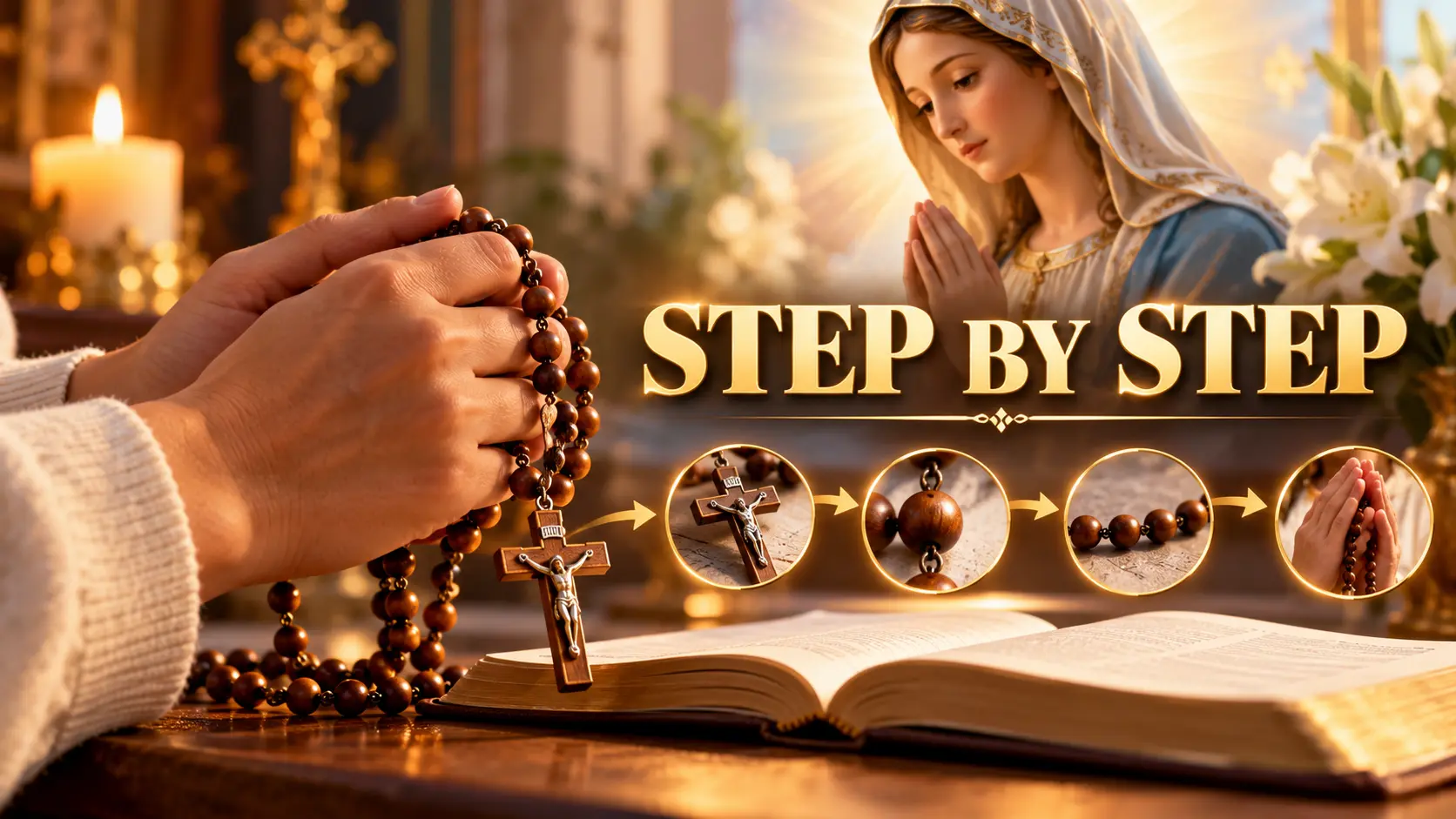

Praying the Holy Rosary correctly is less complicated than it may first appear. You begin with the introductory prayers, pray five decades while meditating on five mysteries from the life of Jesus and Mary, and finish with the traditional closing prayers.
The physical beads help you keep your place but the purpose of the Rosary is not simply to complete a sequence of prayers. The repetition of the Our Father, Hail Mary and Glory Be is meant to accompany meditation on the mysteries of Christ’s life.
Phase 1: Preparation and Setup
Before beginning, it helps to have a rosary in your hands, know which set of mysteries you intend to pray and find a place where you can give reasonable attention to prayer. A quiet space can make concentration easier, although Catholics can pray the Rosary almost anywhere.
Physical rosary beads are useful because they guide you through the sequence without requiring you to count the prayers mentally. They are not required for the prayer itself, so if you do not have beads, you can still pray the Rosary by counting the prayers another way.
The other useful preparation is knowing which mysteries you will meditate on. There are four sets: Joyful, Sorrowful, Glorious and Luminous, making twenty mysteries in total.
Understanding the Parts of the Rosary Beads
A standard five-decade rosary begins with a crucifix, followed by a short introductory section of beads that leads to the centerpiece. From the centerpiece extends the circular portion containing five groups of ten small beads, with larger single beads separating the decades.
The crucifix is where the Apostles’ Creed is traditionally prayed. The first large bead is used for the Our Father, while the next three small beads are used for three Hail Marys, commonly offered for an increase in faith, hope and charity.
After these introductory prayers, you reach the main five-decade portion of the Rosary. Each decade begins with an Our Father on a large bead, continues with ten Hail Marys on the ten small beads while meditating on a particular mystery and ends with the Glory Be.
Once you understand that pattern, the beads become much easier to follow. The Rosary is essentially an introduction followed by the same decade structure repeated five times and then a set of closing prayers.
Phase 2: Sequential Prayer Protocol
1. Opening Prayers
Begin by holding the crucifix and making the Sign of the Cross:
In the name of the Father and of the Son, and of the Holy Spirit. Amen.
Still holding the crucifix, pray the Apostles’ Creed. The Creed serves as a profession of the central beliefs of the Christian faith and traditionally opens the Rosary before the prayers on the beads begin.
Move to the first large bead and pray one Our Father. Then move through the next three small beads, praying one Hail Mary on each bead.
These three introductory Hail Marys are commonly offered for an increase in faith, hope and charity. After completing them, pray the Glory Be before beginning the first mystery.
2. The Five Decades
The five decades form the main body of the Rosary. Each decade follows the same basic structure, while the mystery being contemplated changes.
Announce the Mystery
Before starting each decade, announce the mystery you are going to meditate on. For example, if you are praying the Joyful Mysteries, you would begin the first decade by announcing The Annunciation.
You do not need to give a long explanation of the mystery. Simply naming it is enough, although some people read a short Scripture passage or pause briefly to reflect on the event before continuing.
Pray the Our Father
After announcing the mystery, pray one Our Father on the next large bead. This begins the decade and prepares the transition into the ten Hail Marys.
Once the Our Father is complete, move to the next series of ten small beads. These ten beads form the decade itself.
Pray 10 Hail Marys While Meditating on the Mystery
Pray one Hail Mary on each of the ten small beads. At the same time, keep the announced mystery in mind rather than treating the prayers only as words that need to be completed.
For example, during the Nativity mystery, the repeated Hail Marys accompany meditation on the birth of Christ. During the Crucifixion, the same prayers accompany contemplation of Christ’s death on the Cross.
This combination of vocal prayer and mental meditation is central to the Rosary. The repeated prayers create a steady rhythm that helps the mind remain with the mystery being contemplated.
Pray the Glory Be
After the tenth Hail Mary, pray the Glory Be. This completes the basic structure of the decade before you move to the next mystery.
You then announce the next mystery, pray another Our Father on the next large bead, ten Hail Marys on the ten small beads and another Glory Be. Repeat this pattern until all five mysteries have been completed.
The Fatima Prayer Is Optional
Many Catholics also pray the Fatima Prayer after the Glory Be at the end of each decade:
O my Jesus, forgive us our sins, save us from the fires of hell; lead all souls to Heaven, especially those who have most need of your mercy.
This prayer is widely used but is optional. A Rosary does not become incomplete simply because the Fatima Prayer is not included.
The pattern of one decade is therefore easy to remember: announce the mystery → Our Father → ten Hail Marys → Glory Be → optional Fatima Prayer. Repeat that sequence five times.
3. Closing Prayers
After completing all five decades, the traditional next prayer is the Hail, Holy Queen, also known by its Latin title Salve Regina. It brings the five decades to a devotional conclusion through a prayer asking for Mary’s intercession.
A traditional response follows:
Pray for us, O holy Mother of God, that we may be made worthy of the promises of Christ.
A concluding prayer is then commonly prayed, beginning:
O God, whose Only Begotten Son, by his life, Death and Resurrection, has purchased for us the rewards of eternal life…
The Rosary is then concluded with the Sign of the Cross. Other prayers may be added according to personal, family, parish or community custom but they are not necessary for a beginner to understand the basic structure.
Phase 3: The Four Sets of Mysteries
The mysteries determine what you meditate on while praying the five decades. The Church recognizes four sets containing five mysteries each, giving twenty mysteries altogether.
| Mystery Set | Traditional Days | Core Themes Covered |
|---|---|---|
| Joyful Mysteries | Mondays & Saturdays | The Incarnation and early life of Christ |
| Sorrowful Mysteries | Tuesdays & Fridays | The Passion and Crucifixion of Christ |
| Glorious Mysteries | Wednesdays & Sundays | The Resurrection and heavenly glory |
| Luminous Mysteries | Thursdays | The public ministry of Jesus |
This weekly arrangement is the common pattern, although Catholics may pray a different set of mysteries when appropriate to a liturgical season, feast, personal intention or devotional practice.
Joyful Mysteries
The Joyful Mysteries are the Annunciation, the Visitation, the Nativity, the Presentation and the Finding of Jesus in the Temple. They focus on the Incarnation and the early life of Jesus.
They are traditionally associated with Mondays and Saturdays. These mysteries invite meditation on Mary’s response to God, Christ’s birth, family life and the beginnings of his earthly mission.
Sorrowful Mysteries
The Sorrowful Mysteries are the Agony in the Garden, the Scourging at the Pillar, the Crowning with Thorns, the Carrying of the Cross and the Crucifixion. They follow Christ through his Passion and death.
They are traditionally prayed on Tuesdays and Fridays. They are also commonly used on Sundays during Lent in some devotional schedules.
Glorious Mysteries
The Glorious Mysteries are the Resurrection, the Ascension, the Descent of the Holy Spirit, the Assumption of Mary and the Coronation of Mary. They focus on Christ’s victory over death and the hope of eternal life.
They are normally associated with Wednesdays and Sundays. Their themes move from the Resurrection toward the life of the Church and the hope of heavenly glory.
Luminous Mysteries
The Luminous Mysteries, also called the Mysteries of Light, are the Baptism of Jesus in the Jordan, the Wedding at Cana, the Proclamation of the Kingdom of God, the Transfiguration, and the Institution of the Eucharist. They focus on key moments in the public ministry of Jesus.
Pope John Paul II proposed the Luminous Mysteries in 2002 and Thursdays became their ordinary place in the weekly pattern. Their inclusion allows the Rosary to contemplate important events between Christ’s childhood and his Passion.
You do not need perfect knowledge of every mystery before you begin praying. A beginner can use a printed or digital reference while learning and familiarity usually develops naturally with repetition.
Phase 4: Common Execution Pitfalls
Vocal Prayer Without Meditation
One of the easiest mistakes is to become so focused on saying the words correctly that the mystery disappears from your attention. The Rosary contains repetition but that repetition is intended to support contemplation rather than replace it.
You do not need to maintain a vivid mental image during every Hail Mary. Simply returning your attention to the mystery whenever possible is enough to keep the prayer from becoming purely mechanical.
A short Scripture verse or brief reflection before each mystery can also help. It gives the mind something concrete to return to during the decade.
What to Do When Your Mind Wanders
Distraction during the Rosary is common, especially when you are tired, worried or still learning the prayer. There is no need to restart a decade every time your attention wanders.
Notice the distraction, let it pass and gently return your attention to the prayer or mystery. The goal is not perfect concentration but a sincere effort to remain prayerfully present.
Do Not Rush Simply to Finish
Another common difficulty is treating the Rosary as a race through fifty Hail Marys. A comfortable pace usually helps a beginner pay better attention to both the words and the mystery being contemplated.
As the sequence becomes familiar, less mental effort is needed to remember what comes next. That makes it easier to focus on the spiritual meaning of the prayer rather than the mechanics of the beads.
Prayer Is Not a Performance
Learning the traditional order helps you participate confidently in personal, family and parish Rosaries. The basic sequence is clear: opening prayers, five decades with their mysteries, closing prayers and the Sign of the Cross.
Minor mistakes should not become a source of anxiety. If you lose count, forget an optional prayer or need to check which mystery comes next, simply continue. For those considering a regular devotional practice, what happens when you pray the Rosary every day can be explored separately without changing the procedural focus of this guide.

1 thought on “How to Pray the Holy Rosary With the Correct Prayers”