
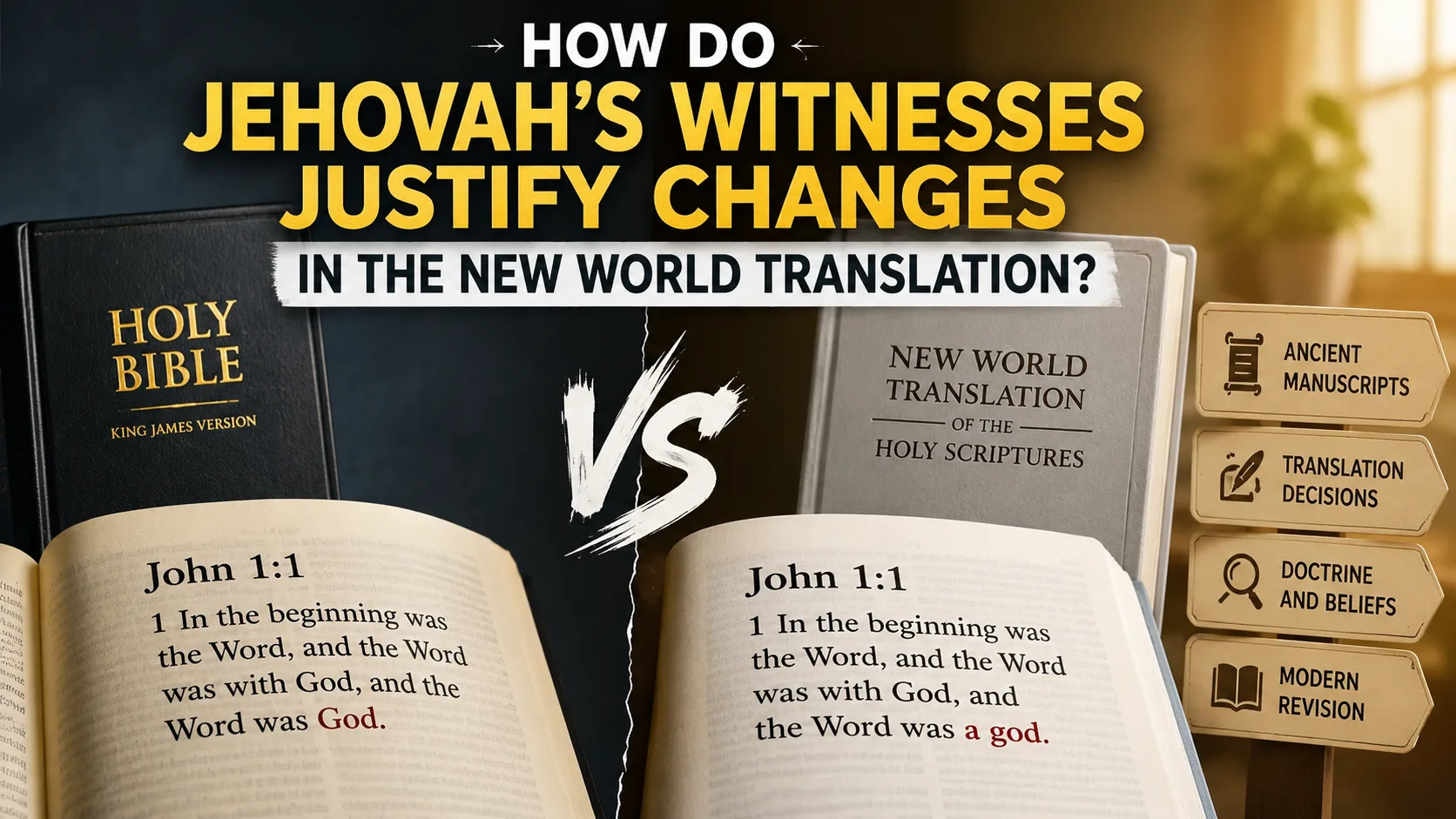

Open the New World Translation beside an NIV, ESV, NRSV or another familiar Bible and some differences are hard to miss. John 1:1 ends with “the Word was a god.” Colossians 1:16 says that through Jesus “all other things were created.”
The name “Jehovah” also appears 237 times in the New Testament, even though the surviving Greek manuscripts use words such as Kyrios (“Lord”) or Theos (“God”) in those places.
For a mainstream Christian, that can immediately feel like a red flag. If a religious group already rejects the Trinity and its own Bible then uses wording that supports a non-Trinitarian view of Jesus, suspicion is understandable.
But that is not how Jehovah’s Witnesses understand what happened.
A Witness who trusts the New World Translation is not normally thinking that the organization changed verses because its theology required different wording. The explanation given within the faith is almost the reverse.
Jehovah’s Witnesses believe traditional Christianity had already allowed doctrine, custom, and centuries of copying and translation to obscure parts of Scripture. The NWT is presented as an attempt to remove those accumulated distortions and recover what the biblical writers originally wrote or intended.
That belief explains why a change that looks troubling from outside the religion can look like a correction from inside it.
“We Are Restoring Truth, Not Changing It”
The clearest example is the name “Jehovah.”
There is little controversy over whether the divine name represented by the Hebrew letters YHWH occurs throughout the Hebrew Bible. It appears nearly 7,000 times and Jehovah’s Witnesses believe that replacing this personal name with titles such as “LORD” has caused ordinary readers to lose something important about how the biblical writers spoke about God.
The controversy begins when the New World Translation carries “Jehovah” into the New Testament.
The NWT prints “Jehovah” 237 times in the Christian Greek Scriptures. The Greek texts available to translators normally have Kyrios or Theos in those places rather than the Tetragrammaton.
Jehovah’s Witnesses do not deny that. Their argument is that the surviving manuscripts are later copies and that the divine name had already disappeared during transmission.
They believe the original Christian writers would have retained YHWH, particularly when quoting passages from the Hebrew Scriptures that contained it. Their publications also point to ancient Greek copies of parts of the Hebrew Scriptures in which the divine name was preserved instead of being replaced with Kyrios.
From that evidence, Witnesses reason that early Christian writers may also have preserved the name when quoting those passages.
Older Watchtower literature sometimes expressed this idea strongly, arguing that later Christian copying practices were responsible for removing the divine name. Within that historical picture, the absence of YHWH from surviving New Testament manuscripts does not necessarily prove to a Witness that the apostles never wrote it.
Instead, the absence can be understood as evidence that the removal happened before the manuscript record we now possess became substantial.
This is why the insertion of “Jehovah” does not feel like an addition from inside the faith. Witnesses believe something important was lost and that their translation is restoring it.
The difficulty is that evidence for YHWH in ancient Greek copies of the Hebrew Scriptures is not the same as possessing an early Greek manuscript of Matthew, Romans, or another New Testament book that contains YHWH in one of those locations.
The Witness position therefore relies partly on reconstructing what they believe existed before the surviving copies were produced. Their justification is not that the Greek manuscript in front of them says “Jehovah,” but that the manuscript tradition no longer preserves what they believe the original contained.
“Grammar Over Dogma”: The Case of John 1:1
John 1:1 involves a different kind of defense.
Most familiar English Bibles end the verse with wording equivalent to “the Word was God.” The NWT reads “the Word was a god.”
Because Jehovah’s Witnesses reject the Trinity and do not identify Jesus as Almighty God, critics have long argued that this wording was chosen because it fits Witness theology.
Jehovah’s Witnesses respond that traditional Christian translators may be the ones allowing theology to shape the English text.
Their explanation centers on the Greek word theos. In the final clause of John 1:1, the word appears without the definite article.
Witness publications argue that this difference matters and that the construction describes the quality or nature of the Word rather than identifying the Word as the same God mentioned earlier in the verse. They have also pointed to other translations using expressions such as “divine” and to the ancient Sahidic Coptic version, which uses an indefinite article in the corresponding phrase.
For a Witness, this can make the NWT feel less like a theological alteration and more like a refusal to let Trinitarian tradition decide the wording in advance.
The grammar, however, is not as simple as saying that the absence of the article automatically requires the English word “a.”
Koine Greek does not have an indefinite article that functions exactly like English “a” or “an.” A noun without the article can be definite, indefinite, or qualitative depending on its grammatical position and context.
That means describing theos as qualitative does not automatically settle how the phrase should be translated into English.
There is a meaningful difference between saying that the Word possesses a divine quality or nature and writing “a god,” which naturally suggests one divine being alongside another.
Bruce Metzger, one of the most influential New Testament textual scholars of the twentieth century, strongly criticized the NWT’s rendering of John 1:1. He did not simply accuse the translators of knowing no Greek, however.
In the same review, Metzger acknowledged that the translation sometimes showed intelligent use of textual-critical material. His criticism was more specific: he believed some important theological passages were rendered in ways that the Greek did not justify.
That makes the question around John 1:1 more interesting than a simple argument over whether the translators understood grammar.
The issue is whether the grammatical evidence naturally leads to the wording “a god,” or whether an existing understanding of Jesus helps determine which possible English rendering is preferred.
“A Living Faith Needs a Living Text”: Why the Bible Changed Again in 2013
The 2013 revision of the NWT belongs in a different category from John 1:1 or the use of “Jehovah” in the New Testament.
Jehovah’s Witnesses substantially revised their English Bible that year. The new edition modernized vocabulary, shortened some expressions, reconsidered sentence structures, and changed a number of individual readings.
Their explanation is largely familiar to anyone who follows modern Bible translation.
English changes over time. Words that were natural several decades earlier can become awkward or misleading, while new manuscript discoveries and better access to ancient textual evidence can affect how a passage is understood.
The Watchtower also explained that translation teams working in other languages had raised many questions about the older English edition. That helped expose places where wording that sounded acceptable to an English speaker was difficult to translate clearly elsewhere.
Some changes were therefore simply about readability.
Earlier English could use “seed” in places where “offspring” now communicates the intended meaning more naturally. Other revisions reflected updated manuscript evidence or reconsideration of how literally certain Hebrew and Greek expressions should be carried into modern English.
One example frequently discussed by Jehovah’s Witnesses involves 2 Samuel 13:21. Earlier editions followed the traditional Hebrew text more closely, while evidence from the Dead Sea Scrolls supported material found in another ancient textual tradition, leading the 2013 edition to revise the passage.
Whatever someone thinks about the NWT’s more controversial theological renderings, that kind of revision is normal textual work.
Other major Bible translations have also been revised repeatedly. The NIV, NASB, NRSV, ESV, and others have all changed wording as language and scholarship developed.
That is why the existence of a 2013 revision is not, by itself, strong evidence that Jehovah’s Witnesses were moving the Bible around to rescue doctrine.
The more important question is what kind of change has been made and what evidence supports it.
Replacing obsolete English because ordinary readers no longer understand it is very different from supplying a word that affects how a reader understands Christ’s relationship to creation.
Two Worlds, Two Definitions of Accuracy
The disagreement becomes deeper when both Jehovah’s Witnesses and their critics use the word “accuracy.”
Witnesses do not define accuracy as preserving familiar English simply because generations of Christians have become accustomed to it. Their publications repeatedly argue that tradition can make a popular translation less faithful to the original meaning.
In the case of the divine name, they go further. If they believe later scribes replaced God’s personal name, then faithfully reproducing the surviving copies would not necessarily preserve the original wording.
Mainstream textual scholarship also reconstructs ancient texts, so the difference should not be exaggerated.
Scholars compare manuscripts, ancient translations, quotations from early Christian writers, scribal habits, geographical distribution, and other evidence. Modern critical editions of the New Testament are themselves attempts to recover the earliest attainable form of the text rather than simple reproductions of one manuscript.
The disagreement appears when the evidence becomes thin.
Jehovah’s Witnesses are willing to restore “Jehovah” in the New Testament because they believe the historical and biblical pattern is strong enough to justify doing so, even though the surviving Greek New Testament manuscripts do not preserve YHWH at those locations.
A more conservative textual approach is reluctant to place such a reconstruction directly into the biblical text without closer manuscript support.
This is why both sides can sincerely believe they are protecting the original Bible.
A Witness may believe that refusing to restore the divine name simply leaves an ancient corruption untouched. A textual scholar may believe that printing a reading absent from the surviving Greek evidence gives a reconstruction more certainty than the evidence allows.
The disagreement is therefore partly about how far a translator should go when the earliest recoverable evidence does not perfectly match what the translator believes the original author must have written.
What Mainstream Scholars Say
Criticism of the New World Translation is strongest when it focuses on particular passages rather than dismissing the entire translation as worthless.
There are parts of the NWT that reflect ordinary textual scholarship. Even critics have acknowledged that its translators sometimes handled manuscript evidence intelligently.
The more serious concerns appear in passages where an unusual translation choice also has major consequences for distinctive Jehovah’s Witness teachings.
The use of “Jehovah” in the New Testament is one example. The 237 appearances are not based on 237 surviving Greek New Testament manuscripts containing YHWH.
Jehovah’s Witnesses instead build the case from Hebrew Scripture quotations, ancient Greek Old Testament manuscripts, later Hebrew New Testament translations, context, and their reconstruction of early Christian copying history.
That is an argument that can be examined, but it is different from translating a Greek word directly preserved in the manuscript.
John 1:1 presents another kind of problem.
The underlying Greek is there, but the disagreement concerns what the grammar means. Jehovah’s Witnesses are right that the lack of the definite article deserves attention, while critics argue that moving from that observation to “a god” places too much theological weight on one possible English interpretation.
Colossians 1:16 makes the relationship between interpretation and translation even easier to see.
The NWT reads that through Christ “all other things were created.” Its own study material acknowledges that a literal rendering of the Greek expression would be “all things.”
Why, then, include “other”?
Jehovah’s Witnesses understand “the firstborn of all creation” in the previous verse to mean that Jesus himself was created. If Jesus belongs to creation, they reason, Paul cannot mean that Jesus created himself.
“All things” must therefore mean all things other than Jesus.
From that perspective, “other” is not viewed as a theological invention. It is understood as an implied word that makes Paul’s intended meaning clearer in English.
Critics object because the need for the word appears only after a particular interpretation of Jesus has already been accepted.
If “firstborn” is understood as language about rank, supremacy, or inheritance rather than the first being God created, then the supposed need for “other” largely disappears.
This is why Colossians 1:16 has become such an important example in discussions of the NWT.
The question is not simply whether translators may ever add words that are implicit in the original language. Every major translation does that when necessary.
The question is whether the context itself requires the added word or whether the translator’s theology is deciding what should be considered implicit.
The original translation committee creates another difficulty.
Jehovah’s Witnesses say its members chose to remain anonymous because they did not want personal recognition and preferred attention to remain on God and the Bible.
Their own literature acknowledges the consequence of that decision: readers cannot judge the committee’s scholarly quality by examining the members’ educational backgrounds.
Witnesses answer that the translation should therefore be judged on the quality of the work itself.
There is some logic in that response. A Greek sentence does not mean something simply because an impressive scholar says it does.
At the same time, anonymity removes a form of transparency normally available with many major Bible translations. Readers cannot independently examine which committee members specialized in Hebrew, Koine Greek, textual criticism, or related fields.
That becomes more noticeable when the translation makes highly unusual decisions.
An anonymous committee does not make the NWT incorrect, but its controversial readings have to stand on the manuscript and linguistic evidence presented for them rather than on publicly verifiable expertise.
Why These Explanations Make Sense to Jehovah’s Witnesses
The disagreement is easier to understand when the larger Witness worldview is kept in view.
Jehovah’s Witnesses believe that Jehovah alone is Almighty God, that Jesus is His Son rather than a person within a Trinity, that God’s personal name is central to true worship, and that mainstream Christianity departed in important ways from the teachings of the earliest Christians.
Once those convictions are in place, the distinctive wording of the NWT can appear corrective rather than suspicious.
Putting “Jehovah” into the New Testament can seem like recovering something later Christianity removed. John 1:1 can seem like a passage freed from Trinitarian assumptions.
The word “other” in Colossians can appear to make explicit what Witnesses already believe Paul meant about Christ and creation. Updating the language in 2013 can simply look like an effort to keep Scripture readable.
This helps explain why telling a Jehovah’s Witness that “your organization changed the Bible” often does not settle anything.
A Witness may already believe that mainstream Christianity allowed doctrine to influence Bible translation long before the New World Translation existed.
The useful discussion begins when each disputed reading is examined on its own evidence.
How Strong Are the Justifications?
Jehovah’s Witnesses have genuine explanations for why the New World Translation differs from other Bibles.
Some of those explanations are relatively ordinary. Modernizing language, reconsidering manuscript evidence, and translating idioms more naturally are normal parts of Bible revision.
Other decisions involve much more interpretation.
John 1:1 requires a judgment about how a Greek construction should sound in English. Colossians 1:16 requires deciding whether “other” is genuinely implied by Paul’s argument.
The New Testament use of “Jehovah” goes further because the translation restores wording that Jehovah’s Witnesses believe once existed even though it is not directly preserved in the surviving Greek New Testament manuscripts.
That difference in method is why the debate cannot be resolved by saying either that Jehovah’s Witnesses simply invented their Bible or that every unusual NWT reading is automatically more accurate than traditional translations.
Jehovah’s Witnesses sincerely understand their translation as an attempt to strip away religious tradition and recover the original Scriptures.
Their critics question whether some of those attempted corrections are themselves shaped by Witness theology.
The most useful way to judge the issue is therefore passage by passage. Look at what the surviving text says, what the NWT changes or supplies, the reason Jehovah’s Witnesses give for doing so, and whether the manuscript, linguistic, and historical evidence is strong enough to support that decision.
That gives their explanation a fair hearing without assuming in advance that every claimed restoration must be correct.
