
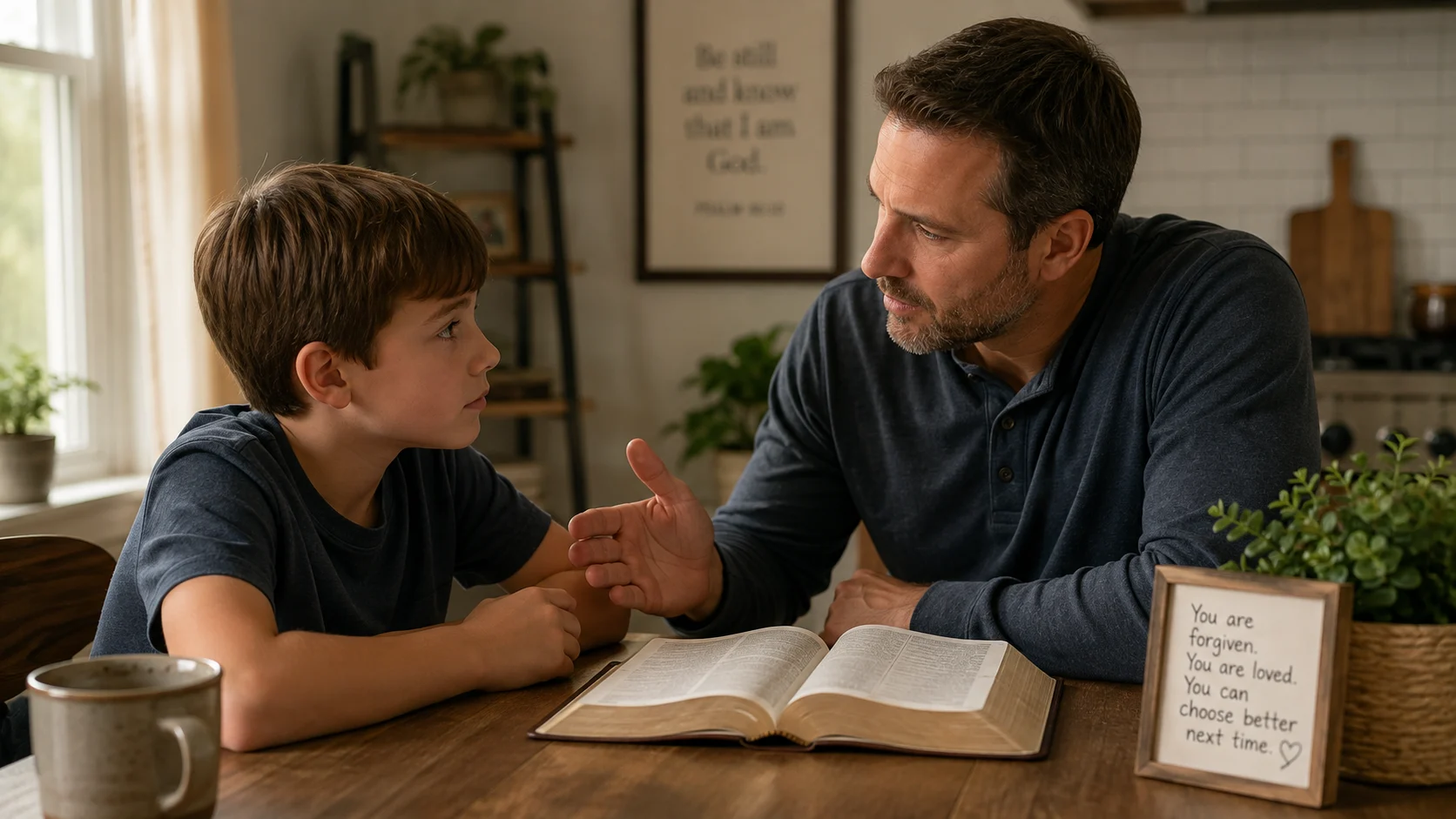

A child breaks something and says, “I didn’t do it.” Another hits a sibling and immediately adds, “But she started it.” A daughter is caught lying and begins crying because she is afraid of what will happen next. These ordinary moments are often where children begin learning what repentance means, long before they can explain the word itself.
Psalm 32 is especially useful for parents because David does not move from wrongdoing straight into a neat, perfect apology. He first hides what happened, remains silent, feels the weight of what he is avoiding, and only later admits the truth to God. After that confession, the psalm moves toward forgiveness, safety, instruction and joy.
That progression gives parents a practical way to explain repentance without teaching a child that feeling terrible is the goal. Repentance means learning to stop hiding, tell the truth about what happened, accept responsibility, repair what can be repaired, and return to God honestly.
What Does Repentance Mean for a Child?
The word repentance can sound complicated to a young child, but the basic idea is simple enough to explain in ordinary language. A parent might say, “Repentance means telling the truth when we have done something wrong, asking God to forgive us and learning to choose what is right.”
That is different from forcing a child to say “sorry” immediately after being caught. A child can repeat an apology while still blaming someone else, feeling angry or simply trying to end the conversation as quickly as possible. Real repentance develops more slowly because it asks the child to understand what they actually did.
Over time, children can learn to recognize that they made a wrong choice without assuming that one wrong choice defines who they are. They can admit what happened, ask forgiveness, make things right where possible and think about what they should do differently the next time the same situation appears.
Psalm 32 gives parents a useful pattern for teaching those habits.
Why Should Forgiveness Come First in Psalm 32?
Psalm 32 begins with the happiness of being forgiven. That starting point matters because many children are already afraid when they know they have done something wrong. They may worry that telling the truth will make a parent angrier, create a larger punishment or change the way they are loved.
Suppose a child lies about finishing homework. Instead of saying, “Why do you always lie?” a parent might say, “You told me something that was not true, and we need to deal with that. Telling me the truth now is still the right thing to do.”
The lie is still taken seriously, but the child is not being told that honesty has become pointless because they already failed once.
Psalm 32 begins with forgiveness because confession only makes sense when mercy is possible. A child needs to understand that telling the truth may still lead to a consequence, but it does not mean that love has disappeared.
What Does Psalm 32 Teach About Hiding Wrongdoing?
In Psalm 32:3–4, David describes what happened while he remained silent. The experience became heavy and exhausting. Children may recognize that feeling even when they cannot describe it in theological language.
Imagine a seven-year-old secretly takes money from a table. At dinner he becomes quieter than usual. When his mother asks whether something is wrong, he says no. Later he becomes irritated when she asks another question because he is now trying to protect the secret as well as deal with the original choice.
A parent can use that moment to explain Psalm 32 without turning the child’s discomfort into a threat. You might say, “David describes how hard it felt when he kept hiding what he had done. Sometimes keeping a secret about something wrong makes everything feel heavier because we are trying to protect the secret too.”
The point is not to tell a child that God is making them miserable until they confess. It is to help them see that hiding often adds another problem to the first one.
If the child is still unwilling to talk, a parent does not need to force a dramatic confession. It may be enough to say, “I think there is more to this. I want you to tell me the truth when you are ready, and we will deal with what happened.”
How Can Parents Stop Excuses From Replacing Confession?
Psalm 32:5 is the turning point because David stops covering his sin and acknowledges it. Children often struggle at exactly this point because they may admit the action while immediately explaining why someone else caused it.
A child says, “I hit him, but he took my pencil.” Another says, “I lied because I thought you would shout.” Another says, “I only copied because everyone else was doing it.”
Some of those explanations may be true, and parents can discuss them later. However, an explanation should not erase responsibility.
If your son says, “I pushed her, but she pushed me first,” you can respond, “We can talk about what she did too. Right now, I want you to tell me about your own choice.”
That keeps the conversation focused without pretending the other child’s behavior is irrelevant.
For younger children, concrete questions often work better than broad ones. Instead of asking, “Why do you behave like this?” try asking what their hands did, what words they used, whether what they said was true, and what they already knew they were supposed to do.
These questions help a child move from vague defensiveness toward an accurate description of what happened.
What If a Child Is Not Sorry Yet?
One of the easiest ways to make repentance feel artificial is to demand an apology before the child has even calmed down.
A parent says, “Say sorry.” The child mutters the word. The parent says, “Say it properly,” so the child repeats the same apology in a softer voice. Everyone may know that the child is still furious.
Psalm 32 does not require parents to manufacture emotion. If a child is not ready to say they are sorry, begin with what can be established honestly.
A parent might say, “I can see that you are still angry. You do not need to pretend that you suddenly feel different, but hitting your brother was still wrong, and we are going to talk about your part in what happened.”
Sometimes it is better to stop the harmful behavior, allow the child to calm down, and return to the conversation later. At that point, asking, “What part of this was your responsibility?” may produce a more meaningful answer than demanding another apology.
The goal is not to teach a child how to perform repentance convincingly. It is to help them become honest enough to recognize their own choices.
Why Should Children Name Exactly What They Did?
Vague apologies can sometimes hide almost as much as silence. Statements such as “I’m sorry for everything,” “I’m sorry you got upset,” or “I’m sorry, okay?” may end an argument without actually naming the wrong.
Psalm 32 moves in the opposite direction because David acknowledges his sin specifically rather than continuing to cover it.
A child who lied can learn to say, “I told you I had finished my homework when I had not.” A child who took something can say, “I took the money without asking.” A child who insulted a sibling can say, “I called him stupid because I was angry.”
Specific confession makes correction possible because the child can see exactly which choice needs to change.
Prayer can work the same way. Instead of teaching a child to pray, “God, forgive me for being bad,” it is more useful to help them say, “God, I lied because I was scared of getting in trouble. That was wrong. Please forgive me and help me tell the truth next time.”
The difference matters because Psalm 32 is about acknowledging wrongdoing, not teaching a child to use wrongdoing as a permanent description of themselves.
Does Forgiveness Mean There Should Be No Consequences?
Forgiveness and consequences are not opposites.
Suppose a child throws a game controller because they lost a game and the controller breaks. The child may admit what happened, apologize, and ask forgiveness. A parent can genuinely forgive the child while still saying that the replacement controller will not be available immediately or that some saved allowance may be used toward replacing what was damaged.
The consequence does not mean forgiveness failed. It helps the child see that choices can have effects that remain even after an apology.
The same principle applies to smaller situations. If a child lies about completing schoolwork, the lie can be forgiven while the unfinished work still needs to be completed. If a child makes a mess in anger, the child may still need to help clean it. If something was taken, it should still be returned.
A simple explanation often works best: “You are forgiven, but we still need to fix what happened.”
This prevents a child from confusing grace with the idea that nothing matters once the word “sorry” has been spoken.
Why Does David Call God His Hiding Place?
Later in Psalm 32, David describes God as his hiding place. That creates an important contrast with the earlier part of the psalm.
At first, David is hiding what he has done. Later, he finds safety in God.
Children can understand that distinction in very practical terms. If a child says, “I don’t want to pray because God is mad at me,” a parent does not need to give a long theological explanation. You can simply say, “This is actually a good time to pray because you can tell God exactly what happened.”
The child does not need to repair everything first and then return to God once they feel worthy enough. Psalm 32 shows that honesty with God is part of the return.
This habit can become increasingly important as children grow older. A young child may hide a broken lamp. A teenager may hide a much more serious decision because of fear or shame. The basic lesson remains the same: failure should not become a reason to create more distance from God.
What Can a Real Psalm 32 Conversation Look Like?
Imagine that nine-year-old Noah has been told not to play football inside. He ignores the rule, kicks the ball, and knocks over a lamp. When his father asks what happened, Noah says that the cat must have knocked it over.
Later, the truth becomes clear.
His father might begin by saying, “Tell me what really happened.”
Noah admits that he kicked the ball, and when his father asks why he blamed the cat, Noah says, “Because I thought you would be mad.”
That response matters. Fear helps explain why Noah lied, but it does not make the lie truthful or remove his responsibility for it.
His father could say, “I understand why you were scared. You knew you had broken the rule, and then you lied because you were afraid of what would happen. In Psalm 32, David also tried to hide what he had done, but hiding did not solve it. Telling the truth was the turning point.”
Then the father can ask, “What part of this do you need to take responsibility for?”
Noah may eventually say, “I played inside when you told me not to, and then I lied about the lamp.”
That is far more meaningful than making him repeat the word “sorry” several times.
There may still be a consequence. Noah can help clean up the broken lamp, and the indoor football rule may become stricter for a while. Once that has been explained, however, the parent does not need to continue the lecture simply to make Noah feel worse.
The issue has moved from hiding into truth, which is exactly the movement Psalm 32 is trying to teach.
What Should Parents Do After a Child Confesses?
Once a child tells the truth, parents should be careful not to turn confession into the beginning of an endless interrogation.
Questions such as “And what else?”, “What were you thinking?”, “Why do you always do this?”, or repeated expressions of disappointment can make the child feel that telling the truth only opened the door to a longer punishment.
There may certainly be situations where more information is needed, especially when someone was harmed. But in an ordinary family conflict, the process can remain simple: establish what happened, name what was wrong, decide what should be repaired, give any necessary consequence, and ask what the child could do differently next time.
After that, allow the matter to close.
Psalm 32 does not leave David permanently inside the heaviness of verses 3–4. The psalm moves forward, and a child’s experience of repentance should eventually move forward too.
What Does Psalm 32 Teach About Choosing Differently Next Time?
Psalm 32:8–9 moves from confession toward instruction. That gives parents an important final step after correcting a child.
Instead of spending the whole conversation discussing what went wrong, ask what the child can do when the same problem happens again.
If a child screamed because a sibling would not share, ask what they could do next time before they start shouting. A younger child may answer, “Come and get you,” or “Ask for a turn.” An older child may be able to explain that they could walk away for a minute or say that they are angry without insulting anyone.
The answer does not need to sound mature or impressive. It needs to be something the child can actually remember and use.
That is where repentance becomes more than repeated apology. The child is beginning to connect a past wrong choice with a future alternative.
How Can Parents Correct Wrongdoing Without Shaming the Child?
Sometimes a child responds to correction by saying, “I’m bad,” “I always ruin everything,” or “God must be angry with me.”
Parents do not need to answer by pretending the wrongdoing did not matter. Instead, separate the action from the child’s entire identity.
You might say, “You lied, and we need to deal with the lie. That does not mean the word ‘liar’ becomes your name.”
Or, “You made a wrong choice today. We are correcting that choice, not deciding that everything about you is bad.”
This keeps the correction specific.
It is especially helpful for sensitive children who quickly move from “I did something wrong” to “there is something wrong with me.” Psalm 32 treats sin seriously, but its destination is not permanent self-condemnation. David admits what he has done and then moves toward forgiveness, guidance, and renewed trust.
What Does Making Things Right Look Like for a Child?
Making things right should be practical and connected to what actually happened.
If something was taken, return it. If a lie affected another person, correct the lie. If a child made a mess in anger, help clean the mess. If someone was insulted, apologize specifically. If something was deliberately damaged, help repair or replace it when that is reasonable for the child’s age.
Parents should also explain that these actions do not purchase forgiveness.
A child does not earn God’s mercy by cleaning the room, returning the toy, or writing an apology. Those actions matter because repentance includes taking responsibility for the effects of a choice.
This distinction keeps both forgiveness and responsibility intact.
Why Does Psalm 32 End With Joy?
Psalm 32 ends very differently from where David began. The heaviness of hiding gives way to trust, steadfast love, and joy.
That final movement matters when teaching children repentance because the child should eventually be allowed to return to ordinary life.
After the truth has been told, the apology made, the consequence explained, and the damage repaired where possible, the parent does not need to require the child to remain visibly miserable for the rest of the evening.
Let dinner become normal again. Let the child laugh. Let them play once the consequence allows it.
A child does not become more repentant simply by looking sad for several extra hours.
Sometimes one of the most helpful things a parent can say is, “We have dealt with what happened. Remember what you learned, and now we can move forward.”
That teaches the child that repentance has a destination rather than becoming an endless cycle of accusation.
A Simple Psalm 32 Pattern Parents Can Use
For younger children, the whole lesson can be reduced to four simple questions that are easy to remember.
Ask what happened so the child can tell the truth. Ask which part was their own choice so that blame does not swallow responsibility. Ask what needs to be repaired or corrected. Finally, ask what they could do differently if the same situation happens again.
Those four questions are usually more useful than demanding a long apology or giving a long lecture.
A Simple Prayer a Child Can Understand
A child’s prayer after wrongdoing does not need formal language.
A parent can help with words such as, “God, I lied because I was scared. I am sorry. Please forgive me and help me tell the truth next time.”
If the problem was anger, the prayer might be, “God, I hit my brother because I was angry. That was wrong. Please forgive me and help me ask for help instead of hitting.”
As children grow older, encourage them to use their own words. The important part is not whether the prayer sounds impressive, but whether it reflects what actually happened.
What Is the Main Lesson of Psalm 32 for a Child?
Psalm 32 does not teach children that wrongdoing is unimportant. David’s sin mattered, and so did his attempt to hide it. What changed the direction of the psalm was his willingness to stop covering what happened and acknowledge it honestly before God.
Parents can bring that same pattern into ordinary family situations.
When a child lies, the goal is not simply to make them say “sorry” as quickly as possible. When they blame someone else, help them identify their own part without pretending the other person’s behavior does not matter. When they are afraid of a consequence, acknowledge the fear without allowing fear to excuse dishonesty. When they finally tell the truth, deal with what happened without keeping them trapped in the mistake after the lesson has been learned.
In that way, Psalm 32 gives children a realistic picture of repentance. They learn that wrongdoing should be faced honestly, consequences may still need to be accepted, damaged relationships or situations may need repair, and God is still someone they can approach rather than avoid.
That is a much healthier lesson than teaching children that repentance means feeling guilty for as long as possible.
