
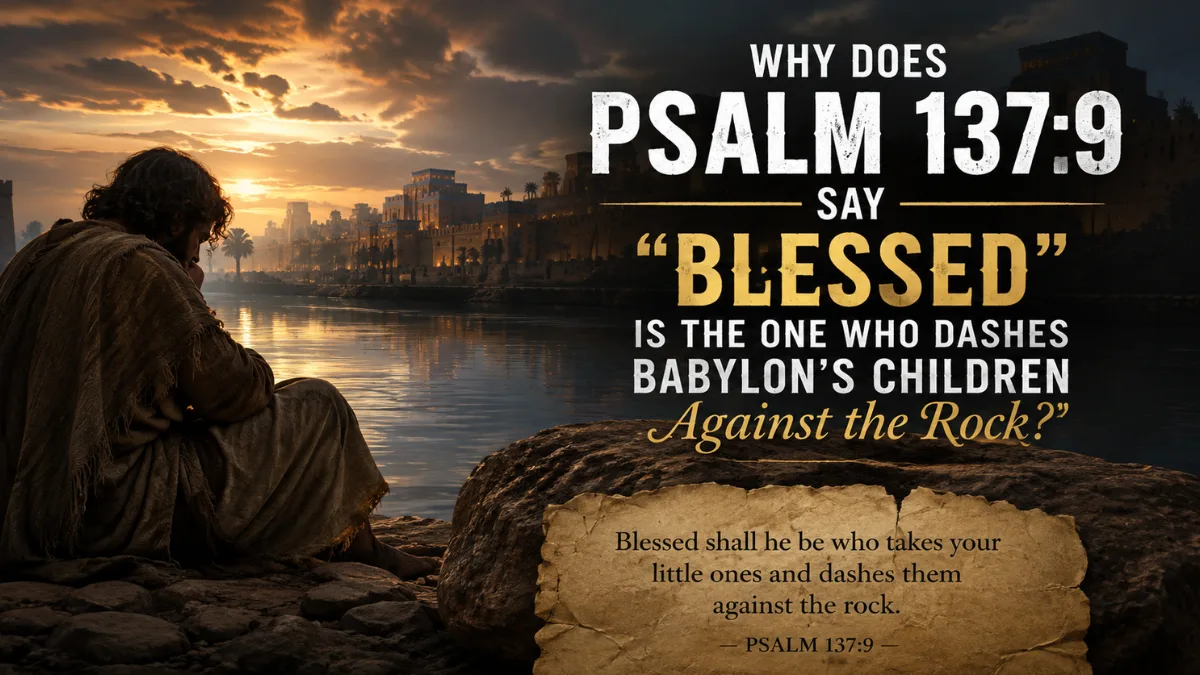

Psalm 137:9 says that the person who takes Babylon’s little ones and dashes them against the rock is “blessed” or “happy.” The verse does not command believers to kill children. It is the climax of an exilic lament in which the devastated people of Jerusalem long for Babylon to experience devastating repayment for what it had done to Judah.
That does not make the verse morally easy or remove its disturbing language. The key to understanding it is to read Psalm 137:9 together with verse 8, where Babylon is addressed directly and the speaker says:
“Blessed shall he be who repays you with what you have done to us.”
Verse 9 intensifies that wish for repayment with one of the harshest images in the Psalms.
Why does Psalm 137:9 use the word “blessed”?
The Hebrew word translated “blessed” or “happy” is ashrei.
It is the same important Hebrew expression that appears in places such as Psalm 1:1, where it describes the fortunate or enviable condition of the righteous person. That makes its use in Psalm 137:9 especially difficult for modern readers.
But verse 9 should not be read as an isolated blessing upon violence.
Psalm 137:8 also begins with ashrei and identifies the person being called blessed as the one who will repay Babylon according to what Babylon had done to Judah. Verse 9 then continues the same thought.
The repetition matters.
The psalmist is not making a general statement that harming children produces blessing. He is imagining Babylon’s catastrophic defeat and calling fortunate the agent through whom Babylon finally receives the repayment described in verse 8.
That explains the literary function of “blessed,” even though the violent form of the wish remains deeply troubling.
Why is Psalm 137:8 essential to understanding verse 9?
Psalm 137:9 is frequently quoted by itself, but verse 8 establishes the framework for the entire statement.
The speaker addresses Babylon and calls for repayment:
“Blessed shall he be who repays you with what you have done to us.”
The phrase “what you have done to us” turns the final verses into a cry for retributive justice.
Verse 9 then gives that retaliation its most horrifying expression.
This does not require claiming that Babylonian soldiers had necessarily killed Judean children in the identical manner described in verse 9. Psalm 137 itself does not explicitly give that historical detail.
What the text does say clearly is that Babylon had devastated Judah and that the psalmist wanted Babylon to experience corresponding destruction.
The safest reading therefore follows the text itself: verse 8 establishes repayment, and verse 9 intensifies that repayment through the brutal imagery associated with a conquered city.
What does “dash your little ones against the rock” mean?
The Hebrew word translated “little ones” refers to young children. English translations variously render it as “little ones,” “children,” “infants,” or “babies.”
There is little reason to treat the children as merely symbolic representations of sins, temptations, or evil thoughts. The force of the verse depends on the literal horror of the image.
The language reflects the brutal realities associated with the destruction of ancient cities.
Similar imagery appears elsewhere in biblical descriptions of catastrophic conquest. Isaiah 13:16, for example, includes the killing of children while describing judgment against Babylon.
That comparison does not make Psalm 137:9 less disturbing. It helps explain why such imagery could function as a picture of Babylon’s complete defeat.
The psalmist imagines not a minor political setback for Babylon, but the reversal of its power so thoroughly that it suffers the horrors associated with the destruction it had inflicted upon others.
Psalm 137 itself begins among Judean exiles mourning Jerusalem beside the rivers of Babylon. Their captors mockingly demand songs of Zion from them, and by the final verses their grief has turned toward remembrance, anger, and the desire for judgment.
That setting is essential. A scholarly discussion of Psalm 137 in its exilic and traumatic context likewise emphasizes how the psalm gives voice to a community responding to devastation and displacement.
Is Psalm 137:9 commanding people to kill children?
No.
Psalm 137:9 is not written as an instruction telling Israel, Christians, or later readers to perform the act described.
There is no command such as “go and do this.” Instead, the speaker describes as ashrei the person who will bring Babylon’s destruction.
That grammatical distinction matters.
However, saying that the verse is not a command does not eliminate its moral difficulty.
The psalmist still speaks approvingly of Babylon’s devastating repayment, and the image chosen involves children. A responsible interpretation should therefore avoid two opposite mistakes.
One mistake is to treat Psalm 137:9 as though God were issuing a universal command authorizing violence against children.
The other is to explain the verse so gently that its violent language effectively disappears.
Neither approach does justice to the text.
Psalm 137 preserves an extreme cry for retribution from people remembering the destruction of Jerusalem and their displacement into Babylon. The statement belongs to that particular lament and to its demand that Babylon be repaid.
For a wider biblical discussion of suffering under oppression and the desire for divine justice, PsalmWisdom’s article on what the Bible says about oppression and divine justice provides the broader context without changing the specific meaning of Psalm 137:9.
Does Psalm 137:9 mean the Bible approves of killing children?
The verse should not be turned into a general biblical approval of killing children.
Its subject is Babylon’s judgment, not a moral rule about how people should treat children.
Psalm 137:8 identifies the governing idea as repayment for Babylon’s actions against Judah. Verse 9 then expresses that hoped-for reversal with violent conquest imagery.
That is why the person is called “blessed” within the logic of the psalm: the person represents the agent through whom Babylon’s domination finally ends and its repayment arrives.
The difficult part is that the psalmist imagines that judgment in an uncompromisingly brutal form.
A careful reading therefore does not need to pretend that Psalm 137:9 is harmless. It needs to distinguish what the verse actually is from what it is not.
It is a violent expression of retributive longing spoken from the setting of Jerusalem’s destruction and exile. It is not an independent command instructing believers to kill children, and it should not be detached from Psalm 137:8, which explicitly frames the final wish as Babylon being repaid for what it had done.
For readers who want the historical and literary background in greater scholarly depth, the peer-reviewed discussion of Psalm 137 published in Verbum et Ecclesia examines the psalm within the experience of trauma, exile, memory, and retaliation.
The disturbing language remains part of the verse. But its meaning becomes clearer when the final two verses are read together: Psalm 137:9 calls the agent of Babylon’s downfall “blessed” because, within the psalmist’s lament, that person carries out the devastating repayment anticipated in verse 8.
