
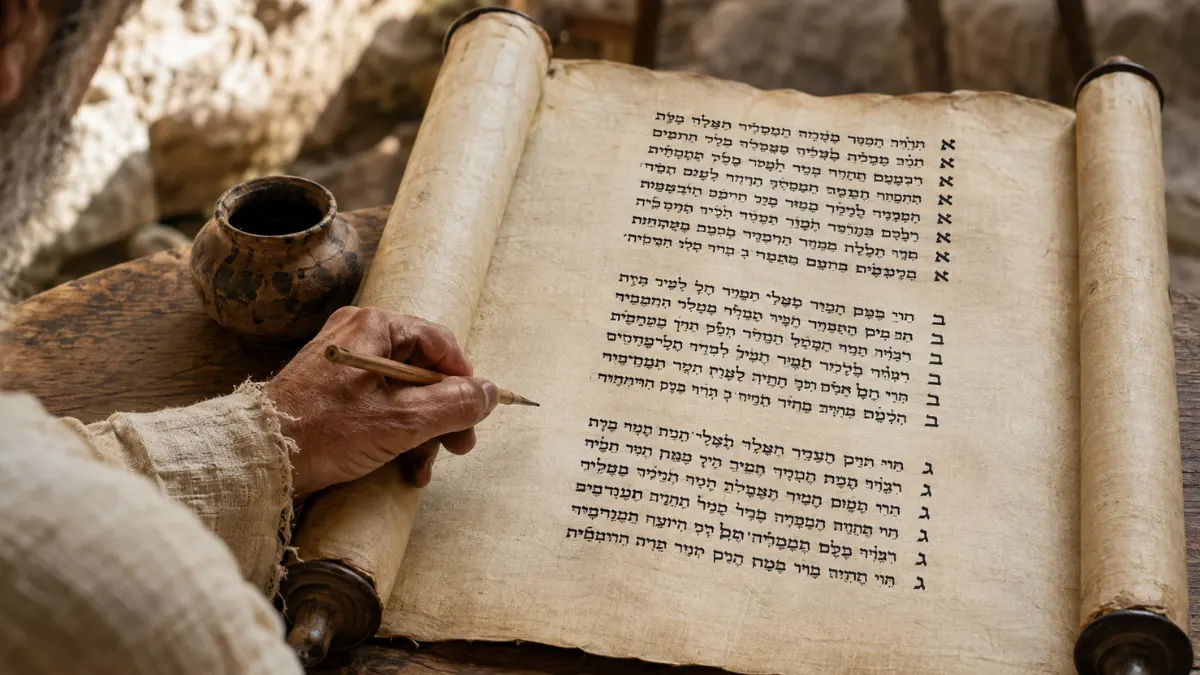

Why does Psalm 119 have Hebrew letters such as Aleph, Beth, and Gimel? They are the names of the 22 letters in the Hebrew alphabet, and they identify the Psalm’s 22 alphabetic sections. In the Hebrew text, every verse within each eight-verse section begins with its assigned letter.
Psalm 119 therefore contains 22 sections of eight verses, producing its total of 176 verses. This carefully constructed pattern is known as an alphabetic acrostic.
What Do Aleph, Beth, and the Other Letters Mean in Psalm 119?
Aleph, Beth, Gimel, and the names that follow are Hebrew letters, comparable to A, B, C and the remaining letters of the English alphabet.
They do not function as separate words that must be translated into English. When an English Bible prints “Aleph” above Psalm 119:1–8, it tells the reader that each of those eight verses begins with א, the Hebrew letter Aleph. “Beth” above verses 9–16 indicates that each of those verses begins with ב, the letter Beth.
The letter names or symbols printed above the sections function as headings in modern Bible editions. They are not additional words within the verses themselves. However, the alphabetic pattern they identify belongs to the Hebrew wording of the Psalm rather than being something English translators invented.
How Is Psalm 119 Divided by the Hebrew Alphabet?
Psalm 119 follows all 22 letters of the Hebrew alphabet in their established order, from Aleph to Tav. Each letter governs one stanza of eight verses.
| Hebrew letter | Common modern name | Other spellings readers may see | Verses |
|---|---|---|---|
| א | Alef | Aleph | 1–8 |
| ב | Bet | Beth | 9–16 |
| ג | Gimel | Gimmel | 17–24 |
| ד | Dalet | Daleth | 25–32 |
| ה | He | Heh | 33–40 |
| ו | Waw | Vav, Vau | 41–48 |
| ז | Zayin | Zain | 49–56 |
| ח | Het | Heth, Chet, Cheth | 57–64 |
| ט | Tet | Teth | 65–72 |
| י | Yod | Yodh, Jod | 73–80 |
| כ | Kaf | Kaph, Caph | 81–88 |
| ל | Lamed | Lamedh | 89–96 |
| מ | Mem | — | 97–104 |
| נ | Nun | — | 105–112 |
| ס | Samekh | Samech | 113–120 |
| ע | Ayin | Ain | 121–128 |
| פ | Pe | Peh | 129–136 |
| צ | Tsadi | Tsadhe, Tzaddi | 137–144 |
| ק | Qof | Qoph, Koph | 145–152 |
| ר | Resh | — | 153–160 |
| ש | Shin/Sin | Schin | 161–168 |
| ת | Tav | Taw, Tau | 169–176 |
The different English spellings do not represent different alphabets or different sections. They reflect different transliteration traditions, pronunciations, and older conventions used by Bible publishers.
For example, one Bible may print Waw while another prints Vav or Vau. Similarly, the final letter may appear as Tav, Taw, or Tau. Each spelling points to the same Hebrew letter.
How Does the Acrostic Pattern Work in Hebrew?
An acrostic organizes a composition according to its opening letters. In Psalm 119, the writer repeats the assigned letter at the beginning of every verse within a stanza rather than using a different letter for each successive verse.
The first section demonstrates the pattern clearly. Psalm 119:1 begins with the Hebrew word ashrei, meaning “happy” or “blessed.” The word begins with Aleph. The opening words of verses 2 through 8 also begin with Aleph.
Psalm 119:9 begins the next stanza with bammeh, meaning “by what?” or “how?” That word begins with Beth. The next seven verses also begin with Beth.
Readers can see these repeated opening letters directly in the Hebrew text of Psalm 119. The pattern continues through all 176 verses until the final eight verses begin with Tav.
This makes Psalm 119 more complex than an acrostic that simply assigns one verse to each letter. It uses every letter eight consecutive times before moving to the next one.
Why Is the Alphabetic Pattern Difficult to See in English?
The pattern depends on Hebrew vocabulary and word order. When translators express the meaning naturally in English, the first word of a verse rarely begins with an equivalent English letter.
For example, a Hebrew verse beginning with Aleph may require an English translation beginning with “Blessed,” “They,” or another word. A translator could preserve the alphabetical pattern only by changing the wording considerably, and those changes could make the translation less accurate or less natural.
Most English Bibles therefore preserve the meaning of the verses while displaying the Hebrew letter names as section headings. The headings allow readers to recognize a literary feature that the translation cannot reproduce easily.
Some poetic adaptations attempt to recreate Psalm 119 as an English acrostic, but those works should be understood as creative renderings rather than ordinary translations.
Why Did the Writer Use Every Hebrew Letter?
Psalm 119 never directly explains why its writer chose this structure, so any proposed purpose requires appropriate caution. The form itself is certain, but the writer’s complete intention cannot be proven.
The alphabetic structure clearly demonstrates literary discipline and artistry. Composing eight meaningful verses beginning with each Hebrew letter required careful control of vocabulary and word order. The structure also gives an orderly form to a Psalm devoted to God’s Torah, instruction, commandments, promises, and judgments.
Using the complete alphabet may also suggest comprehensiveness. English speakers sometimes use the expression “from A to Z” to describe something presented fully. In a similar way, Psalm 119 praises God’s instruction from Aleph to Tav. This is a reasonable interpretation of the form, although the Psalm does not explicitly state it.
The repeated pattern also supports sustained meditation. Rather than presenting a simple argument that moves quickly from one conclusion to another, the Psalm repeatedly considers God’s instruction through experiences of delight, affliction, obedience, longing, danger, hope, and prayer. Tyndale House’s explanation of Hebrew acrostics describes Psalm 119 as a meditative journey through its recurring groups of letters.
The structure therefore contributes to the Psalm’s message without turning the letters into a hidden code. Its ordered form complements its extended meditation on the order, reliability, and enduring value of God’s instruction.
Was Psalm 119 Designed to Help People Memorize It?
The alphabetic structure could have helped ancient hearers remember the order of the Psalm. A known sequence provides a framework for recalling what comes next, and acrostics can serve as useful memory aids.
However, Psalm 119 never says that memorization was the reason for its construction. The structure may have supported memorization, recitation, teaching, artistic expression, or several purposes at once.
It is therefore more accurate to call memorization a plausible benefit of the acrostic form rather than a proven explanation for why the writer used it.
Do the Hebrew Letters Give Each Section a Hidden Meaning?
The text does not show that Aleph, Beth, Gimel, and the remaining letters provide secret spiritual meanings for their respective stanzas.
Later Jewish and Christian traditions sometimes associate Hebrew letters with numbers, ancient pictorial forms, symbolic ideas, or words that begin with those letters. Those associations may be interesting within their own historical or devotional settings, but they do not prove that Psalm 119 assigns a separate coded message to each letter.
For example, explaining Beth as “house” and then claiming that every verse in the Beth stanza concerns a spiritual house goes beyond what the Psalm establishes. The verses begin with Beth because the poem follows an acrostic pattern, not because the letter automatically controls their theological meaning.
Nothing in Psalm 119 presents the letters as angelic messages, predictions, or a method for discovering private revelation. Readers should interpret the stanzas through their actual words, sentences, and biblical context.
Why Are There Eight Verses for Each Hebrew Letter?
Psalm 119 consistently gives eight verses to each of the 22 letters, but it does not explain why the writer chose eight.
The repeated number creates symmetry and gives each letter equal space. It also allows the writer to develop a lengthy meditation while maintaining a recognizable structure.
Some interpretations give the number eight a special symbolic meaning, but the Psalm itself does not connect the eight-verse pattern with new beginnings, resurrection, eternity, or another numerological idea. Such claims should not be presented as the Psalm’s stated explanation.
What the text demonstrates is straightforward: 22 letters multiplied by eight verses produce the Psalm’s 176 verses.
Does Every Eight-Verse Section Have Its Own Subject?
Each stanza contains recognizable emphases, but the letters do not divide Psalm 119 into 22 completely separate subjects.
Ideas such as love for God’s instruction, requests for understanding, suffering at the hands of enemies, hope in God’s promises, and commitment to obedience recur throughout the Psalm. A particular stanza may emphasize one of these ideas more strongly, but the subjects regularly overlap.
The Nun stanza in verses 105–112, for example, includes the familiar declaration that God’s word is a lamp to the writer’s feet and a light to his path. That image connects naturally with other Psalms about seeking direction from God, but guidance is not the exclusive meaning of the letter Nun.
The alphabet controls how the verses begin. It does not require every stanza to function as an independent chapter with a subject determined by the meaning of its assigned letter.
Is Psalm 119 the Only Alphabetic Acrostic in the Bible?
Psalm 119 is not the only biblical alphabetic acrostic, although its 176-verse construction makes it the most extensive and immediately recognizable example.
Other acrostic Psalms include Psalms 25, 34, 37, 111, 112, and 145. Proverbs 31:10–31 also follows the Hebrew alphabet in its description of the capable wife. The first four chapters of Lamentations use different forms of alphabetic organization, with Lamentations 3 repeating each assigned letter across three successive verses.
Scholars also discuss an incomplete or disrupted acrostic in Nahum 1, although its exact extent remains disputed. These compositions do not all follow the same arrangement. Some assign one poetic line or verse to each letter, while Psalm 119 assigns an entire eight-verse stanza to every letter.
