
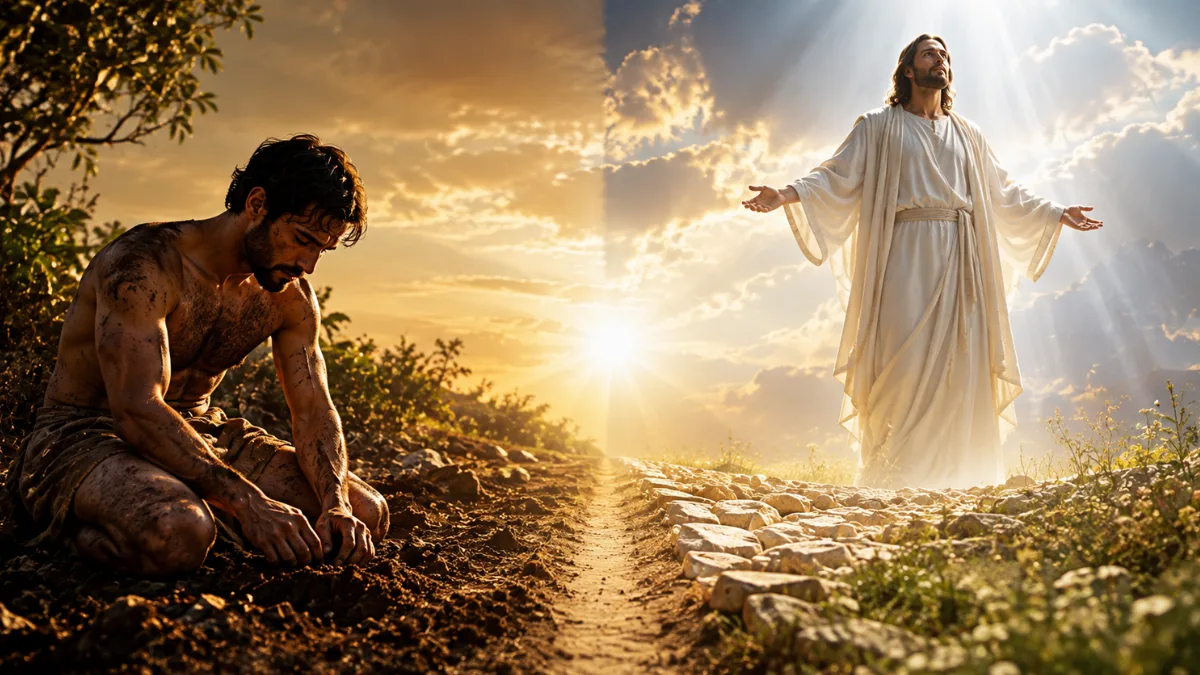

“The first man Adam was made a living soul” means that God formed Adam from the dust and caused him to become a living human being. In 1 Corinthians 15:45, Paul contrasts Adam, who received earthly human life, with Jesus Christ, the last Adam, who gives resurrection life to those who belong to Him.
Paul is not merely retelling Adam’s creation. He quotes Genesis 2:7 to explain the difference between humanity’s present condition through Adam and the transformed resurrection life established through Christ.
“And so it is written, The first man Adam was made a living soul; the last Adam was made a quickening spirit.” — 1 Corinthians 15:45 KJV
Adam became alive because God gave him life. Paul presents the risen Christ as the life-giving last Adam. Unlike Adam, who received created life, Christ has the power to give resurrection life to His people.
What Does 1 Corinthians 15:45 Mean?
First Corinthians 15:45 contrasts two representative men and two conditions of human life. Adam became a living human being through God’s creative action, while Christ is the risen Lord who gives resurrection life.
The verse appears within Paul’s explanation of the resurrection. He has described the body as sown in corruption and raised in incorruption, sown in weakness and raised in power, and sown as a natural body and raised as a spiritual body.
Paul then connects those two bodily conditions with Adam and Christ.
Adam represents humanity’s present earthly condition. Christ represents the resurrection order that belongs to those who are united with Him.
Adam’s original life came from God and was good, but it was earthly life rather than the glorified resurrection condition Paul describes. Christ’s risen life belongs to the final resurrection order that is free from corruption and death.
The article explaining how the dead are raised and what kind of body they receive examines that bodily transformation in detail. First Corinthians 15:45 focuses more specifically on why Paul connects natural human life with Adam and life-giving resurrection power with Christ.
Why Does Paul Say “And So It Is Written”?
Paul begins with “And so it is written” because he is quoting Genesis 2:7:
“And the Lord God formed man of the dust of the ground and breathed into his nostrils the breath of life; and man became a living soul.” — Genesis 2:7 KJV
Genesis describes two divine actions. God formed the man from the dust and God gave him the breath of life. Adam then became a living soul.
The KJV wording “was made” in 1 Corinthians 15:45 carries the sense of “became.” Paul is not describing a lifeless soul being manufactured separately from Adam. He quotes the result of God’s creative action: the man formed from the ground became a living human being when God gave him life.
Paul uses Genesis to establish Adam as the beginning of earthly humanity. Adam received his life from God and belonged to the natural human order that came first.
The quotation supports Paul’s contrast between the natural body and the spiritual body. The first belongs to humanity’s present earthly existence. The second belongs to the resurrection order established through Christ.
Paul does not use Genesis to suggest that physical creation was evil or unimportant. God created human embodied life. Paul’s point is that the earthly condition represented by Adam is not the final condition God promises to His people.
What Does “The First Man Adam” Mean?
Adam is called “the first man” because he stands at the beginning of humanity.
Genesis presents Adam as the first human being formed by God. Paul also treats him as the representative of earthly humanity.
Earlier in 1 Corinthians 15, Paul writes:
“For as in Adam all die, even so in Christ shall all be made alive.” — 1 Corinthians 15:22 KJV
Paul compares more than two individual lives. Adam and Christ represent two different orders of humanity.
Adam stands as the representative of earthly humanity, whose present bodily condition is marked by weakness and mortality. Christ stands as the representative and life-giving head of the resurrection humanity that belongs to Him.
Adam is first in the natural order. Christ is first in the resurrection order.
This is why Paul also describes Christ as the firstfruits of the resurrection harvest. Christ has already risen beyond death’s authority, and those who belong to Him will be raised in God’s appointed time.
What Does “Adam Was Made a Living Soul” Mean?
“Adam was made a living soul” means that Adam became a living human being when God gave him life.
The phrase “living soul” may sound to modern readers as though God first completed Adam’s body and then placed a separate object called a soul inside it. Genesis 2:7 emphasizes the complete living person produced through God’s action.
God formed the man from the ground, breathed into him the breath of life, and the man became a living soul.
The word translated “soul” can refer to a living person or creature, depending on its context. Here, it describes Adam as a living human being brought to life by God.
Adam did not possess life independently. His life was received, created, and sustained by God.
Paul uses this truth to explain the natural human life connected with the first Adam. It is genuine human life and part of God’s good creation, but it is not the incorruptible resurrection life that Christ gives.
Does “Living Soul” Define Everything the Bible Teaches About the Soul?
No. Genesis 2:7 and 1 Corinthians 15:45 do not, by themselves, settle every theological question about the soul.
The phrase directly describes Adam becoming a living person through God’s creative action. It emphasizes the complete living human being in this context.
Paul’s purpose is not to provide a full explanation of consciousness after death, the intermediate state, or the precise relationship between body and soul. Those questions require consideration of other biblical passages.
Readers should therefore avoid using “living soul” as though it answers every debate about human nature.
In 1 Corinthians 15, Paul’s main contrast concerns two conditions of embodied human life:
- The earthly, natural life represented by Adam
- The transformed resurrection life given through Christ
Adam received life from God. Christ gives resurrection life that death cannot overcome.
Why Is Jesus Called the Last Adam?
Jesus is called the last Adam because He is the final and decisive Adam in Paul’s comparison.
The title does not mean that Jesus was the last human being to exist. It identifies Him as the representative head of a new resurrection humanity.
The first Adam stands at the beginning of earthly humanity. Christ stands at the beginning of the resurrection order.
Adam’s disobedience brought sin and death into human experience. Christ obeyed the Father, died for sins, and rose from the dead.
Paul’s argument rests on the gospel truth that Christ died for our sins, was buried, and rose again on the third day.
Christ does not merely return His people to Adam’s original earthly condition. He brings them toward a greater condition of incorruptible resurrection life.
Calling Jesus the last Adam presents Him as the final and decisive Adam in Paul’s comparison. Christ establishes the resurrection humanity that will not be replaced by another earthly order.
What Does “The Last Adam Was Made a Quickening Spirit” Mean?
“Quickening” means life-giving.
The phrase means that the risen Christ gives resurrection life to those who belong to Him.
Adam became a living person because God gave him life. Christ is presented as the One who gives life to His resurrection people.
Paul is not saying that Jesus became the Holy Spirit. He is also not saying that Christ ceased to possess a real body after rising from the dead.
Jesus rose bodily. Paul’s entire argument in 1 Corinthians 15 depends on the reality of Christ’s resurrection and the future bodily resurrection of believers.
The description “life-giving Spirit” concerns Christ’s role and power in the resurrection order. Adam received created human life; the risen Christ communicates resurrection life.
This wording does not imply that the eternal Son previously lacked life or only acquired divine life after His resurrection. Paul presents Christ in His risen role as the last Adam who gives life to His people.
Resurrection life also involves the work and power of God’s Spirit, but the Son and the Holy Spirit should not be confused as though they were the same Person.
Paul’s central contrast remains clear:
- Adam became a living human being.
- Christ gives resurrection life.
How Are Adam and Christ Different?
Paul develops four main contrasts between Adam and Christ in 1 Corinthians 15:45–49.
Adam Received Life; Christ Gives Resurrection Life
Adam depended on God for his created existence. Christ is the risen Lord who has power to give resurrection life to His people.
Adam Was Formed From the Earth; Christ Is the Heavenly Man
Paul describes Adam as “of the earth, earthy.” God formed him from the dust of the ground.
Paul contrasts Adam with Christ, whose identity, authority, and resurrection life belong to heaven. This does not deny that Jesus truly became human or possessed a real human body. It identifies Him as the heavenly Man who brings the resurrection order.
Adam Represents Humanity’s Present Earthly Condition
Human beings presently share an embodied condition marked by frailty, ageing, and mortality.
Christ heads the resurrection humanity that belongs to Him. His people will not remain permanently under the conditions that now lead to death.
Humanity Bears Adam’s Image Now; Believers Will Bear Christ’s Image
Paul writes:
“And as we have borne the image of the earthy, we shall also bear the image of the heavenly.” — 1 Corinthians 15:49 KJV
Human beings currently bear the earthly condition associated with Adam. Believers will bear Christ’s heavenly image through resurrection transformation.
Why Does the Natural Come Before the Spiritual?
Paul writes:
“Howbeit that was not first which is spiritual, but that which is natural; and afterward that which is spiritual.” — 1 Corinthians 15:46 KJV
The natural comes first in ordinary human experience. People begin life in the earthly condition represented by Adam.
The spiritual body follows through resurrection.
Paul does not mean that the natural body is sinful simply because it is physical. God created embodied human life, and the body remains part of His redemptive purpose.
The sequence explains why believers still experience physical weakness and death even though Christ has risen. Christ has already entered resurrection life, but His people still await the transformation of their bodies.
The natural condition comes first. The promised resurrection condition follows through Christ.
What Does It Mean to Bear the Image of the Heavenly?
To bear the image of the heavenly means that believers will share the transformed resurrection condition established by Christ.
Paul does not provide every detail about appearance, age, memory, or recognition. The verse focuses on the believer’s future condition rather than answering every question about life after resurrection.
Those who presently bear an image marked by mortality will receive bodies no longer ruled by corruption, dishonour, weakness, or death.
Bearing Christ’s heavenly image does not mean becoming equal to Him in His divine identity. Believers remain created human beings.
It means that God will transform them according to the resurrection life revealed in His Son.
Christ’s risen life provides both the pattern and assurance of that future.
What Does 1 Corinthians 15:45 Teach Christians Today?
First Corinthians 15:45 contrasts two representative men and two conditions of human life. Adam became a living being because God gave him earthly human life. Christ, the last Adam, is the risen Lord who gives resurrection life to His people.
Paul does not present the body or natural human life as evil. He teaches that humanity’s present Adamic condition is not the final condition God has promised. The natural comes first; the transformed resurrection life established through Christ follows.
Believers therefore do not place their hope in Adam’s earthly condition overcoming death by itself. Their hope rests in the last Adam, whose resurrection assures them that they will one day bear the image of the heavenly Man.
