
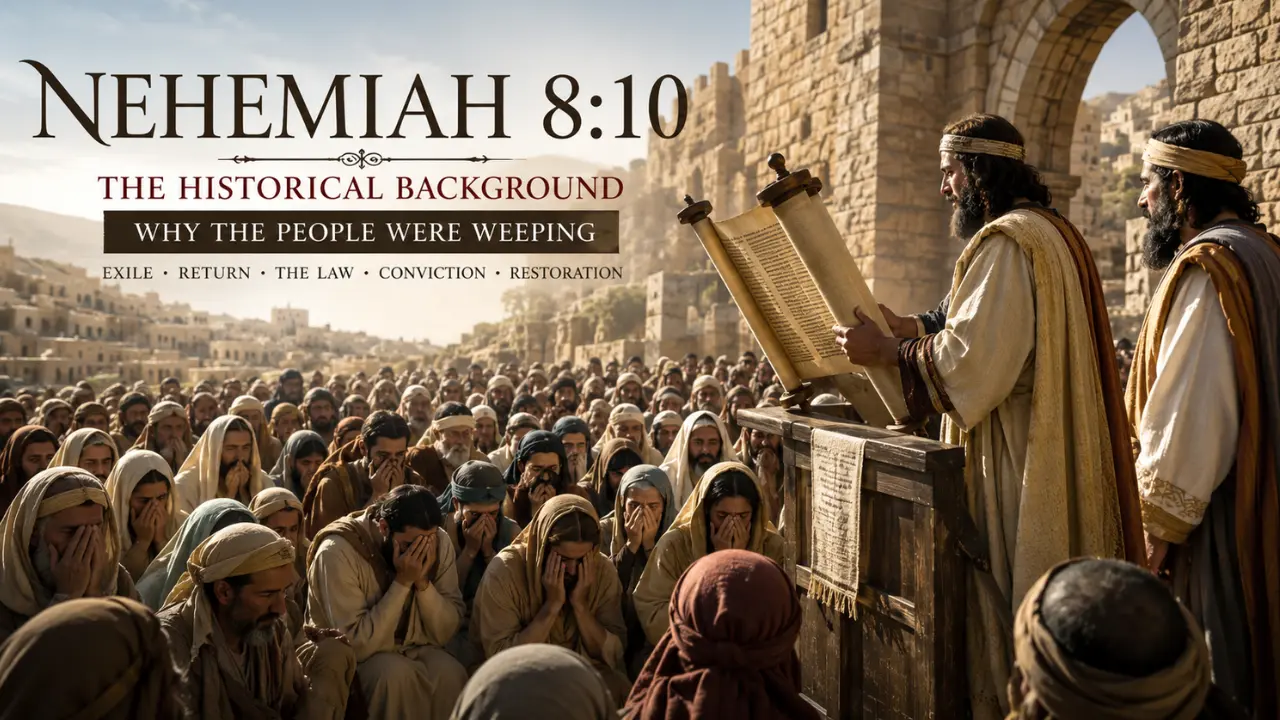

Nehemiah 8:10 is often remembered for the phrase, “the joy of the Lord is your strength,” but the historical background of Nehemiah 8:10 is not a light or casual moment. The verse was spoken to a gathered community of returned exiles who had survived national collapse, foreign captivity, a difficult return to Jerusalem, and the painful process of rebuilding what had been broken.
The people were not weeping because they were emotionally moved by a beautiful religious ceremony alone. They were weeping because the public reading of the Law exposed the spiritual condition of the nation. As Ezra read and the Levites explained, the people began to understand how deeply their history, suffering, exile, and covenant failure were connected.
The people were weeping in Nehemiah 8 because the returned exiles heard the Law of God publicly explained, understood their nation’s disobedience, and felt the weight of covenant conviction after years of judgment, loss, and restoration. Nehemiah 8:10 was spoken into that moment to redirect them from mourning alone toward holy joy, because God was restoring His people rather than merely exposing their failure.
Nehemiah 8:10 Happened After the Babylonian Exile
To understand Nehemiah 8:10, the first historical detail is exile. Judah had not simply gone through a hard season; the nation had experienced divine judgment, military defeat, temple destruction, and forced displacement. Jerusalem, the city connected with David’s throne and temple worship, had been devastated by Babylon.
The exile was not viewed by Israel merely as political misfortune. In the biblical worldview, it was the result of covenant unfaithfulness. The people had broken God’s commandments, ignored prophetic warnings, practiced injustice, and drifted into idolatry. This meant that when later generations heard the Law again, they were not hearing abstract religious rules. They were hearing the covenant standard that explained why their nation had suffered so deeply.
By the time of Nehemiah 8, some Jewish exiles had returned to the land under Persian rule. They were back in Jerusalem, but they were not yet living in the full strength and glory of the earlier kingdom. Their return was real, but their restoration was still fragile. The city had walls again, the people had leadership again, and public worship was being restored, but the memory of national failure had not disappeared.
Also Read: The Joy of the Lord is My Strength: Finding Hope in Tough Times
Returned Exiles Were Rebuilding More Than a City
Nehemiah’s main work is often associated with rebuilding the walls of Jerusalem, but the historical setting is larger than a construction project. The walls mattered because they represented protection, identity, dignity, and public stability. A city without walls in the ancient world was exposed, vulnerable, and dishonored.
When Nehemiah arrived in Jerusalem, he found the city physically broken and socially weakened. Rebuilding the wall was necessary, but walls alone could not restore the nation. A secure city still needed a spiritually renewed people. This is why Nehemiah 8 follows the rebuilding work with the public reading of the Law.
The sequence is important. The wall was rebuilt, but then the people had to be rebuilt. Jerusalem’s stones could be restored by labor, but the heart of the nation had to be restored through the Word of God. Nehemiah 8 shows that national restoration in Israel was never only political, architectural, or cultural. It had to be covenantal.
Ezra’s Role Was Central in the Public Reading of the Law
Ezra appears in Nehemiah 8 as a priest and scribe who stands before the gathered people with the Book of the Law. His role is important because this moment is not led by a king, military commander, or political official. The central figure in the reading is a teacher of God’s Law.
Ezra’s presence shows that restoration required instruction. The people needed more than enthusiasm about returning to Jerusalem. They needed to hear what God had commanded, understand what had been neglected, and recover the covenant identity that had shaped Israel from the time of Moses.
The reading was also public. Men, women, and all who could understand gathered together. This was not a private study for religious specialists. It was a national moment where the community stood under the authority of God’s revealed Word. The Law was read openly because the entire community needed to understand who they were before God.
Also Read: 7 Lessons From “The Joy of the Lord Is My Strength”
People Gathered at the Water Gate
Nehemiah 8 places the gathering at the Water Gate, not inside the temple courts. This detail matters because it shows the broad public nature of the event. The people assembled in an open space where the Law could be read and explained to the wider community.
This setting fits the moment. The returned exiles were not only resuming ritual worship; they were recovering public obedience. Their identity as God’s covenant people had to shape the whole community, not only temple ceremony. The Word of God was brought into the public square of restored Jerusalem.
The gathering also took place in the seventh month, a significant time in Israel’s religious calendar. This month was connected with sacred observances, including the Feast of Trumpets, the Day of Atonement, and the Feast of Booths. Nehemiah 8 therefore happens in a season already marked by remembrance, repentance, worship, and covenant reflection.
The Law Was Read and Explained Clearly
One of the most important details in Nehemiah 8 is that the Law was not only read; it was explained. The Levites helped the people understand the reading. This means the emotional response of the people came from comprehension, not confusion.
The people were not weeping because they heard unfamiliar religious sounds. They wept because the meaning became clear. They understood the commandments, the covenant obligations, and the seriousness of their failure as a people. The Word reached the conscience because it was explained in a way they could grasp.
This also gives the passage strong historical authority. Nehemiah 8 is not describing emotionalism detached from teaching. It describes conviction that came through public Scripture, careful explanation, and communal understanding. The people’s grief was rooted in truth.
Why Were the People Weeping in Nehemiah 8?
The people were weeping because the Law revealed the distance between God’s covenant standard and Israel’s actual history. For generations, the nation had suffered because of disobedience. Now, after returning to the land, they were hearing the Law again and realizing that exile had not been random.
Their tears likely carried several layers of emotion. There was grief over sin, sorrow over neglected obedience, pain over national failure, and awe that God had preserved them despite judgment. They were standing in a rebuilt Jerusalem, hearing the Law that their ancestors had failed to honor, and recognizing that their return was an act of mercy.
This kind of weeping was not weakness. It was conviction. The people were not rejecting God; they were finally understanding the seriousness of His Word. Their tears showed that the Law was doing what it was meant to do: exposing sin, awakening reverence, and calling the people back to covenant faithfulness.
Their Weeping Was Connected to Covenant Memory
The returned exiles were not hearing the Law as isolated individuals. They heard it as members of a covenant people with a long national memory. The Law reminded them of God’s promises, Israel’s calling, and the consequences of disobedience.
This is why the scene is historically powerful. The people were standing in the land promised to their ancestors, in the city that had once been destroyed, after years of exile and humiliation. When the Law was read, it gathered all of that history into one moment. Their tears were the response of a people who suddenly saw their story through the lens of God’s covenant.
The Law did not merely tell them what to do next. It explained who they were, why their past had unfolded as it did, and what restoration required. Their weeping was therefore not only personal sadness. It was national recognition.
Nehemiah and Ezra Told the People Not to Mourn That Day
Nehemiah 8:10 must be understood in connection with the leaders’ response to the people’s tears. Nehemiah, Ezra, and the Levites told the people not to mourn or weep because the day was holy to the Lord. This does not mean their sorrow was wrong in every sense. It means that sorrow was not the final message of that particular day.
The people had heard the Law, and conviction had come. But the leaders understood that the holy day was also a sign of restoration. God had not gathered the people merely to crush them with guilt. He had gathered them to renew them.
This is the historical force behind the command to eat, drink, share portions, and rejoice. The people were not being told to ignore sin. They were being taught that covenant conviction must lead to restored fellowship with God. Mourning had its place, but on that day, holy joy was the proper response because God was rebuilding His people.
“The Joy of the Lord Is Your Strength” Was Spoken to a Restored Community
The phrase “the joy of the Lord is your strength” was not first spoken into a comfortable religious setting. It was spoken to people who knew loss, exile, guilt, rebuilding, and weakness. Their strength would not come from pretending the past had not happened. Their strength would come from recognizing that God was still present with His restored people.
In this historical context, joy is not shallow happiness. It is the covenant joy of a people who realize that God has not abandoned them. The same Law that exposed their failure also showed that they still belonged to the Lord. The same God who had judged disobedience was now restoring worship, community, and identity.
This is why Nehemiah 8:10 carries such weight. The verse does not erase repentance. It places repentance inside restoration. The people could rejoice because God had brought them back, given them His Word again, and allowed them to stand as His covenant community in Jerusalem.
Sharing of Food Showed Communal Restoration
Nehemiah 8:10 includes instruction to send portions to those who had nothing prepared. This detail is easy to overlook, but historically it matters. The restored community was not supposed to celebrate in isolation while others lacked provision.
The command to share food showed that national restoration included social care. The people were being taught to respond to God’s Word not only with emotion but with covenant-shaped community life. Joy was to become visible through generosity.
This also connects with the larger biblical concern for justice, mercy, and care within Israel. The people had returned from exile, but they still needed to learn how to live as a holy community. Celebration was not private escape. It was shared obedience.
Nehemiah 8 Was a Turning Point in National Restoration
Nehemiah 8 marks a major turning point because the focus shifts from physical reconstruction to spiritual renewal. The wall had been rebuilt, but now the people were being re-formed by the Law. This moment helped restore Israel’s identity after the trauma of exile.
The chapter also prepares for later covenant renewal. Once the people understood the Law, they could respond more seriously to God’s commands. Public reading led to conviction, conviction led to instruction, and instruction led to renewed commitment.
This is why the historical background is essential. Nehemiah 8:10 is not a detached inspirational statement. It belongs to a national restoration scene where God’s Word, covenant memory, communal repentance, and holy celebration all meet together.
Why the Historical Background Changes How We Read the Verse
Without the historical background, Nehemiah 8:10 can be reduced to a general statement about staying positive. But in context, the verse is much deeper. It was spoken after exile, after rebuilding, after public Scripture reading, and after the people were pierced by conviction.
The people were weeping because they understood the Law and saw their failure. They were told to rejoice because God was restoring them. That balance is what gives the verse its authority. It does not separate joy from holiness, and it does not separate strength from repentance.
Nehemiah 8:10 teaches that the returned exiles were not strengthened by denial, national pride, or emotional excitement. They were strengthened by the joy of belonging again to the Lord, hearing His Word again, and seeing His mercy at work in their restored community.

3 thoughts on “8 Facts Behind the Background of Nehemiah 8:10”