
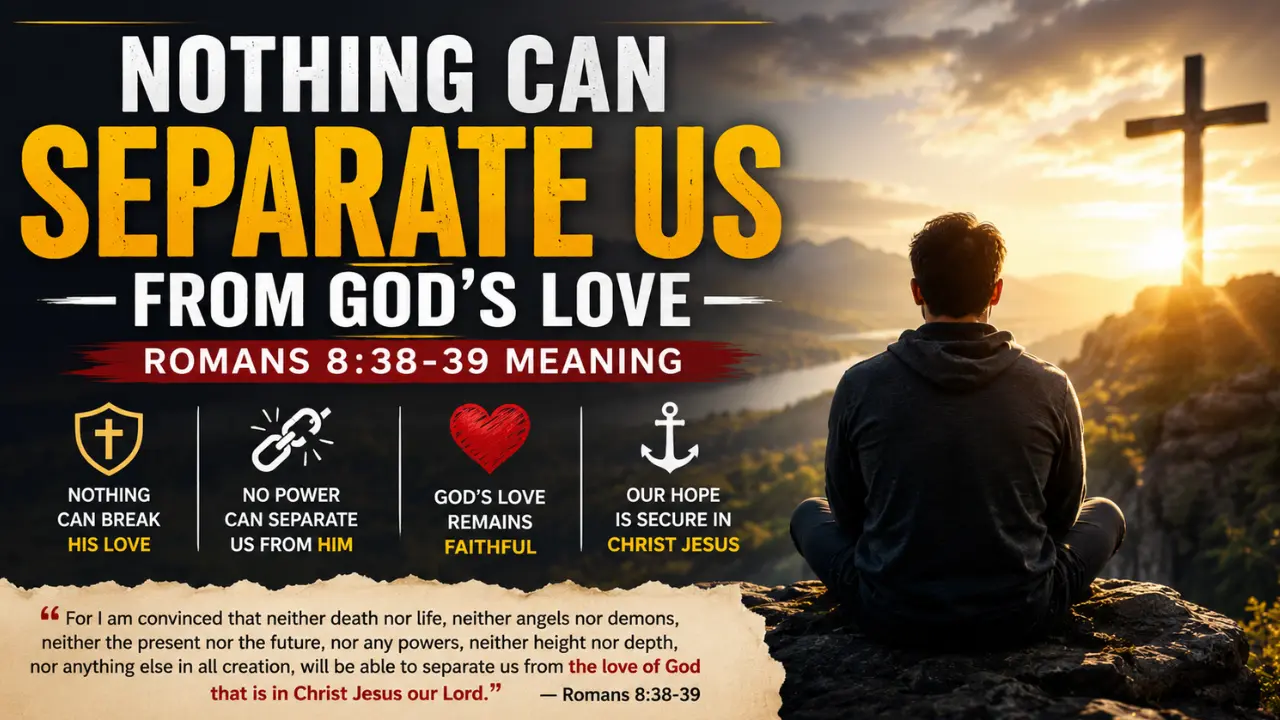

Nothing can separate us from God’s love means that no suffering, fear, death, spiritual power, present trouble, future uncertainty, or created thing has the authority to remove believers from the love God has shown in Christ Jesus. Romans 8:38–39 gives assurance because God’s love is not fragile, temporary, or dependent on the believer’s changing emotions.
The meaning of “nothing can separate us from God’s love” is that the love of God in Christ remains secure even when life feels painful, uncertain, spiritually heavy, or emotionally confusing. Paul is not saying believers will never suffer. He is saying suffering does not have the final power over God’s love.
This matters because many people read Romans 8:38–39 during seasons when they feel afraid, guilty, abandoned, weak, or spiritually distant. The verse does not deny those feelings. It gives a stronger truth beneath them: the believer’s security rests on God’s faithful love, not on the stability of human emotion.
What Does “Nothing Can Separate Us From God’s Love” Mean?
“Nothing can separate us from God’s love” means that no power, situation, accusation, suffering, spiritual force, or future event can cancel the saving love God has revealed in Christ. The word “separate” carries the idea of being cut off, removed, divided, or pushed away from something secure.
Paul’s point is not that believers never pass through painful seasons. Romans 8 itself speaks honestly about suffering, weakness, groaning, waiting, and the need for hope. The promise is not that Christians escape hardship. The promise is that hardship cannot remove them from the love of God.
This is the difference between emotional comfort and biblical assurance. Emotional comfort may rise and fall depending on circumstances. Biblical assurance stands on what God has done in Christ. Paul wants believers to know that God’s love is stronger than the things that frighten them most.
When life feels peaceful, this verse is comforting. When life feels unstable, this verse becomes an anchor. It teaches that God’s love is not only present when the believer feels strong, prayerful, joyful, or certain. God’s love remains faithful even when the believer feels weak, overwhelmed, or unable to explain what is happening.
Also Read: 12 Ways Agape Love Differs From Human Emotion
What Is the Context of Romans 8:38–39?
Romans 8 is one of the strongest chapters in Scripture about assurance, suffering, hope, and the work of God for His people. Paul does not build assurance by ignoring pain. He builds assurance while looking directly at the reality of pain.
Earlier in the chapter, Paul speaks about life in the Spirit, adoption as children of God, suffering with Christ, future glory, creation groaning, believers groaning, and the Spirit helping in weakness. This means Romans 8:38–39 is not an isolated comforting phrase. It is the final assurance after Paul has already admitted that believers still live in a world marked by suffering.
That context is important. Paul is not writing as though Christians will never face grief, confusion, persecution, sickness, pressure, temptation, or fear. He is writing as someone who understands that believers need a deeper confidence than their circumstances can provide.
Romans 8 moves toward one clear truth: if God has acted for His people in Christ, then no opposing force has greater authority than God’s saving love. The chapter does not make human life look easy. It makes God’s faithfulness look greater.
This is why Romans 8:38–39 is so powerful. It does not offer shallow optimism. It offers assurance grounded in the love of God in Christ Jesus our Lord.
Why Does Paul Mention Death and Life?
Paul mentions death and life because these two words cover the deepest boundaries of human existence. Death is one of humanity’s greatest fears, and life is where many of our struggles happen.
Death cannot separate believers from God’s love because God’s love is not limited by the grave. For those in Christ, death does not have the final word. It may end earthly life, but it cannot cancel the believer’s union with Christ or undo the love God has already shown.
Life also cannot separate believers from God’s love. This is important because many people fear death, but they also suffer deeply while living. Life can bring disappointment, illness, betrayal, unanswered prayer, financial pressure, family pain, emotional exhaustion, spiritual dryness, and seasons of confusion.
Paul includes life because the daily weight of living can make a believer feel distant from God. A person may not be afraid of dying today, but may feel crushed by what they are carrying today. Romans 8:38–39 speaks into both fears. Death cannot separate you from God’s love, and the burdens of life cannot separate you from God’s love either.
The assurance is complete. The end of life cannot break God’s love, and the pressures within life cannot break it.
Also Read: Love in the Bible: Why It’s Stronger Than Death Itself
Why Does Paul Mention Angels, Rulers and Powers?
Paul mentions spiritual powers to show that invisible forces are not stronger than God’s love. The Bible does not treat spiritual conflict as imaginary, but it also does not present spiritual powers as equal to God.
This matters because many believers worry about spiritual attack, accusation, temptation, oppression, or unseen forces working against them. Romans 8:38–39 does not say these things are harmless. It says they are not supreme.
No angelic being, no spiritual ruler, no demonic power, and no unseen authority can separate believers from the love of God in Christ. God’s love is not vulnerable to spiritual intimidation. It does not collapse because the believer is under pressure.
This gives assurance without creating fear. Paul does not list spiritual powers so believers will become obsessed with them. He lists them to show their limits. They may trouble, accuse, tempt, or oppose, but they cannot overthrow the love of God.
The believer’s confidence is not in personal strength against spiritual darkness. The believer’s confidence is in the greater authority of God’s love revealed in Christ.
Why Does Paul Mention Things Present and Things to Come?
Paul mentions things present and things to come because believers often fear both what is happening now and what may happen later. Present trouble can feel overwhelming, and future uncertainty can feel frightening.
Things present include today’s burdens. They may include grief, anxiety, sickness, guilt, loneliness, conflict, financial stress, family pressure, or spiritual weakness. Paul’s message is that none of these present realities can separate believers from God’s love.
Things to come include what the believer cannot yet see. This may include future suffering, future loss, future failure, future temptation, future change, or future uncertainty. Many people suffer not only from what has happened, but from what they fear might happen.
Romans 8:38–39 speaks to that fear. The future is unknown to the believer, but it is not unknown to God. The love of God does not only cover the present moment. It remains faithful beyond what the believer can predict.
This is one reason the verse gives deep assurance. God’s love is not strong only for today and uncertain for tomorrow. The believer does not need to know every future detail in order to trust the love of God. The future may be unknown, but it is not stronger than Christ.
Can Anything Separate Us From God?
Romans 8:38–39 answers this clearly: no created thing can separate believers from the love of God in Christ Jesus. Paul’s list stretches across life, death, spiritual powers, present realities, future uncertainties, height, depth, and all creation.
The phrase “nor anything else in all creation” is especially important because it closes every possible gap. If something is created, it is not greater than the Creator. If it belongs to the visible or invisible world, it still does not have more power than God’s love.
This does not mean a person should treat faith carelessly. It does not mean sin is harmless, prayer is unnecessary, obedience does not matter, or spiritual growth is optional. Paul is speaking about the security of God’s love in Christ, not giving permission for spiritual laziness.
The assurance is for those whose hope is in Christ. The love of God is not presented as a vague religious feeling. It is the love of God “in Christ Jesus our Lord.” That phrase matters because Paul’s confidence is not based on human worthiness. It is based on what God has done through Christ.
So the answer is not merely, “Nothing can separate us from God.” More precisely, nothing can separate believers from the love of God that has been revealed, secured, and given in Christ Jesus.
Does This Mean Christians Will Never Feel Distant From God?
No, Romans 8:38–39 does not mean Christians will never feel distant from God. Believers can go through seasons of spiritual dryness, guilt, grief, fear, confusion, or emotional heaviness. A person may feel abandoned even while God has not abandoned them.
This distinction is very important. Feeling distant from God and being separated from God are not the same thing.
A believer may feel distant because of suffering. A believer may feel distant because prayer feels unanswered. A believer may feel distant because of shame after sin. A believer may feel distant because emotions are exhausted. A believer may feel distant because grief has made the heart numb.
Romans 8:38–39 does not shame the believer for feeling weak. Instead, it gives the believer a truth stronger than weakness. Paul’s assurance does not depend on whether the believer feels God’s love perfectly in every moment. It depends on whether God’s love in Christ is truly secure.
This is why the verse is so helpful during spiritual struggle. It teaches believers not to measure God’s love only by emotional sensation. Feelings may become cloudy, but God’s covenant love remains firm.
Can Sin Separate Us From God’s Love?
Sin is serious, but Romans 8:38–39 teaches that for those who are in Christ, sin does not have greater power than the love of God. This needs to be understood carefully because the Bible never treats sin as harmless.
Sin can damage fellowship with God. It can harden the heart, grieve the Spirit, weaken prayer, produce guilt, harm others, and lead a person into spiritual danger. A believer should never use God’s love as an excuse to continue in sin.
At the same time, the believer’s hope is not that they have loved God perfectly. The believer’s hope is that God’s love in Christ is greater than failure. When a believer sins, the answer is not despair. The answer is confession, repentance, and returning to the mercy of God.
Romans 8:38–39 does not make sin small. It makes Christ greater.
This is the balance the article must keep. God’s love is not permission to live carelessly, but it is also not so weak that one failure destroys the believer’s hope. The love of God calls the believer back, restores what sin damages, and teaches the heart to walk in obedience again.
What This Verse Does Not Mean
Romans 8:38–39 is sometimes misunderstood when people treat it as a promise that life will always feel peaceful. Paul is not saying that believers will be protected from every painful experience. He is saying that painful experiences cannot separate them from God’s love.
This verse does not mean Christians will never suffer. Romans 8 openly acknowledges suffering and groaning.
- It does not mean believers will always feel emotionally strong. Paul speaks about weakness and the Spirit’s help.
- It does not mean every situation will make sense immediately. Hope often waits before it sees the full answer.
- It does not mean sin is harmless. God’s love is holy love, and holy love calls people away from sin.
- It does not mean believers should deny grief. Assurance does not erase tears; it gives truth beneath tears.
This verse should not be used to create false expectations. Its comfort is deeper than that. It does not promise that nothing will hurt. It promises that nothing created can separate believers from the love of God in Christ.
Why Romans 8:38–39 Gives Assurance to Believers
Romans 8:38–39 gives assurance because it shifts the believer’s confidence away from self and toward God. Many people lose peace because they keep measuring their security by their emotional strength, spiritual performance, or ability to understand every circumstance.
Paul does not point believers to themselves. He points them to the love of God in Christ Jesus.
That matters because human strength changes. Human emotion changes. Human confidence changes. Even spiritual discipline can feel weak during seasons of grief, pressure, or exhaustion. But God’s love is not built on the believer’s changing condition. It is grounded in God’s own character and revealed through Christ.
- Assurance does not mean the believer feels brave every day. It means the believer has a reason to trust God even when fear is present.
- Assurance does not mean the believer never struggles with doubt. It means doubt does not have greater authority than God’s promise.
- Assurance does not mean the believer has perfect emotional peace. It means the believer’s relationship with God is not held together by emotion alone.
Romans 8:38–39 gives believers confidence because God’s love is stronger than the things that make them feel unsafe.
How This Verse Helps During Fear
Fear often makes the future feel stronger than God’s love. A person may fear death, failure, loss, sickness, judgment, rejection, or what may happen next. Fear narrows the mind until the threat feels larger than every promise.
Romans 8:38–39 helps by widening the believer’s view. Paul stretches across death, life, spiritual powers, present trouble, future uncertainty, height, depth, and all creation. He does this to show that there is no category of fear outside the reach of God’s love.
This does not mean fear disappears instantly. Many believers still have to pray through fear patiently. But the verse gives faith something solid to hold. It reminds the believer that fear may be loud, but it is not Lord.
God’s love does not become smaller when fear becomes stronger. The believer may tremble, but God’s love does not tremble.
How This Verse Helps During Grief
Grief can make God feel far away because loss changes how the world feels. A grieving person may still believe in God and yet feel emotionally numb, confused, or wounded. Romans 8:38–39 does not rush grief or pretend that loss is easy.
Instead, it gives assurance that death itself cannot separate believers from God’s love. This is one of the deepest comforts in the passage. Death may separate people from earthly presence, but it cannot overpower the love of God in Christ.
For the grieving believer, this verse does not remove all sorrow. It gives sorrow a boundary. Grief is real, but it is not ultimate. Loss is painful, but it is not stronger than God’s redeeming love.
This is why Christians can grieve with hope. Hope does not mean the heart feels no pain. Hope means pain does not get the final word over God’s people.
How This Verse Helps During Guilt and Shame
Guilt and shame can make a believer feel unworthy of God’s love. After failure, a person may think God is finished with them, prayer is no longer welcome, or forgiveness is too far away. Romans 8:38–39 speaks against that despair.
The love of God in Christ is not based on the believer’s perfection. It is based on Christ’s saving work. This does not make repentance unnecessary. It makes repentance possible.
A person who truly understands God’s love does not use grace as an excuse to hide sin. They bring sin into the light because they trust that God’s mercy is greater than their failure.
Shame says, “You are too far away.” Romans 8:38–39 says no created thing has the authority to separate believers from God’s love in Christ.
The right response to guilt is not to run from God. The right response is to return to Him with honesty, repentance, and trust.
How This Verse Helps During Spiritual Dryness
Spiritual dryness can make a believer question whether God’s love is still present. Prayer may feel empty. Scripture may feel hard to receive. Worship may feel heavy. The heart may feel dull even while the person still wants God.
Romans 8:38–39 helps because it teaches that God’s love is not measured only by emotional experience. A dry season is not the same as separation from God.
Sometimes believers assume that if they cannot feel God strongly, then God must be far away. But Paul’s assurance is not based on constant emotional intensity. It is based on the unbreakable love of God in Christ.
In dry seasons, this verse teaches believers to stand on truth while emotions recover slowly. God’s love remains true before the feeling returns. His faithfulness is not canceled by numbness, exhaustion, or weakness.
Spiritual dryness should be taken seriously, but it should not be allowed to define God’s love. Romans 8:38–39 gives the believer permission to trust what God has said even when the heart feels tired.
Love of God Is “In Christ Jesus Our Lord”
The final phrase of Romans 8:39 is essential. Paul says this love is found in Christ Jesus our Lord. This means the assurance of God’s love is not vague, sentimental, or disconnected from the gospel.
God’s love is revealed in Christ. It is secured through Christ. It is understood through Christ. It is received through Christ. Paul’s confidence is not based on a general idea that God is kind. His confidence is based on the saving work of Christ and the faithfulness of God to those who belong to Him.
This keeps the verse from becoming shallow. The love of God is not merely a feeling that God has toward people. It is His covenant mercy revealed through the life, death, resurrection, and lordship of Christ.
That is why nothing can separate believers from this love. It is not held together by human emotion. It is held by Christ Himself.

1 thought on “Nothing Can Separate Us From God’s Love Meaning in Romans 8:38–39”