
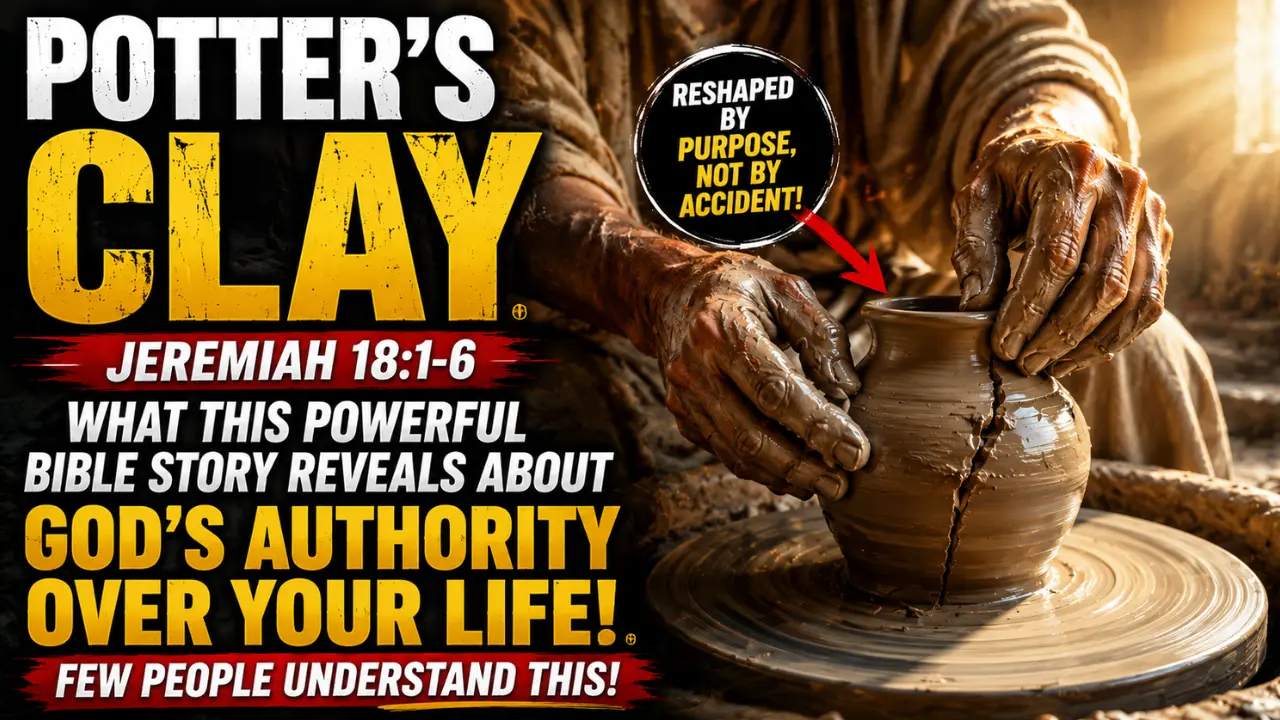

Jeremiah 18:1–6 presents a prophetic image concerning God’s authority over Judah, covenant accountability, judgment and the possibility of repentance. God sends Jeremiah to the potter’s house, where the prophet observes a craftsman working clay on a wheel. When the vessel becomes spoiled in the potter’s hand, the potter reshapes it into another vessel according to his purpose.
God then applies the image directly to Israel: “Like clay in the hand of the potter, so are you in my hand, O house of Israel.” The passage is not primarily about personal self-improvement or emotional comfort. In its original setting, it addresses Judah as a covenant people under God’s authority during a period of serious rebellion.
The potter’s clay symbolizes Israel as a nation subject to God’s sovereign rule, covenant evaluation and moral accountability. The marred vessel represents Judah’s corrupted covenant condition, while the potter’s reshaping shows that God has authority to judge, reform or restore according to His righteous purposes.
Judah’s Crisis Behind the Image
Jeremiah ministered during the final years of Judah before the Babylonian exile. The nation was marked by idolatry, injustice, corrupt leadership, false prophecy and resistance to prophetic warning. Many in Judah assumed that Jerusalem, the temple and covenant identity guaranteed safety, even while the people persisted in disobedience.
Jeremiah’s message challenged that false security. Covenant privilege did not remove covenant responsibility. The potter’s house became a living illustration of Judah’s situation before God. The nation could not claim protection from judgment while refusing repentance, reflecting [why the prophets repeatedly warned that outward covenant identity without obedience could not prevent judgment — The Danger of False Security in the Old Testament Prophets].
Why the Potter’s House Matters
The potter’s house is important because Jeremiah does not receive only an abstract doctrine. He watches a process. The potter forms a vessel, the vessel becomes spoiled, and the potter reshapes the same clay into another vessel.
The central point is not the wheel itself but the potter’s authority over the clay. The clay does not determine its own form, use or future. The potter has the right to respond to the condition of the clay and reshape it according to his intention. God uses this image to explain His authority over the covenant nation.
The Marred Vessel and Judah’s Covenant Condition
The vessel becomes marred in the potter’s hand. This detail must be understood carefully. The problem is not weakness or failure in the potter. The spoiled vessel represents the condition of Judah under covenant rebellion.
Judah had distorted its calling through idolatry, injustice, and refusal to listen to God’s word. The nation had been shaped by covenant grace and prophetic instruction, yet its life no longer reflected faithful obedience. The marred vessel therefore represents moral and covenant corruption rather than random imperfection.
This makes the image judicial as well as formative. God is not merely shaping passive material. He is addressing a covenant people responsible for their response to His word.
Jeremiah 18:7–10 as the Interpretive Key
Although the title passage is Jeremiah 18:1–6, the next verses explain how the image should be understood. In Jeremiah 18:7–10, God says that if He announces judgment against a nation and that nation turns from evil, He may relent from the disaster. Likewise, if He announces blessing and that nation turns to evil, He may reconsider the good He intended.
This nearby explanation is essential. The potter and clay image does not teach fatalism. It teaches God’s sovereign authority applied within a moral covenant framework. Nations are accountable for repentance or rebellion. God is free to judge but He is also free to show mercy when repentance occurs.
The image therefore joins divine sovereignty with human responsibility. The potter has authority over the clay but the passage immediately emphasizes moral response. Judah’s future is not controlled by national presumption, but neither is the call to repentance meaningless.
Divine Sovereignty Without Fatalism
Jeremiah 18 affirms God’s authority over nations and history. Judah does not possess the right to define its own covenant future apart from God. The nation is clay in the potter’s hand.
Yet the passage does not present God’s sovereignty as mechanical determinism. God’s dealings with nations include moral evaluation. Repentance matters. Evil matters. Covenant response matters. This is why Jeremiah 18 is especially important for biblical theology: it holds together God’s authority and human accountability without weakening either truth.
Judgment and Mercy in the Same Image
The potter image includes both warning and mercy. The marred vessel can be reshaped, but the reshaping remains under the potter’s authority. For Judah, this meant that judgment was real but repentance was still being called for.
The image does not promise that Judah can avoid every consequence. Jeremiah’s broader ministry makes clear that judgment was approaching because of persistent rebellion. Yet the passage still reveals that God’s warnings are not empty announcements. They call people to respond rightly before Him.
The Clay as Covenant Dependence
Clay in the potter’s hand represents dependence. Judah’s security did not rest in political alliances, temple possession, royal identity or religious tradition. The nation existed under God’s covenant authority.
This directly confronted Judah’s false confidence. The people could not appeal to sacred symbols while rejecting the God who gave those symbols meaning. The temple did not protect rebellion. Covenant identity did not excuse disobedience. Like clay in the potter’s hand, Judah remained accountable to the Lord who formed and judged His people, reinforcing [why the prophets warned against trusting religious identity while living in covenant disobedience — The Problem of Empty Religion in the Old Testament].
Restoration as Re-Formation
When the potter reshapes the clay into another vessel, the image introduces the possibility of re-formation. Restoration in Jeremiah is not merely returning to a previous condition. It involves God’s authority to form His people according to His covenant purpose after corruption has been exposed.
This theme fits Jeremiah’s wider message. The book contains severe judgment, but it also contains promises of future restoration, renewed covenant and God’s continued purpose for His people. The potter image fits that pattern. God may judge what is corrupt, but His authority also includes the power to reform what belongs to Him.
Relation to Other Potter Imagery in Scripture
Other biblical passages use potter imagery to emphasize the Creator’s authority over His people. Isaiah uses the image to confront human pride and resistance against God. Paul later draws on potter imagery in Romans 9 while discussing divine sovereignty and covenant history.
These later connections are important but Jeremiah 18 should be interpreted first on its own terms. The immediate focus is Judah’s covenant condition and God’s authority to respond to repentance or rebellion. Romans 9 may echo broader potter imagery but Jeremiah’s specific emphasis is not abstract speculation. It is prophetic warning addressed to a nation under covenant accountability.
What the Potter’s Clay Means in Jeremiah 18:1–6
The potter’s clay in Jeremiah 18:1–6 symbolizes Israel and Judah under God’s sovereign covenant authority. The marred vessel represents Judah’s corrupted condition through rebellion, while the potter’s reshaping reveals God’s right to judge, reform or restore.
The nearby explanation in Jeremiah 18:7–10 shows that the image must be read through the lens of repentance and moral accountability. If a nation turns from evil, God may relent from judgment. If a nation turns from obedience to evil, judgment may replace blessing.
The passage therefore teaches that God’s sovereignty is not fatalism, covenant privilege is not immunity, and repentance remains central to prophetic warning.
Frequently Asked Questions
What does the marred vessel represent in Jeremiah 18?
The marred vessel represents Judah’s corrupted covenant condition caused by rebellion, idolatry and refusal to repent.
Is Jeremiah 18 mainly about personal transformation?
No. In its original context, the passage primarily concerns Judah as a covenant nation facing judgment and accountability before God.
What does the potter symbolize in Jeremiah 18?
The potter symbolizes God’s sovereign authority over nations, covenant history, judgment and restoration.
Does Jeremiah 18 teach fatalism?
No. Jeremiah 18:7–10 shows that repentance and moral response still matter within God’s sovereign dealings with nations.
