
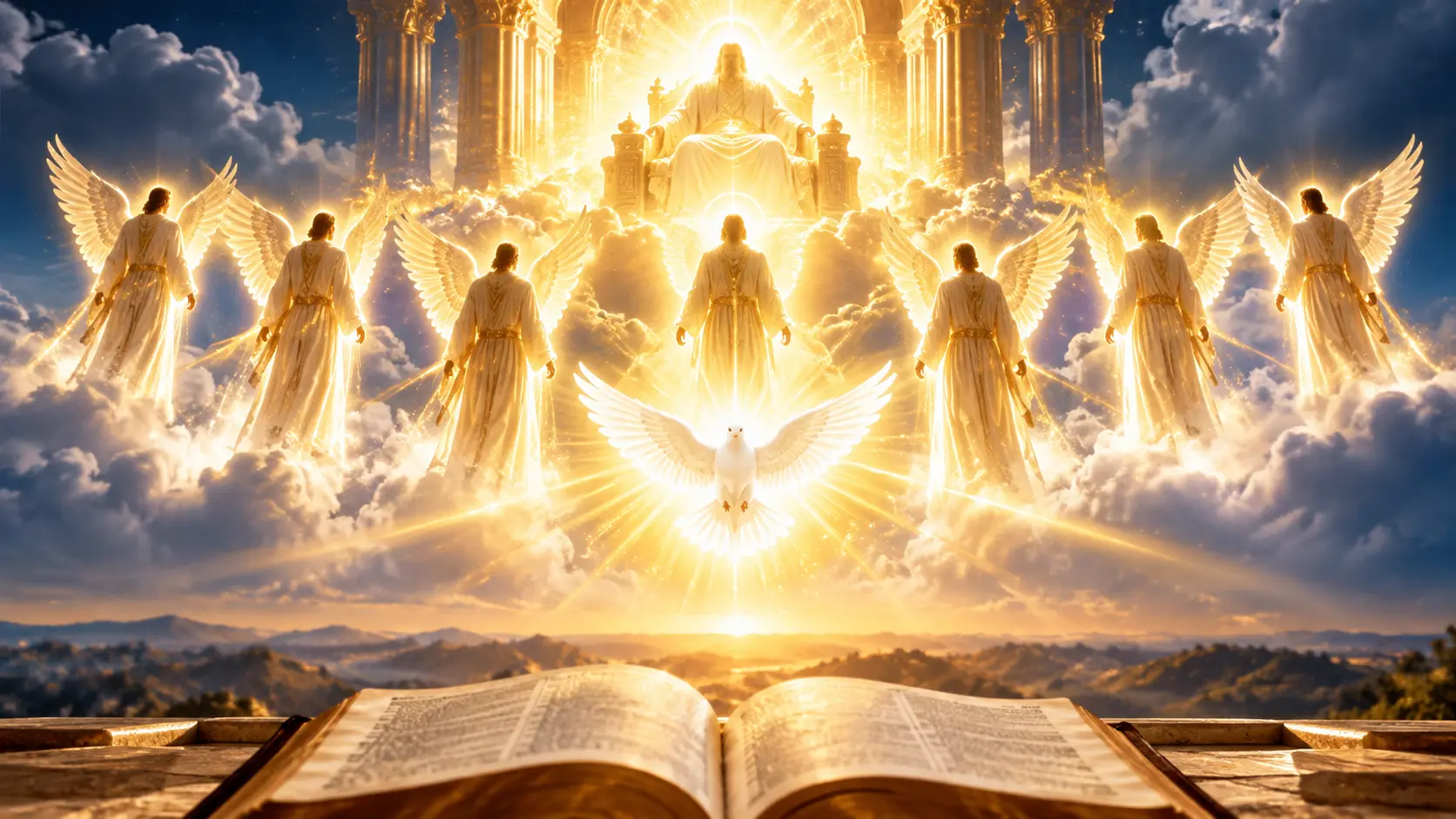

Revelation 1:4 contains one of the most unusual descriptions of God in the New Testament. John addresses seven churches in Asia, offers them grace and peace, describes God as the One who exists eternally and refers to seven spirits before His throne. Although the verse appears to be a customary greeting, its language introduces important questions about God’s identity and the heavenly imagery found throughout Revelation.
Two details make this verse especially interesting. John’s description of God has a distinctive connection to the divine name revealed in Exodus, while the identity of the seven spirits has been debated among Christian interpreters for centuries. Understanding these details requires more than assigning symbolic meanings to individual words. We need to consider the original readers, the Greek wording and the other biblical passages that develop the same imagery.
What Does Revelation 1:4 Mean?
Revelation 1:4 introduces a greeting of grace and peace to seven historical Christian churches, coming from the eternal God and the seven spirits before His throne. The greeting continues in Revelation 1:5 by naming Jesus Christ, making both verses essential for understanding the complete message. John establishes from the beginning that the communities receiving Revelation are being addressed in relation to God’s heavenly authority.
The verse introduces four subjects that deserve careful attention:
- The seven churches in the Roman province of Asia.
- The meaning of grace and peace in John’s greeting.
- God’s identity as the One who exists eternally and is to come.
- The seven spirits before God’s throne.
These details are connected rather than being separate theological statements placed together without a clear purpose. John identifies the recipients of his message and then describes the divine source of the blessing offered to them. An important observation is that Revelation 1:4 and Revelation 1:5 form one continuous greeting, so reading verse 4 alone can obscure the significance of how John introduces God, the seven spirits and Jesus Christ.
Revelation 1:4 in the Bible
The King James Version of Revelation 1:4 begins with John addressing the seven churches and offering the familiar blessing, “Grace be unto you and peace, from him which is and which was and which is to come.” The verse then refers to seven spirits before God’s throne, introducing imagery that becomes more significant as the book develops.
The passage combines an ordinary letter greeting with language that is anything but ordinary. John identifies himself and the recipients, as a letter writer normally would but then describes the source of grace and peace through expressions associated with God’s eternal existence and heavenly court. This combination is characteristic of Revelation, a book that speaks to real communities while revealing a heavenly perspective on their circumstances.
To understand why John begins this way, we first need to identify the people receiving his message and consider what the greeting would have meant in their historical setting.
Who Were the Seven Churches in Revelation 1:4?
The seven churches were Christian congregations in the Roman province of Asia, located in what is now western Turkey. The word Asia in Revelation 1:4 does not refer to the entire modern continent but identifies a particular Roman administrative region where these communities existed.
Revelation 1:11 names the seven cities:
- Ephesus
- Smyrna
- Pergamum
- Thyatira
- Sardis
- Philadelphia
- Laodicea
These were genuine Christian communities, not imaginary churches created merely to represent different spiritual conditions. Their historical identities matter because Revelation was intended to be heard by people living in recognizable circumstances. The messages in chapters 2 and 3 reveal that these congregations did not all face the same difficulties, making the differences between them important for understanding John’s opening greeting.
Seven churches but seven different spiritual conditions
Consider three examples that demonstrate how different these congregations were. The church in Ephesus receives recognition for its perseverance and discernment, yet it is confronted about having abandoned its first love (Revelation 2:2–4). Its difficulties were not primarily described in terms of material poverty or external suffering but involved a serious problem within the community’s spiritual life.
The church in Smyrna, by contrast, is addressed in the midst of affliction and poverty. Its message includes encouragement to remain faithful through suffering (Revelation 2:8–11), presenting circumstances quite different from those described in Ephesus. The church in Laodicea receives an entirely different rebuke because it considers itself prosperous and secure, while Christ describes its spiritual condition as deeply inadequate (Revelation 3:14–17).
These examples show why the opening greeting cannot be reduced to a generic message for people experiencing persecution. Some churches were suffering, while others were compromising, becoming complacent, or failing to recognize their own condition. John’s greeting reaches all seven, offering grace and peace before their individual circumstances are discussed without removing the need for repentance, perseverance or obedience.
Why did John address exactly seven churches?
The number seven appears throughout Revelation in connection with churches, seals, trumpets, lamps and other important images. Because seven frequently carries associations of completeness in biblical literature, many commentators understand the selection of seven churches as having a representative significance. According to this interpretation, the historical congregations also illustrate spiritual conditions that can appear throughout the wider Christian church.
However, Revelation 1:4 does not explicitly explain why these particular communities were selected instead of others. We can confidently identify the churches as historical congregations and recognize the possible symbolic significance of their number but a specific theory about John’s selection should not be presented as an established fact.
Some systems of biblical interpretation treat the seven churches as seven successive periods of church history. This remains an interpretive approach rather than a chronology explicitly established by Revelation 1:4. The most secure starting point is therefore the historical audience John actually names, followed by a careful consideration of how the number seven functions elsewhere in the book.
Why Does John Begin With Grace and Peace?
It might seem surprising that a book containing visions of conflict, judgment and suffering begins with a familiar expression of blessing. However, grace and peace are common features of early Christian letters and Paul frequently uses similar language in passages such as Romans 1:7 and 1 Corinthians 1:3.
Grace refers to God’s favour and generosity, while peace carries a wider meaning than simply the absence of conflict. In biblical usage, peace can include reconciliation, well-being and a right relationship with God. These words would not have been unfamiliar to early Christians but the way John identifies their source gives the greeting its distinctive character.
John connects grace and peace with God’s eternal identity and heavenly throne, then continues the greeting through Jesus Christ in the following verse. This matters because the blessing is introduced before the churches receive the encouragement, correction and warnings that follow in chapters 2 and 3.
What Did Grace and Peace Mean to the Churches?
The meaning becomes clearer when we remember the differences between the seven congregations. Smyrna’s suffering was not the same problem as Laodicea’s self-satisfaction, while Ephesus needed a different correction from Sardis. Yet all these communities were addressed with the same opening blessing.
This does not suggest that their spiritual conditions were equally acceptable. Revelation 2 and 3 clearly distinguish faithful endurance from behaviour requiring repentance, showing that the greeting was not intended to overlook serious failures. Instead, it establishes the divine source of grace and peace before the churches are confronted with their particular responsibilities.
The greeting also helps explain why Revelation should not be read exclusively as a collection of predictions about the future. From the beginning, the book speaks to the relationship between God and His people, including the responsibilities that arise from that relationship.
What Does “Who Is, Was and Is to Come” Mean?
This expression describes God’s eternal identity but its wording deserves closer attention because John does not merely say that God has always existed and will continue to exist. Instead, he uses a distinctive three-part description emphasizing God’s present existence, His existence before the present and His coming. The expression appears again in Revelation 1:8, where God is identified as the Almighty.
For Christian readers, the description communicates that God’s identity is not dependent on the rise and fall of earthly powers. Human governments, institutions and generations exist within the changing circumstances of history, while John describes God in language that extends beyond those limitations. A closer examination of the original wording reveals that this description also has an important connection with an earlier biblical passage.
How Revelation 1:4 Connects to Exodus 3:14
In Exodus 3, Moses asks what he should say when the Israelites ask for the name of the God who sent him. God’s answer in Exodus 3:14 becomes one of the most important passages concerning the divine name in the Hebrew Bible, with the King James Version giving the familiar expression I AM THAT I AM.
When the Hebrew Scriptures were translated into Greek, the Greek version of Exodus 3:14 used language associated with God as the One who is. Revelation 1:4 contains a closely related expression, making the connection significant because Revelation repeatedly draws on the language and imagery of earlier biblical books.
John’s description of God can therefore be understood against the background of God’s self-revelation to Moses. This does not mean Revelation 1:4 repeats Exodus 3:14 word for word but it appears to develop an existing biblical way of speaking about God’s identity. Recognizing this connection gives readers a deeper understanding than simply defining the expression as a statement that God lives forever.
An unusual detail in the original Greek
There is an additional feature of Revelation 1:4 that English translations generally cannot reproduce naturally. In Greek, the preposition meaning from ordinarily requires the following noun or expression to appear in a particular grammatical form, called the genitive case. However, John uses a different form in the description of the eternal God, producing a construction that is grammatically unusual.
The NET Bible’s translation notes discuss the possibility that John deliberately preserved a recognizable divine title rather than changing its form to fit ordinary Greek grammar. This explanation is particularly interesting because it would suggest that preserving the divine description mattered more than following conventional sentence structure.
Not every grammatical question in Revelation can be settled with certainty, especially because the book contains other unusual linguistic constructions. Interpreters differ in how they explain these features and the grammatical evidence should not be treated as conclusive on its own. Nevertheless, the possible connection with Exodus makes this detail valuable for understanding how John’s language may reflect earlier descriptions of God.
The unusual wording may therefore communicate more than the idea that God exists forever. It may also preserve an intentional echo of how God identified Himself in Israel’s Scriptures, connecting the opening greeting of Revelation with a much older tradition of divine self-revelation.
Why Does John Describe God as “To Come”?
The final part of the description is particularly interesting because the Greek wording uses a form of a verb associated with coming. As a result, the expression does not simply describe future existence in the most ordinary way; it can also evoke the expectation of God’s coming or manifestation.
Within Revelation, this distinction is meaningful because the book repeatedly presents God as acting in history and bringing His purposes to fulfillment. His eternal identity is not described as passive existence detached from the world but in language that can also suggest His future action.
Nevertheless, Revelation 1:4 should not be isolated from its context and turned into a prediction about a particular modern event. The immediate emphasis is on God’s identity as the source of the greeting offered to the churches. The One from whom they receive grace and peace is not a temporary earthly authority but the eternal God whose existence and purposes extend beyond their present circumstances.
What Are the Seven Spirits of God?
The identity of the seven spirits is probably the most difficult interpretive question in Revelation 1:4. John refers to seven spirits before God’s throne, and later passages mention them again using imagery involving lamps, eyes and activity throughout the earth. These descriptions have led interpreters to ask whether John means the fullness of the Holy Spirit, seven heavenly beings or another symbolic presentation of divine activity.
Revelation 1:4 does not explicitly identify the seven spirits in a way that eliminates every interpretive disagreement. Although certain explanations have become familiar within Christian traditions, a careful reading requires examining the evidence supporting them. Two major interpretations have received particular attention in Christian commentary, while a third approach explores the relationship between divine spiritual activity and angelic imagery.
Interpretation 1: The Fullness of the Holy Spirit
A widely held Christian interpretation understands the seven spirits as symbolic language for the one Holy Spirit. According to this reading, the number seven communicates completeness rather than referring to seven separate divine persons. Supporters of this explanation point to the importance of seven throughout Revelation and the structure of John’s opening greeting.
Revelation 1:4–5 mentions God, the seven spirits, and Jesus Christ within a continuous blessing. Many Christian interpreters understand this arrangement in relation to the Father, the Holy Spirit and the Son, making the seven spirits a symbolic description of the Spirit’s fullness.
Later passages provide additional support for this reading. Revelation 4:5 connects the seven spirits with seven lamps burning before God’s throne, while Revelation 5:6 associates them with the seven eyes of the Lamb, described as being sent throughout the earth. These images have encouraged interpreters to understand the seven spirits as a representation of the Holy Spirit’s complete presence and activity.
Does Isaiah 11:2 explain the seven spirits?
Isaiah 11:2 is frequently mentioned in connection with the interpretation that the seven spirits represent the Holy Spirit’s fullness. The passage describes the Spirit resting upon the promised ruler from Jesse’s line, using language associated with wisdom, understanding, counsel, might, knowledge and the fear of the Lord.
Some Christian traditions connect this description with sevenfold Spirit imagery, particularly through the wording of the ancient Greek translation. The association has a long interpretive history and forms part of the theological background commonly discussed in relation to Revelation 1:4.
However, Isaiah 11:2 does not explicitly state that it is explaining the seven spirits mentioned in Revelation. The passage provides a possible biblical background for the interpretation rather than a direct identification that settles the question beyond dispute. Recognizing that distinction allows readers to appreciate the connection without confusing an interpretation with an explicit statement of Scripture.
Interpretation 2: Seven Heavenly Angels
Another interpretation understands the seven spirits as a group of exalted heavenly beings associated with God’s throne. This explanation draws on the wider background of Jewish apocalyptic literature, where heavenly messengers and attendants sometimes appear in descriptions of God’s divine court.
Ancient Jewish writings occasionally describe distinguished angels who stand in God’s presence and carry out divine assignments. One especially relevant example appears in Tobit 12:15, where Raphael identifies himself as one of seven angels who stand before God’s glory.
Tobit belongs to the Catholic and Orthodox biblical traditions but is generally classified among the Apocrypha by Protestants. Its relevance to Revelation 1:4 is historical and literary because it demonstrates that the idea of seven angels standing before God existed within ancient Jewish religious literature.
This provides a meaningful comparison with John’s reference to seven spirits before the throne. Although the wording does not prove that the same heavenly beings are intended, it helps explain why some scholars understand the phrase as referring to an angelic group rather than the Holy Spirit.
Why do some scholars favor the angelic interpretation?
The location of the seven spirits is an important part of the argument. They are described as being before God’s throne, a setting associated elsewhere in biblical and Jewish literature with heavenly attendants. Scholars who favor this reading therefore consider the historical background of the imagery rather than interpreting the expression solely through later Christian theological categories.
In a 2025 research article examining the seven spirits of Revelation, biblical scholar David A. deSilva argued that the interpretation involving heavenly angels deserves more serious consideration than it often receives. His argument challenges the tendency to assume that the seven spirits must represent the Holy Spirit simply because the greeting can be understood through Trinitarian theology.
This does not establish the angelic interpretation as certain, nor does it mean that the traditional Christian explanation lacks evidence. Instead, the scholarly discussion shows that the question involves the literary background of Revelation, the structure of the greeting, and the way John uses heavenly imagery.
What is the difficulty with the angelic interpretation?
One major difficulty arises from the structure of John’s greeting. Revelation 1:4–5 identifies grace and peace as coming from the eternal God, the seven spirits, and Jesus Christ, placing all three references within a coordinated blessing.
If the seven spirits are angels, interpreters must explain why heavenly creatures appear in such a prominent position within a greeting associated with divine blessing. Supporters of the Holy Spirit interpretation regard this as an important argument in their favour because it allows the three references to be understood in relation to the Father, Spirit, and Son.
Those who prefer the angelic reading must account for the literary and theological framework that would permit heavenly beings to occupy this position. This difficulty does not automatically disprove their interpretation, but it demonstrates why the question can not be answered simply by identifying similar angelic imagery elsewhere.
Interpretation 3: The Holy Spirit in Angelic Imagery
Recent scholarship has also explored an approach that does not fit neatly into the first two categories. Sometimes described as angelomorphic pneumatology, this interpretation considers whether the one Spirit of God is being portrayed through forms of angelic imagery.
The idea is not necessarily that the Holy Spirit is simply an angel. Instead, the approach investigates how ancient religious texts could describe divine spiritual activity using imagery associated with heavenly messengers and God’s celestial court.
In a 2026 scholarly study, Simon Johansson examined the Holy Spirit interpretation, the seven-angels interpretation, and this third approach. His work illustrates why the historical background of Revelation’s language continues to attract scholarly attention, particularly when the imagery does not fit easily into categories familiar to modern readers.
The debate is therefore not limited to whether the number seven should be understood literally or symbolically. It also concerns how John uses the language of God’s heavenly court and how that language relates to broader Jewish and early Christian traditions.
Which interpretation is most convincing?
For readers approaching Revelation through traditional Christian theology, the sevenfold fullness of the Holy Spirit remains a familiar and substantial interpretation. It has important support from the structure of the greeting and the later symbolism of Revelation, especially the references to the spirits in relation to the Lamb and God’s throne.
However, the angelic interpretation also has meaningful historical evidence, particularly when the description is compared with ancient Jewish accounts of heavenly beings standing before God. The third approach adds another dimension by considering whether spiritual and angelic imagery could overlap within the religious language available to John.
The most responsible conclusion is that Revelation 1:4 identifies seven spirits before God’s throne but does not explicitly resolve their precise identity. Christian readers can examine the evidence for the Holy Spirit interpretation without pretending that every scholar agrees, just as recognizing the angelic interpretation does not require abandoning Christian beliefs about the Holy Spirit. Understanding the difference between what the passage states and how interpreters explain it makes the study more accurate and meaningful.
How Revelation 1:4 Connects to Revelation 4:5 and 5:6
One of the best ways to understand an unfamiliar expression in Revelation is to examine how the book uses it elsewhere. The seven spirits appear in four important passages and their descriptions develop through imagery involving God’s throne, Jesus Christ, burning lamps, and the Lamb.
- Revelation 1:4: The seven spirits are mentioned before God’s throne in John’s opening greeting.
- Revelation 3:1: Jesus describes Himself as possessing the seven spirits of God and the seven stars.
- Revelation 4:5: Seven burning lamps before the throne are identified with the seven spirits of God.
- Revelation 5:6: The Lamb’s seven eyes are identified with the seven spirits of God sent throughout the earth.
Taken together, these references show that the seven spirits are not an isolated expression introduced only in the opening greeting. They appear before the throne, are associated with Christ, are represented by burning lamps and are connected with activity extending across the world.
The development of this imagery is important because it provides a wider biblical context for evaluating the different interpretations. Rather than deciding what the seven spirits represent from Revelation 1:4 alone, readers can examine how later passages expand the description and connect it with other biblical symbols.
Why is Zechariah 4 especially relevant?
The imagery of Revelation 5:6 bears a notable resemblance to Zechariah 4:10, where the Lord’s seven eyes are described as ranging throughout the earth. Revelation similarly describes seven eyes associated with the Lamb and identifies them with the seven spirits of God sent into the world.
This connection matters because Zechariah 4 also contains a vision involving a lampstand. Revelation’s references to lamps and eyes therefore have identifiable connections with earlier prophetic imagery, suggesting that John is drawing upon symbols already present in Israel’s Scriptures.
Rather than treating every image in Revelation as something entirely new, readers should consider how John adapts familiar biblical language. The relationship with Zechariah does not settle every disagreement about the identity of the seven spirits, but it helps explain why lamps, eyes, and divine activity appear together.
Why Are the Seven Spirits Mentioned Between God and Jesus?
This detail becomes apparent when Revelation 1:4 and 1:5 are read together rather than as independent statements. The greeting identifies three sources through the repeated use of the word from, beginning with the eternal God, proceeding to the seven spirits before His throne and continuing with Jesus Christ.
This arrangement is one reason the passage has been important in Christian theological discussions. Readers who understand the seven spirits as the Holy Spirit see a greeting that can be interpreted in relation to the Father, Spirit and Son, an understanding that fits within traditional Trinitarian theology.
However, the passage itself does not pause to explain the relationship between the three references. Its immediate purpose is to introduce the divine source of grace and peace, while the precise identification of the seven spirits remains a subject of interpretation.
The order is also worth observing because Jesus Christ appears after the seven spirits rather than immediately following the description of the eternal God. John then develops the greeting into a description of Jesus as the faithful witness, the firstborn from the dead and the ruler of earthly kings.
This transition gives verse 5 its own emphasis. Readers interested in those titles can examine our separate explanation of Revelation 1:5, where the focus moves from the opening greeting to the identity and work of Jesus Christ.
What Does God’s Throne Symbolize in Revelation 1:4?
The throne is one of Revelation’s central images of divine authority, and John mentions it here before presenting the fuller heavenly vision of Revelation 4. This is meaningful because the opening greeting introduces a heavenly setting while addressing Christian communities living within the Roman world.
The seven churches existed under earthly institutions and faced practical questions about faithfulness, worship and community life. Yet John’s greeting places their message in relation to God’s throne, introducing a contrast between heavenly authority and earthly circumstances that becomes increasingly important throughout Revelation.
This does not require the throne to be interpreted as a symbol of a particular modern government or geographical location. Its immediate significance lies in the identity and authority of the One associated with it, while the heavenly setting also provides context for understanding the seven spirits.
Their position before the throne is not an incidental detail. It connects them with the divine presence and heavenly imagery that Revelation describes more fully in later chapters, regardless of which interpretation of their identity a reader ultimately finds most convincing.
How Did Early Christians Understand Revelation 1:4?
We cannot recover every thought of the original recipients and Revelation does not provide a record of their individual reactions to John’s greeting. We can, however, identify several features of the passage that would have been relevant to Christians living in the Roman province of Asia.
These readers would have recognized the cities named in Revelation 1:11 and belonged to communities whose spiritual conditions would later be addressed. They were also receiving a work that combined recognizable features of a letter with prophetic and visionary material, making its opening both familiar and distinctive.
Grace and peace belonged to the vocabulary of early Christian communication, so the basic form of the greeting would not have been entirely unexpected. At the same time, the description of the eternal God and the reference to the heavenly throne introduced a much larger theological setting.
For readers familiar with Israel’s Scriptures, the language could recall earlier descriptions of God’s identity and heavenly authority. The later messages to the churches would then connect those theological realities with specific responsibilities.
For example, the instruction to remain faithful in suffering would have immediate relevance for Smyrna, while the call to repentance would confront communities whose conduct or spiritual condition required correction. The opening greeting thus provides a theological foundation for messages addressing genuinely different situations.
Understanding Revelation 1:4 in this historical setting helps prevent two common mistakes. The first is treating the verse as though it were written only for modern speculation about future events, while the second is reading it as a purely abstract theological statement with no connection to the people who first received it.
John’s greeting belongs to a real communication addressed to identifiable Christian communities. Its meaning becomes clearer when the historical audience, the wording of the passage and the wider message of Revelation are considered together.
Lessons From Revelation 1:4 for Christians Today
Revelation 1:4 offers more than an opportunity to study ancient symbols because it also provides a way to think carefully about the relationship between God’s identity and the circumstances of His people. The seven churches were not identical in their conduct or experiences, yet John’s greeting begins by identifying the eternal God and the heavenly source of grace and peace.
Some of these communities displayed perseverance, while others needed serious correction. Their differences remind modern readers that difficult circumstances and spiritual faithfulness are not always the same thing, just as material prosperity does not necessarily indicate spiritual health.
For contemporary Christians, the verse suggests that spiritual confidence should not depend entirely on favourable circumstances. However, this should not be misunderstood as a promise that believers will avoid suffering, since Revelation itself contains repeated warnings about hardship and the need for endurance.
A more grounded application is to recognize that the knowledge of God’s enduring identity should influence how believers respond to uncertainty, difficulty and responsibility. John’s greeting encourages attention to the God who addresses the churches rather than making their temporary circumstances the sole measure of their spiritual condition.
There is also a valuable lesson in the interpretive challenges surrounding the seven spirits. Not every biblical expression can be explained responsibly through one familiar statement and careful study sometimes requires comparing passages, considering historical background, and acknowledging genuine scholarly disagreement.
Such uncertainty need not diminish a reader’s appreciation of Scripture. Instead, it can encourage a more attentive approach that distinguishes the actual wording of the text from the conclusions people draw about it.
How to Study Revelation 1:4 in Context
A useful study of this verse should move through several related passages rather than relying on Revelation 1:4 alone. Begin with Revelation 1:1–5 to understand the introduction, blessing and complete greeting, then continue with Revelation 1:11 to identify the seven churches receiving John’s message.
Reading Revelation 2–3 provides the historical and spiritual context for the individual congregations. The differences between their messages help explain why the opening blessing was addressed to communities experiencing varied circumstances.
Next, compare Exodus 3:14 with the description of God’s identity in Revelation 1:4 and Revelation 1:8. This comparison helps readers recognize the relationship between John’s unusual language and the earlier biblical account of God’s self-revelation to Moses.
The next step is to examine Revelation 3:1, 4:5, and 5:6, where the seven spirits appear again through additional imagery. Finally, consider Zechariah 4, particularly its references to the lampstand and the Lord’s seven eyes, to understand the prophetic background of some of Revelation’s descriptions.
Studying these passages together reveals connections that may remain hidden when a verse is examined in isolation. It also provides a stronger foundation for evaluating interpretations that initially sound convincing but depend on only one part of the biblical evidence.
Final Understanding of Revelation 1:4
Revelation 1:4 begins as a greeting, but its language introduces questions that reach into the historical setting of early Christianity, the identity of God, and the symbolism of Revelation’s heavenly visions. The seven churches remind us that the book was written to actual communities, while the description of the eternal God connects John’s message with the earlier Scriptures. The reference to the seven spirits introduces a theological question that requires careful attention to both Revelation and its wider religious background.
Perhaps the most important detail is the connection between these subjects. John does not introduce the churches independently of God, nor does he describe divine authority without addressing the people who must live faithfully under it. The greeting brings these two concerns together by identifying the recipients of the message and the heavenly source of the grace and peace offered to them.
For readers studying Revelation today, this provides a useful place to begin: with the historical audience, the actual wording of Scripture and an awareness of which conclusions the text clearly supports and which remain open to interpretation. Such an approach makes it possible to appreciate the verse’s theological significance without losing sight of the real Christian communities to whom it was originally addressed.
Sources and Further Reading
Biblical passages: Revelation 1:1–11; Revelation 2–3; Revelation 4:5; Revelation 5:6; Exodus 3:14; Isaiah 11:2; Zechariah 4; Tobit 12:15. These passages provide the primary biblical context for understanding John’s greeting, the seven churches, God’s eternal identity and the imagery associated with the seven spirits.
NET Bible translation notes, Revelation 1:4: These notes discuss the Roman province of Asia, the unusual construction of the original Greek and the possible connection with Exodus 3:14. They provide useful linguistic background for understanding why John’s description of God differs from an ordinary statement about eternal existence.
David A. deSilva (2025): The Seven Spirits of God: The Holy Spirit or the Angels of the Presence. This scholarly examination considers the principal interpretations of the seven spirits and the evidence for understanding them in relation to heavenly angels.
Simon Johansson (2026): The Mysterious Identity of the Seven Spirits of God in the Book of Revelation: An Exploration of Interpretations. This study examines the Holy Spirit, angelic and angelomorphic approaches, illustrating the continuing scholarly discussion surrounding one of Revelation’s most intriguing expressions.
Frequently Asked Questions
Who wrote Revelation 1:4, and who was it written for?
The Book of Revelation identifies its writer as John, who addresses seven historical Christian congregations in Asia Minor. Christian tradition has commonly identified this John with the apostle John, although the author’s precise identity remains debated among scholars. The original recipients were churches in Ephesus, Smyrna, Pergamum, Thyatira, Sardis, Philadelphia and Laodicea, whose different spiritual circumstances are discussed in Revelation chapters 2 and 3.
What are the seven spirits mentioned in Revelation 1:4?
The seven spirits are mentioned before God’s throne, but the verse does not explicitly explain their identity. Many Christian interpreters understand them as a symbolic description of the fullness of the Holy Spirit, while others interpret them as seven exalted heavenly beings. The discussion becomes more meaningful when Revelation 1:4 is compared with Revelation 3:1, 4:5 and 5:6, where the seven spirits appear in additional heavenly imagery.
Are the seven spirits in Revelation 1:4 the Holy Spirit?
The interpretation that the seven spirits represent the Holy Spirit is prominent in traditional Christian theology. It understands the number seven as expressing completeness rather than referring to seven separate Holy Spirits. However, some scholars favor an interpretation involving heavenly angels, drawing on ancient Jewish religious literature. Because Revelation does not explicitly settle the question, readers should distinguish the biblical wording from the interpretations developed around it.
