
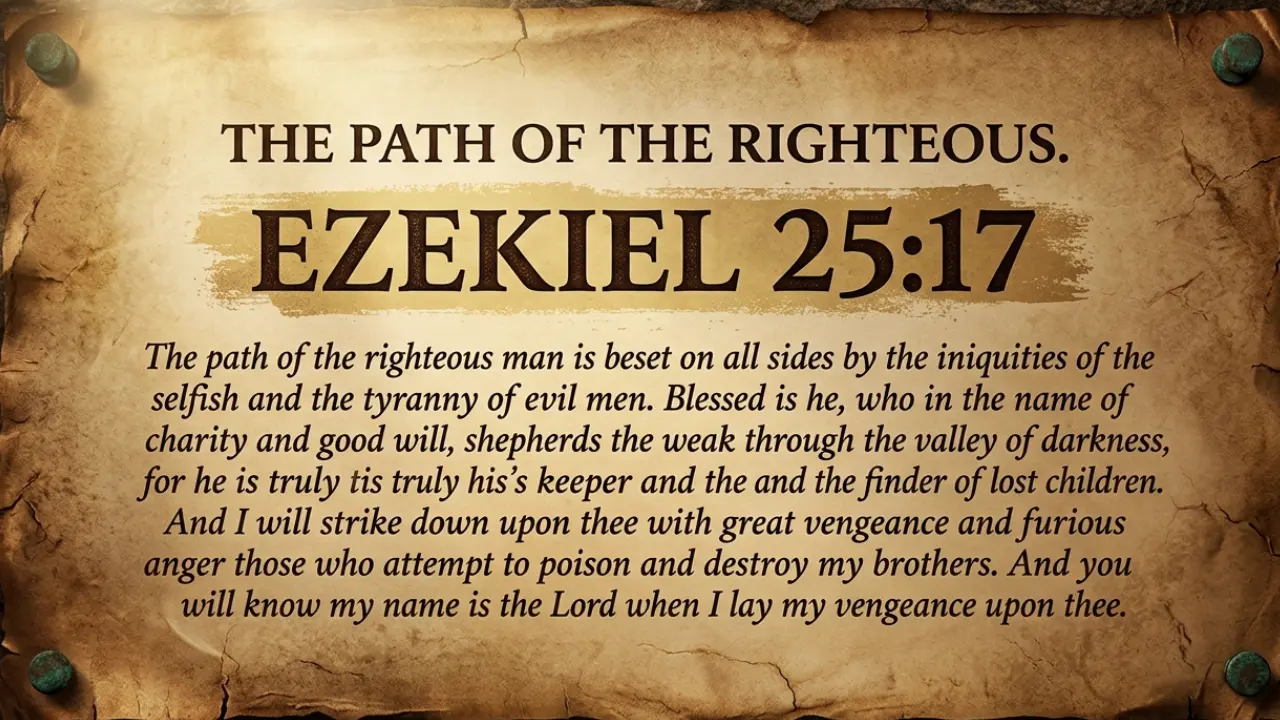

Ezekiel 25:17 means that God would bring judgment on His enemies in a way that revealed His justice, holiness, and authority. The verse is not about uncontrolled anger or personal revenge; it shows divine vengeance as God’s righteous response to violence, hostility and rebellion.
When God says, “they shall know that I am the Lord,” the meaning is that judgment would force the nations to recognize His power and covenant authority. Ezekiel 25:17 is about justice that exposes evil, vengeance that belongs to God, and judgment that reveals who the Lord truly is.
Ezekiel 25:17 in Context
When people hear the words of Ezekiel 25:17, they generally do not picture an ancient Middle Eastern prophet. Instead, they picture Samuel L. Jackson in the film Pulp Fiction. The director Quentin Tarantino created a highly stylized, mostly fictionalized version of this verse that became a permanent fixture in modern pop culture. However, when an individual removes the cinematic flair and examines the actual scripture, the authentic biblical setting reveals a completely different story.
Ezekiel 25:17 is not a broad, generalized endorsement of personal revenge. It is the conclusion of a specific legal sentence passed down by God against a historic enemy of Israel: the Philistines.
The Historical Setting
To comprehend the intense tone of this passage, one must look at its location within the Book of Ezekiel. The prophet Ezekiel wrote these words during the Babylonian Captivity, a bleak period around 590 Before the Common Era. Jerusalem had fallen and the citizens of Judah were exiled and broken.
Instead of offering sympathy or remaining neutral, the neighbouring nations celebrated the downfall of Israel. Chapters 25 through 32 of Ezekiel function like a courtroom log, where God pronounces judgments on these hostile neighbours. The list includes Ammon, Moab, Edom and ultimately, Philistia.
Why the Philistines?
The Philistines were among the most relentless adversaries of Israel. Their conflict spanned centuries, dating back to the time of the Judges and King David. Ezekiel emphasizes that their actions were not a standard wartime dispute. Their behaviour was driven by ancient hostility and malice. They viewed the vulnerability of Judah during the Babylonian invasion as a perfect opportunity to satisfy old grudges and attempt total destruction.
Also Read: Israel Iran War in Biblical Prophecy
What Ezekiel 25:17 Actually Says
Before diving into the deep theological meaning of this passage, it is essential to look directly at the text itself. Ezekiel 25:17 is relatively brief but it is packed with intense language. When you look closely at the structure of the verse, you can break it down into three distinct movements: divine vengeance, furious rebuke and ultimate recognition.
First Movement: Vengeance
The verse begins with a promise of action: “I will carry out great vengeance on them…” This first movement establishes that God is stepping into human history to address a wrong. It serves as the formal announcement of the sentence. The Philistines had spent generations inflicting malicious harm on Judah and this opening movement confirms that their actions have consequences that they can no longer avoid.
Second Movement: Rebuke
The text then moves to the method of this judgment: “…and punish them in my wrath,” which is alternatively translated in many historical texts as “furious rebukes.” This second movement shows that God does not punish blindly or in silence. A rebuke is a corrective exposure of sin. God is not merely striking back; He is explicitly telling the offending nation exactly why they are facing judgment and highlighting the gravity of their cruelty.
Third Movement: Knowing the Lord
The final movement is the climax of the entire verse: “‘Then they will know that I am the Lord, when I take vengeance on them.’” This shift is vital. The passage does not end with a declaration of destruction but rather with a declaration of awareness. The ultimate destination of this biblical movement is not a graveyard but a profound moment of realization where a rebellious nation finally acknowledges the true King of the universe.
“Great Vengeance” Means God’s Righteous Judgment
In modern English, the word vengeance carries a highly negative connotation. It typically evokes images of petty retaliation, spiteful grudges and people taking the law into their own hands. Because of this contemporary definition, a surface-level reading of Ezekiel 25:17 can make God appear vindictive or needlessly cruel. However, the biblical concept of divine vengeance is fundamentally different from human revenge.
When the text states that God will execute great vengeance, it is describing the fullfillment of absolute, righteous justice.
Human Revenge Versus Divine Vengeance
To understand this distinction, one must look at the Hebrew word used for vengeance in the Old Testament, which is naqam. Human revenge is almost always emotional, unbalanced and deeply flawed. It is driven by anger and a desire to make someone else suffer.
Conversely, divine vengeance is an act of restoration. It is the rightful response of a holy God who must uphold moral order in the universe. When God acts in vengeance, He is acting as a righteous judge who steps in to defend the helpless and right a terrible wrong. The Philistines had spent centuries inflicting cruelties upon others; therefore, the great vengeance mentioned here is simply the direct consequence of their own violent choices.
The Standard of the Covenant
This judgment is also directly tied to the concept of covenant law. In the ancient Near East, kings made binding legal agreements with their people. God had a covenant with Israel, which included a promise to protect them from total annihilation by hostile neighbours.
When neighbouring countries sought to wipe out Judah, they were not just attacking a nation. They were defying the cosmic order established by God. The execution of great vengeance was a necessary legal intervention to demonstrate that wickedness does not have the final word. It was a declaration that the sovereign ruler of the universe will always hold nations accountable for cruelty and oppression.
Also Read: 7 Key Elements of Salvation Every Christian Should Know
“Furious Rebukes” Shows the Seriousness of Evil
The phrase “furious rebukes” can easily startle a modern reader. It sounds terrifying, and it is easy to misinterpret the phrase as a depiction of uncontrolled, chaotic rage. However, within the biblical framework, this description has nothing to do with a human temper tantrum. Instead, it demonstrates the absolute seriousness of evil.
Holy Judgment Versus Uncontrolled Anger
Human anger is often erratic and unpredictable but divine fury is completely steady and judicial. When the Bible uses terms like “furious rebukes,” it is describing a measured, righteous opposition to sin. Think of it as the intense intolerance that a good judge feels toward systemic injustice. God cannot remain neutral or indifferent when the vulnerable are abused. If God did not react with intensity against malice and destruction, He would not be a good or loving God.
“They Shall Know That I Am the Lord”
It is incredibly easy to focus exclusively on the frightening elements of Ezekiel 25:17. The vocabulary of vengeance and fury tends to dominate the conversation. However, the most important part of the verse occurs at the very end. The final purpose of the entire passage is found in the declaration: “Then they will know that I am the Lord.”
Revelation Over Punishment
This conclusion reveals that the ultimate objective of divine discipline is revelation, not merely punishment. God does not take pleasure in destruction for its own sake. If the goal were purely vindictive, the verse would end with the elimination of the enemy. Instead, it ends with their education. The ultimate desire of God throughout the entire book of Ezekiel is for all people—both Israel and the surrounding nations—to clearly perceive His identity, His holiness and His sovereignty.
God’s Justice in Ezekiel 25:17 Is Not Human Revenge
Because of popular culture, many individuals mistakenly use Ezekiel 25:17 as a slogan for personal retaliation. They view it as a dramatic green light to take matters into their own hands when they face mistreatment. However, the exact opposite is true. When a person genuinely understands that ultimate vengeance belongs solely to a holy God, it should completely eliminate the desire for private revenge.
The New Testament Balance
This is where the New Testament provides a crucial balance to the Old Testament narrative. The principle of divine justice does not change between the testaments but the human application is made explicitly clear. The apostle Paul addresses this exact dynamic in his letter to the Romans, drawing directly from the laws of the Old Testament to show who holds the right to execute cosmic justice.
Romans 12:19 (NIV):
“Do not take revenge, my dear friends, but leave room for God’s wrath, for it is written: ‘It is mine to avenge; I will repay,’ says the Lord.”
Why Human Revenge Fails
By placing Ezekiel 25:17 alongside Romans 12:19, the biblical message becomes perfectly clear. Human beings are fundamentally incapable of executing pure justice. When humans lash out in anger, their motives are almost always corrupted by selfishness, pride, hurt feelings and incomplete information. Human retaliation rarely solves a problem; instead, it usually creates a cyclical chain reaction of more chaos, bitterness, and pain.
God reserves vengeance for Himself because only an all-knowing, flawless Creator can administer consequences without being stained by malice. God sees the entire timeline of history, understands the hidden motives of every heart and weighs actions with absolute accuracy.
Laying the Desire for Revenge to Rest
Therefore, rather than using Ezekiel 25:17 as a battle cry for personal vendettas, readers should view this text as a profound reason to lay their weapons down. This scriptural truth should kill the urge to seek private retaliation. It brings immense peace to realize that you do not have to settle every score, right every wrong or punish every enemy through your own power. You can release your grievances and leave room for God, trusting that the true Judge of the universe will always ensure that genuine justice prevails in the end.
What Ezekiel 25:17 Means for the Wronged Person
It is easy to analyse Ezekiel 25:17 from a purely intellectual or historical perspective. However, scripture is also meant to address human emotion and lived experience. For an individual who carries the heavy weight of mistreatment, betrayal, or injustice, this passage offers a surprisingly deep sense of comfort. It speaks directly to the person who is currently tempted toward bitterness or consumed by the pain of a wound that has not healed.
Acknowledging the Pain of Injustice
When you are wronged, the natural human response is a mixture of grief and anger. Too often, well-meaning people tell victims to simply forget what happened or move on as if the offense did not matter. Ezekiel 25:17 demonstrates that God does not dismiss human suffering.
The fierce vocabulary of this passage proves that God takes injustice seriously. He does not look away from malice, nor does He minimize the pain inflicted by the cruel choices of others. To the person who feels invisible or forgotten in their suffering, this verse declares that the Creator of the universe sees the wrong, labels it accurately, and cares deeply about the violation of moral boundaries.
Overcoming the Temptation of Bitterness
When justice is delayed, bitterness easily takes root in the human heart. Bitterness is a toxic emotional state that promises to protect an individual but ultimately destroys them from the inside out. People often cling to their anger because they fear that letting go means the offender gets away with their behaviour.
Ezekiel 25:17 provides the ultimate antidote to this spiritual poison. It reminds the wronged person that accountability is certain. You can safely release the burning desire to make an offender suffer, because accountability is already securely in the hands of God. Letting go of bitterness is not an act of weakness; it is an act of profound trust. It means transferring the case from your flawed, limited courtroom into the flawless courtroom of a sovereign God.
Peace in True Liberation
Ultimately, this realization offers true liberation. It frees the victim from being perpetually bound to the person who hurt them. You do not need to spend your emotional energy waiting for an apology that may never arrive, nor do you need to plot a way to even the score. The heavy imagery of divine judgment means you can rest. You are permitted to heal, to breathe and to live in peace, confident that the wrongs of history are fully accounted for by a loving and righteous Judge.
Related Posts You May Want to Read Next
Frequently Asked Questions
Is Ezekiel 25:17 about personal revenge?
No. Ezekiel 25:17 speaks about God’s vengeance, not human revenge. The verse is about divine justice, not personal retaliation.
Who is Ezekiel 25:17 talking about?
The verse speaks about the Philistines, who were enemies of Israel and acted with long-standing hatred and revenge.
Why does Ezekiel 25:17 sound so harsh?
It sounds harsh because it is a judgment verse. It shows that God does not ignore violence, pride and hatred forever.
Does Ezekiel 25:17 teach that God is angry?
Yes, but in a righteous sense. The verse shows God’s holy anger against evil, not sinful or uncontrolled anger.
Is Ezekiel 25:17 often misunderstood?
Yes. Many people quote it as if it supports personal vengeance but the verse actually teaches divine justice.

This section of the bible is trending because some people in the US are using it to justify a war they cannot explain. To do otherwise would be to say their leader is the Messiah. Scary stuff.