
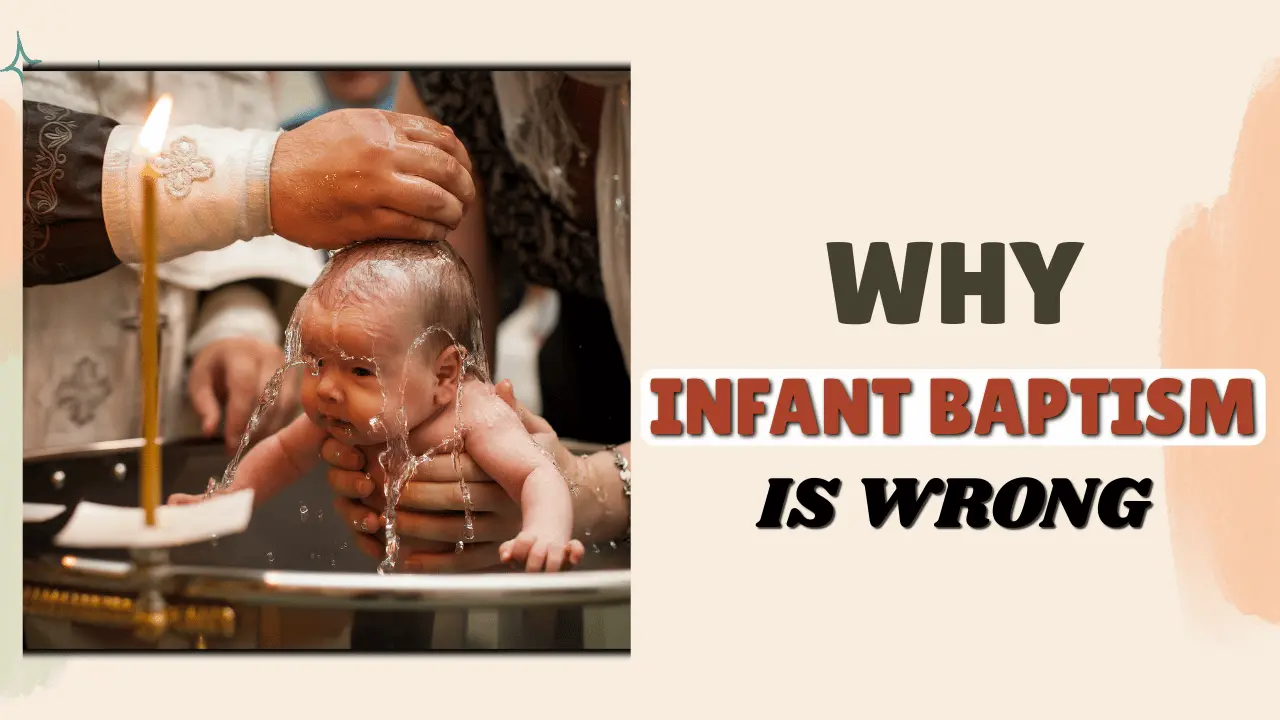

Why infant baptism is wrong, according to Christians who support believer’s baptism, comes down to the biblical order of faith and baptism. The New Testament repeatedly connects baptism with hearing the gospel, repenting, believing in Jesus and consciously becoming His disciple.
No New Testament passage directly commands churches to baptize infants, and no passage clearly states that an infant received Christian baptism. Supporters of infant baptism build their position from covenant theology, household baptisms, church tradition and passages about believers’ children.
Those arguments deserve a fair examination. However, Christians who reject infant baptism believe they do not outweigh the clearer examples of baptism following a personal response to Christ.
Why Do Some Christians Believe Infant Baptism Is Wrong?
Christians who reject infant baptism believe that baptism should belong to people who personally profess faith in Jesus.
Baptism represents repentance, identification with Christ, spiritual renewal and entrance into a life of discipleship. An infant can receive love, prayer, teaching and care from a Christian family, but an infant cannot yet consciously understand the gospel or make a credible profession of faith.
The objection is not that children are unimportant to God. The objection concerns what baptism means and who the New Testament presents as its proper recipient.
Understanding the broader biblical meaning of baptism helps explain why many churches reserve it for professing believers.
Does the Bible Place Faith Before Baptism?
The clearest New Testament conversion accounts normally place a personal response to the gospel before baptism.
In Acts 2:38, Peter told his hearers to repent and be baptized. Acts 2:41 says that those who accepted his message received baptism.
Acts 8:12 records that men and women in Samaria believed Philip’s preaching about the kingdom of God and Jesus Christ before they were baptized. Later in the chapter, the Ethiopian official heard the gospel about Jesus and then requested baptism.
In Acts 10, Cornelius and those gathered with him heard Peter’s message and received the Holy Spirit before they received water baptism.
Acts 18:8 says that many Corinthians heard the message, believed and were baptized.
These examples do not establish adulthood as a requirement. Scripture gives no minimum numerical age for baptism. A younger person may be ready when that person understands the gospel and genuinely professes faith.
The issue is not age alone. The issue is whether baptism follows the recipient’s personal response to Christ.
Does Matthew 28 Support Believer’s Baptism?
In Matthew 28:19–20, Jesus commanded His followers to make disciples of all nations, baptize them, and teach them to obey everything He commanded.
Believer’s-baptism Christians see baptism as part of the process of making disciples. The recipients are not merely present within Christian families. They become followers of Jesus who receive instruction and learn obedience.
Matthew 28 does not directly discuss infants or establish a detailed order for every conversion. However, it closely connects baptism with discipleship and teaching.
This connection supports the view that the person receiving baptism should knowingly enter a life of following Christ.
The command also shows why baptism should never be dismissed as an optional tradition. The question is not whether baptism matters, but why Jesus commanded baptism and who should receive it.
Is Infant Baptism Commanded Anywhere in the Bible?
The New Testament contains no explicit command telling Christian parents to baptize their babies.
It also contains no account that specifically identifies an infant as receiving baptism.
Supporters of infant baptism do not usually deny this absence. Instead, they argue that infant baptism follows logically from other biblical teachings, including:
- God’s covenant promises to believers and their children
- The relationship between circumcision and baptism
- The baptism of entire households
- Peter’s words in Acts 2:39
- The “holy” status of believers’ children in 1 Corinthians 7:14
- Jesus welcoming and blessing young children
Christians who reject infant baptism believe a practice this important should rest on a direct command or a clear apostolic example. They do not believe theological inference should override the repeated connection between baptism and personal faith.
Do Household Baptisms Prove That Babies Were Baptized?
The New Testament mentions the baptism of Lydia’s household, the Philippian jailer’s household, the household of Crispus and the household of Stephanas.
Supporters of infant baptism argue that households in the ancient world could include children and infants. They believe it is reasonable to assume that some household baptisms included babies.
However, none of these accounts states that an infant was present.
Acts 16 says Paul and Silas spoke the word of the Lord to the jailer and everyone in his house. The account also connects the household with rejoicing and belief.
Acts 18:8 says that Crispus believed in the Lord with his entire household. First Corinthians 16:15 later describes the household of Stephanas as devoted to serving believers.
Lydia’s household remains less detailed. Acts 16 records Lydia’s faith and the baptism of her household without describing the age or response of every household member.
These passages do not prove that every baptized person was an adult. They also do not prove that infants received baptism. Using them as definite examples of infant baptism requires an assumption that the text never confirms.
Does Acts 2:39 Teach Infant Baptism?
Acts 2:39 says that the promise was for Peter’s hearers, their children and all who were far away.
Christians who practice infant baptism often see “your children” as evidence that believers’ children remain included in God’s covenant promises.
Believer’s-baptism Christians point to the complete statement. Peter says that the promise extends to everyone whom the Lord calls. He had also just told his hearers to repent and be baptized.
From this perspective, Peter was announcing that the gospel promise would extend beyond his immediate audience. It would reach their descendants and people in distant places.
The verse assures parents that God’s promise is available to their children. It does not directly say that those children should receive baptism before personally responding to God’s call.
Does First Corinthians 7:14 Support Baptizing Children?
First Corinthians 7:14 says that the unbelieving spouse is sanctified through the believing spouse and that their children are holy.
Some Christians interpret this holiness as covenant membership and use it to support infant baptism.
However, Paul does not mention baptism in the passage. He also describes the unbelieving husband or wife as sanctified through the believing spouse.
If “sanctified” automatically created eligibility for baptism, the same reasoning could appear to support baptizing the unbelieving spouse. The passage does not teach that conclusion.
Believer’s-baptism Christians therefore understand “holy” as set apart through a special relationship with a believing parent. Children receive the blessing of Christian instruction, prayer, moral guidance, and exposure to the gospel.
That privileged position does not necessarily mean that the child has personally believed, received salvation or become ready for baptism.
Did Baptism Replace Circumcision?
The connection between circumcision and baptism forms one of the strongest arguments for infant baptism.
Under the old covenant, Israelite boys received circumcision as a covenant sign when they were eight days old. Some Reformed Christians argue that baptism now functions as the new covenant sign and should also be given to believers’ children.
Believer’s-baptism Christians recognize continuity between God’s covenants but question whether the New Testament directly transfers the infant pattern of circumcision to water baptism.
Circumcision marked physical descent within Israel and applied only to males. Christian baptism extends to male and female disciples from every nation and is repeatedly connected with faith in Christ.
Colossians 2:11–12 mentions circumcision and baptism closely together. However, Paul describes a circumcision performed without human hands and says believers were raised with Christ through faith in God’s power.
Christians who reject infant baptism understand this as spiritual circumcision through union with Christ. They do not see it as an instruction to baptize infants because Israel circumcised infant boys.
Did Jesus Baptize the Children He Welcomed?
Jesus welcomed young children in Mark 10:13–16 and Luke 18:15–17. He rebuked the disciples for trying to keep them away, took the children into His arms, and blessed them.
These passages clearly reveal Jesus’ love for children. Churches should welcome children, pray for them, protect them, teach them, and help them understand the gospel.
However, neither passage says that Jesus baptized the children. It also does not say that He commanded His disciples to baptize them.
A blessing is not the same act as baptism. The passages support bringing children to Jesus, but they do not establish baptism before personal faith.
Does Infant Baptism Confuse the Meaning of Salvation?
Infant-baptizing churches do not all teach the same doctrine.
Catholic and Lutheran traditions connect baptism with the giving of grace. Reformed traditions commonly describe infant baptism as a covenant sign and seal. Many Anglican and Methodist churches express the practice through their own sacramental and covenant understandings.
It would be inaccurate to claim that every church practicing infant baptism teaches that every baptized baby is automatically saved.
The believer’s-baptism concern is more specific. A person may grow up relying on an infant ceremony without ever considering whether they have personally repented and trusted Christ.
Baptism should not replace the need for personal faith. It should not create false assurance merely because a religious act occurred during infancy.
Christians hold different views about why baptism is important for salvation but water should never become a substitute for a genuine relationship with Christ.
Is Believer’s Baptism More Consistent With the New Testament?
Believer’s baptism keeps the outward sign connected with the recipient’s personal confession.
The person hears the gospel, believes in Christ, turns toward God, and receives baptism as an act of obedience. The baptism then visibly expresses the faith that the person professes.
This pattern appears throughout the clearest baptism accounts in Acts.
Infant baptism depends more heavily on covenant connections and theological inference. Believer’s baptism depends more directly on explicit examples involving people who hear and respond to the gospel.
For that reason, Christians who reject infant baptism believe believer’s baptism offers the clearer and safer application of New Testament teaching.
A balanced explanation of both positions appears in adult baptism versus infant baptism.
Should Someone Baptized as a Baby Be Baptized Again?
Church traditions answer this question differently.
Churches that recognize infant baptism normally reject a second baptism. They believe the original baptism remains valid even though the recipient could not personally profess faith at the time.
Believer’s-baptism churches generally encourage a person baptized only as an infant to receive baptism after personally trusting Christ.
From this perspective, the later baptism is not merely a repetition. It is the first baptism that follows the person’s own profession of faith.
The decision should not express anger toward parents or contempt for another church. Parents may have acted from sincere love and theological conviction.
A believer can respect that intention while following a present conviction about the biblical order of faith and baptism.
The denomination-specific explanation is covered separately in why Baptists do not baptize babies.
What Should Christian Parents Do Instead of Infant Baptism?
Parents who reject infant baptism should not simply wait passively for their children to grow older.
They should pray for them, teach them Scripture, explain sin and grace, model repentance, involve them in church life, and encourage sincere questions about faith.
Many churches also hold child-dedication services. During these services, parents commit themselves to raising the child according to Christian teaching.
The New Testament does not establish child dedication as a sacrament or an ordinance equal to baptism. It does not save the child or guarantee future faith.
Its value lies in expressing parental responsibility while preserving baptism for the child’s own profession of faith.
Parents should avoid rushing children into baptism merely because they reach a certain age. They should look for real understanding, sincere faith, and a credible desire to follow Jesus.
Why Does the Order of Faith and Baptism Matter?
The order matters because baptism communicates a spiritual reality.
It identifies the baptized person with Christ, publicly expresses faith, and marks entry into a life of discipleship. When baptism follows personal faith, the recipient can knowingly confess what the act represents.
From the believer’s-baptism perspective, infant baptism is wrong not because children lack value or because every parent has bad intentions.
It is wrong because it gives the sign of professed faith before the recipient can make that profession.
The clearest New Testament pattern remains straightforward: the gospel is proclaimed, people respond through repentance and faith, and baptism follows as an act of obedience.
Frequently Asked Questions
Why do some Christians believe infant baptism is wrong?
Some Christians believe infant baptism is wrong because the Bible presents baptism as an act that follows personal faith and repentance. Since infants cannot believe or repent, baptizing them separates baptism from its biblical purpose.
Does the Bible command infant baptism anywhere?
No, there is no clear command or direct example of infant baptism in the New Testament. Passages describing baptism consistently connect it to belief, repentance, and discipleship, as seen in Matthew and Acts.
Why must faith come before baptism?
Faith must come before baptism because baptism is a public declaration of trust in Jesus Christ. In the Bible, people are baptized after hearing the gospel and responding in faith, not before.
Can infant baptism cause confusion about salvation?
Yes, infant baptism can unintentionally suggest that salvation is connected to a ritual rather than personal faith. Scripture teaches that salvation comes by grace through faith, not through ceremonies or traditions.
What does baptism symbolize according to the Bible?
Baptism symbolizes identification with Jesus’ death, burial, and resurrection. In Romans, baptism represents dying to an old life and rising to a new one, something that requires conscious belief.
