
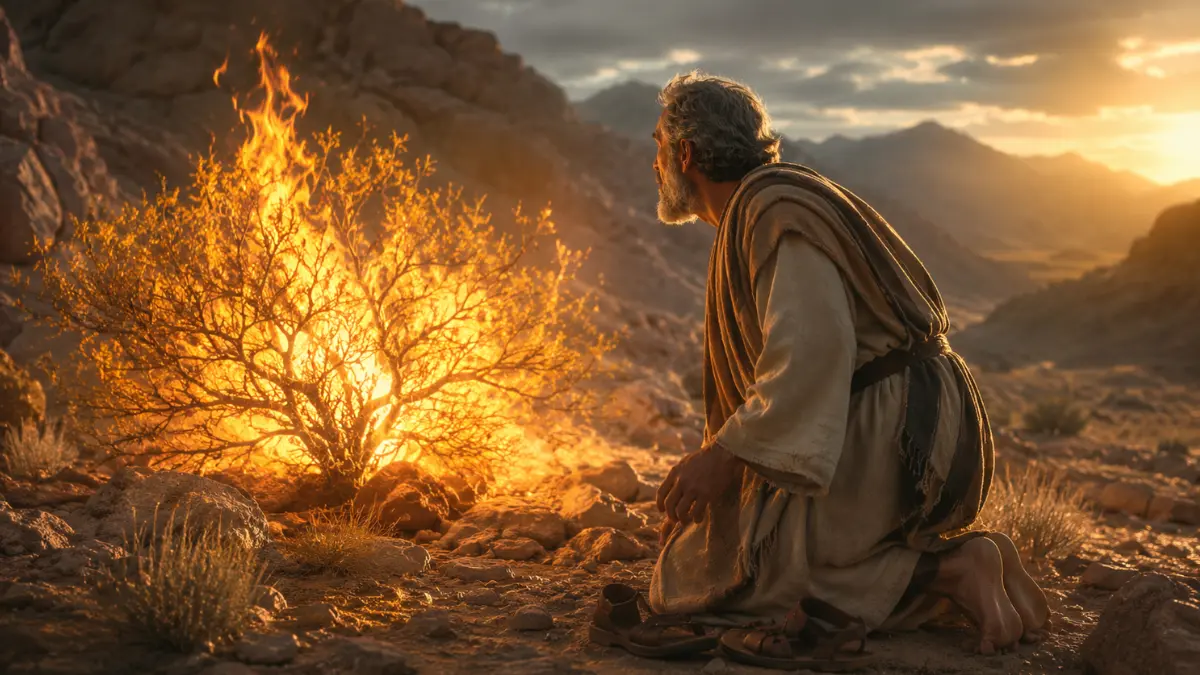

Moses and the burning bush is the biblical account of God calling Moses to lead the Israelites out of slavery in Egypt. Recorded in Exodus 3 and 4, the encounter reveals God’s holiness, compassion, covenant faithfulness and presence with those He calls.
The burning bush was a supernatural sign of God’s presence. Although the bush burned with fire, it was not consumed, drawing Moses closer so that God could reveal His name and give him a mission.
Where Does the Story of Moses and the Burning Bush Appear?
The story begins in Exodus 3 while Moses is tending the flock of Jethro, his father-in-law. Moses leads the animals to the far side of the wilderness and comes to Horeb, which the passage calls the mountain of God.
Moses had once lived in Pharaoh’s household. He later fled Egypt after killing an Egyptian who was beating a Hebrew. In Midian, he married Zipporah, became a father and worked as a shepherd.
God met Moses during this quiet period of his life. Moses was not standing before Pharaoh or leading a nation. He was carrying out an ordinary responsibility in the wilderness.
Readers who need the broader timeline can explore the full story of Moses from Pharaoh’s Egypt to Mount Nebo.
Exodus 3 says that the angel of the Lord appeared to Moses in a flame of fire from within a bush. Moses noticed that the bush was burning but was not being consumed.
He turned aside to examine the unusual sight. When God saw that Moses had approached, He called him by name.
“Moses, Moses.”
Moses answered, “Here I am.”
That response began one of the most important conversations in the Old Testament.
What Happened at the Burning Bush?
God told Moses not to come any closer. He commanded him to remove his sandals because the ground on which he stood was holy.
God then identified Himself as the God of Abraham, Isaac, and Jacob. When Moses understood that he was in God’s presence, he hid his face because he was afraid to look at God.
The Lord told Moses that He had seen the suffering of the Israelites in Egypt. He had heard their cries and knew the pain caused by their slave drivers.
God had not forgotten His people. He announced that He had come down to rescue them and bring them into a fertile land.
He then gave Moses an unexpected command: “So now, go. I am sending you to Pharaoh to bring my people the Israelites out of Egypt.”
The burning bush encounter was not merely a private spiritual experience. God revealed Himself to Moses because He was calling him into a mission connected with Israel’s deliverance.
Moses would return to the country he had fled, confront the most powerful ruler he had known and demand freedom for an enslaved people.
Why Did the Burning Bush Not Burn Up?
Exodus presents the unconsumed bush as a supernatural sign connected with God’s appearance. The passage does not describe a natural cause or explain how the bush remained intact.
Its unusual condition captured Moses’ attention and distinguished the encounter from an ordinary wilderness fire.
Fire often appears alongside God’s presence in Scripture. It can communicate holiness, power, guidance, purification or judgment. In Exodus 3, the fire burns powerfully without destroying the bush.
The miracle shows that the fire remained entirely under God’s authority. It did not behave like an uncontrolled natural flame.
Some Jewish and Christian interpreters have understood the bush as a picture of Israel suffering in Egypt without being destroyed. That interpretation fits the surrounding account of oppression and preservation, but Exodus does not directly state that the bush represents Israel.
The clearest meaning comes from the passage itself: God revealed His holy presence, drew Moses near and called him to participate in Israel’s deliverance.
The broader scriptural pattern is explained in how God revealed His presence through fire in the Bible.
Why Did God Tell Moses to Remove His Sandals?
God commanded Moses to remove his sandals because he was standing on holy ground.
The wilderness soil did not possess holiness on its own. The place became holy because God had revealed His presence there.
Within the passage, removing his sandals marked Moses’ recognition that he had entered sacred ground. The text does not explain the custom in detail, but the command clearly required Moses to approach with reverence rather than casual curiosity.
Moses first approached because he wanted to understand the unusual fire. God quickly taught him that he was not merely investigating a strange event. He was standing before the living God.
This moment reveals an important balance in the biblical understanding of God. God came close enough to call Moses by name, yet His nearness did not remove His holiness.
Moses could listen and respond, but he could not treat the encounter casually. He had to recognize God’s authority and approach with humility.
For Christians, the passage does not teach that certain physical locations possess magical power. It teaches that God’s presence deserves reverence, attention, and obedience.
Who Spoke to Moses From the Burning Bush?
Exodus 3:2 says that the angel of the Lord appeared in the flame. The following verses say that the Lord and God called to Moses from the bush.
The narrative therefore presents the encounter as a genuine revelation of God. Moses did not merely receive advice from an ordinary messenger. He heard God’s word and received a commission carrying divine authority.
Christians interpret the identity of the angel of the Lord in different ways.
Some understand the figure as an appearance of the Son of God before the incarnation. Others understand the figure as a heavenly messenger who represented God and spoke with His authority.
The passage does not require readers to settle that debate before understanding its central message. Moses encountered God’s presence, heard His word and received His command.
What Does “I AM WHO I AM” Mean?
Moses asked God what he should say if the Israelites asked for the name of the God who had sent him.
God answered, “I AM WHO I AM.” He then told Moses to say, “I AM has sent me to you.”
The Hebrew wording can also carry the sense “I will be what I will be.” Christians have traditionally understood the name as revealing God’s eternal existence, self-sufficiency, and independence from creation.
God does not receive life or authority from another source. He exists according to His own nature and remains faithful to His character.
The wording also emphasizes God’s presence and freedom to act. The same Hebrew verb appears in God’s earlier promise to Moses: “I will be with you.”
Moses focused on his own inadequacy, but God directed him toward the identity and presence of the One who was sending him.
The mission did not depend on Moses becoming naturally fearless, eloquent, or powerful. It depended on God remaining with him.
God also told Moses to identify Him as the Lord, the God of Abraham, Isaac, and Jacob. English Bibles commonly print “LORD” in capital letters when the Hebrew text uses the covenant name represented by the letters YHWH.
The name connected the burning bush encounter with God’s promises to Israel’s ancestors. The God who called Moses was not a new or unknown deity. He was the covenant God who had promised to remain faithful to Abraham’s descendants.
Why Did God Call Moses?
God called Moses because He had chosen to deliver Israel and had appointed Moses to serve as His representative.
The Israelites did not persuade God to care about them. He had already seen their suffering, heard their cries and known their pain.
Exodus places the initiative with God. He remembered His covenant, announced His plan and sent Moses to Pharaoh.
Moses had spent years away from Egypt. During that period, his position, confidence and former influence disappeared. He went from living in Pharaoh’s household to tending sheep in the wilderness.
Those years were not wasted. God used them as part of how He prepared Moses through failure and waiting.
When Moses asked, “Who am I?” God did not answer by praising Moses’ hidden greatness. He answered, “I will be with you.”
God’s presence, rather than Moses’ personal strength, would make the mission possible.
What Were Moses’ Five Objections?
Moses did not accept God’s command immediately. Across Exodus 3 and 4, he raised five objections.
1. “Who Am I?”
Moses asked who he was to go to Pharaoh and lead the Israelites out of Egypt.
His question reflected the enormous size of the assignment. He had no army, royal position or visible authority.
God answered by promising, “I will be with you.”
The success of the mission would not rest on Moses’ status. It would rest on God’s presence.
2. “What Shall I Say About Your Name?”
Moses then asked how he should answer if the Israelites wanted to know who had sent him.
God revealed Himself as “I AM WHO I AM” and as the Lord, the God of Abraham, Isaac and Jacob.
Moses would not return to Egypt with a plan based on his own authority. He would carry the word and name of the covenant God.
3. “What if They Do Not Believe Me?”
Moses feared that the Israelites would reject his claim that God had appeared to him.
God gave him miraculous signs involving his staff, his hand and water from the Nile. These signs would confirm that the Lord had truly sent him.
The signs were not entertainment. They supported the message Moses had been commanded to deliver.
4. “I Am Slow of Speech and Tongue”
Moses then focused on his speaking ability. He believed that his lack of eloquence made him unsuitable for confronting Pharaoh.
God reminded Moses that He was the Creator of the human mouth. He promised to help Moses speak and teach him what to say.
God did not tell Moses that his weakness was imaginary. He showed that human weakness could not prevent divine power from accomplishing its purpose.
5. “Please Send Someone Else”
Moses finally asked God to send another person.
At this point, his questions had moved beyond uncertainty toward resistance. God became angry but He did not abandon Moses.
He appointed Aaron, Moses’ brother, to help him speak. Aaron would serve as a spokesman, but Moses would still carry the responsibility God had given him.
God provided support without cancelling the call.
What Does the Burning Bush Symbolize?
The burning bush most clearly symbolizes God’s holy presence and supernatural power.
The bush had no greatness of its own. Its significance came from the God who chose to reveal Himself through it.
In the same way, Moses’ authority did not come from his speaking ability, former royal position, or confidence. His authority came from the God who called and accompanied him.
The unconsumed bush can also remind believers that God can preserve what appears vulnerable. Fire surrounded the bush but the flames did not destroy it.
Israel also suffered under Egypt’s oppression, yet Pharaoh could not eliminate the people through whom God had promised to work.
That parallel can support Christian reflection, but it should not replace the passage’s direct message. God appeared, announced deliverance and called Moses to obey.
What Does the Burning Bush Teach Christians Today?
The burning bush teaches that God can call people during ordinary seasons of life.
Moses was tending sheep when God interrupted his routine. He was not seeking fame, leadership or a dramatic spiritual experience.
The story also teaches that God sees suffering. Israel’s cries had not disappeared into silence. God knew what the people were enduring and acted according to His covenant faithfulness.
The encounter shows that reverence and relationship belong together. God knew Moses by name but Moses still removed his sandals and hid his face.
God’s closeness did not make His holiness less serious.
Moses’ objections also show that weakness does not automatically disqualify a person from serving God. Moses felt inadequate, feared rejection and doubted his ability to speak.
God answered those concerns with His presence, His name, His signs, His instruction and Aaron’s help.
However, the passage does not celebrate endless hesitation. God listened to Moses’ concerns but He still commanded him to go.
The central lesson does not focus on Moses becoming confident in himself. It focuses on Moses learning to trust the God who said, “I will be with you.”
Frequently Asked Questions
Why did the burning bush not burn up?
Exodus presents the unconsumed bush as a supernatural sign connected with God’s appearance. The passage does not explain a natural cause but the unusual fire drew Moses closer so that God could speak to him.
Why did God tell Moses to remove his sandals?
God told Moses to remove his sandals because he was standing on holy ground. God’s presence made the place sacred and Moses had to approach with reverence rather than casual curiosity.
What does “I AM WHO I AM” mean?
“I AM WHO I AM” reveals God as eternally existing, independent, faithful and present with His people. The wording also connects with God’s promise to Moses, “I will be with you.”
What were Moses’ five objections?
Moses asked who he was, what he should say about God’s name, what would happen if Israel did not believe him, how he could speak effectively and whether God could send someone else.
Where did Moses see the burning bush?
Moses saw the burning bush at Horeb, which Exodus calls the mountain of God. Horeb is commonly associated with Mount Sinai, although its precise modern location remains uncertain.

2 thoughts on “Moses and the Burning Bush Meaning in Exodus 3”