
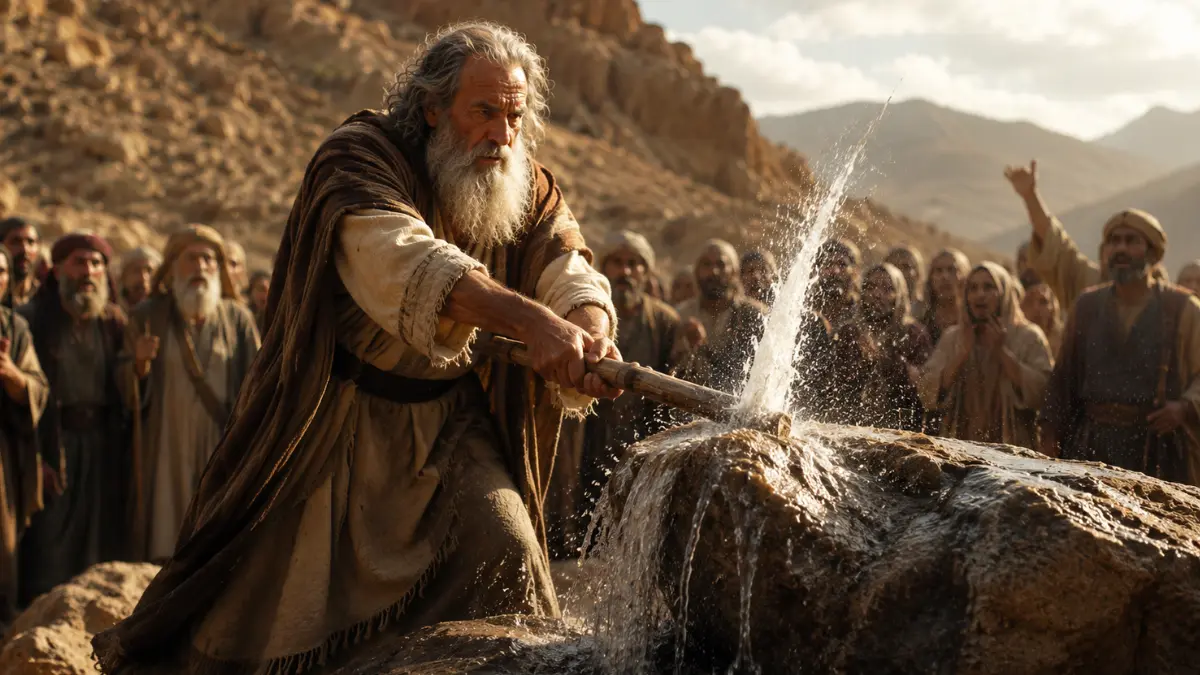

Moses did not enter the Promised Land because he and Aaron disobeyed God at the waters of Meribah. God told Moses to speak to the rock but Moses spoke rashly before Israel and struck the rock twice.
Scripture describes the failure as disobedience, lack of trust, rebellion against God’s command and failure to uphold Him as holy before the people. Moses striking the rock formed one part of this wider failure.
What Is the Main Reason Moses Did Not Enter the Promised Land?
The main reason appears in Numbers 20. Israel had no water, and the people complained against Moses and Aaron.
God told Moses to take the staff, gather the assembly with Aaron, and speak to the rock before everyone. God promised that water would come from the rock for the community and its livestock.
Moses gathered the people, called them rebels, and asked, “Must we bring you water out of this rock?” He then raised his staff and struck the rock twice.
Water came out abundantly, and the community and its livestock drank. God provided what the people needed while still holding Moses and Aaron accountable for their disobedience.
God told both leaders that they had not trusted Him enough to uphold Him as holy before Israel. As a result, they would not lead the people into the land He had promised.
The full explanation goes beyond one physical action. Striking the rock formed part of a wider failure involving disobedience, lack of trust, rash speech, and failure to uphold God’s holiness before Israel.
Readers who need the wider timeline can follow the complete story of Moses from Egypt to Mount Nebo.
What Happened at the Waters of Meribah?
The event took place at Kadesh during Israel’s wilderness journey. The community had no water, and the people gathered against Moses and Aaron.
They accused the two leaders of bringing them into the wilderness to die. They complained that the area had no grain, figs, vines, pomegranates, or water.
Moses and Aaron left the assembly, went to the entrance of the tent of meeting, and fell facedown. The glory of the Lord appeared to them, and God gave Moses clear instructions.
Moses was to take the staff, gather the people with Aaron, and speak to the rock before their eyes. God promised that the rock would produce water.
Moses took the staff as commanded, but he did not complete the instruction as God had given it. He spoke harshly to the people and struck the rock twice instead of speaking to it.
The place became known as the waters of Meribah, a name connected with the people’s quarreling.
What Did God Tell Moses to Do?
God told Moses to speak to the rock before the assembled Israelites.
That command matters because God had previously told Moses to strike a rock. In Exodus 17, when Israel needed water at Horeb, God instructed Moses to strike the rock with his staff.
Water came out, and the people drank.
The event in Numbers 20 looked similar, but God gave a different command. Moses was not free to repeat the method he had used before.
At Meribah, faithful obedience required Moses to listen to God’s present instruction. A former command could not replace what God had now said.
This distinction explains why the act of striking the rock mattered. Moses used a familiar action, but it was not the action God had commanded on that occasion.
Why Was Striking the Rock So Serious?
Striking the rock was serious because Moses publicly departed from God’s instruction while serving as His appointed representative before Israel.
Moses was not acting privately. The whole community had gathered, and God intended to reveal His provision before them.
God told Moses to speak to the rock. Moses instead struck it twice.
The action did not prevent water from coming out, but the successful result did not make the disobedience acceptable. God fulfilled His promise to provide water and then announced the consequence for Moses and Aaron.
The event shows that a visible result does not always prove that a leader acted faithfully. God’s power produced the water, while Moses remained responsible for following the command correctly.
Was Moses Punished Only for Striking the Rock?
No. Several biblical passages describe connected failures at Meribah.
Numbers 20 says that Moses and Aaron did not trust God enough to uphold Him as holy before Israel.
Numbers 27 describes their conduct as disobedience or rebellion against God’s command.
Deuteronomy 32 says that they broke faith with God and failed to uphold His holiness among the Israelites.
Psalm 106 adds that the people provoked Moses and that rash words came from his lips.
The judgment therefore did not rest only on the number of times Moses struck the rock. The physical action belonged to a larger failure involving his words, trust, obedience, and public responsibility.
Why Did Moses Say, “Must We Bring You Water?”
Before striking the rock, Moses asked the people, “Must we bring you water out of this rock?”
Some readers understand the word “we” as Moses and Aaron drawing attention toward themselves rather than clearly directing the people toward God. Others understand the statement mainly as an expression of frustration with Israel.
The passage does not say that this sentence alone caused the judgment.
However, Moses’ words fit the wider problem described in Scripture. God had promised to bring water from the rock, and Moses served as His representative.
Psalm 106 describes Moses’ speech as rash. His words and actions together failed to uphold God as holy before the community.
The safest conclusion is that Moses’ statement formed part of the larger act of disobedience rather than serving as the only reason for God’s judgment.
Why Was Aaron Also Not Allowed to Enter?
Aaron shared the consequence because Scripture includes both leaders in the failure at Meribah.
Numbers 20 says that Moses and Aaron did not trust God enough to uphold Him as holy before Israel. Numbers 27 says that both disobeyed God’s command, while the account of Aaron’s death says that both rebelled against His instruction.
The Bible does not describe Aaron striking the rock, and it does not explain his individual part as fully as Moses’ actions. However, it clearly holds both men accountable as Israel’s appointed leaders.
Aaron later died on Mount Hor. His priestly garments passed to his son Eleazar, who succeeded him as high priest.
Neither Moses nor Aaron would lead Israel into Canaan.
Why Did Moses Say It Happened “Because of You”?
In Deuteronomy, Moses told Israel that the Lord was angry with him because of them.
Psalm 106 similarly says that the people provoked trouble for Moses at Meribah and that rash words came from his lips.
These statements recognize the pressure created by Israel’s rebellion. The people’s complaints formed the setting in which Moses became provoked and responded rashly.
However, Israel’s behavior did not remove Moses’ responsibility. Numbers 20 says that Moses and Aaron failed to trust God and uphold Him as holy.
Numbers 27 calls their conduct disobedience, and Deuteronomy 32 says they broke faith with God.
Israel provoked the situation, but Moses remained accountable for his own words and actions.
Did Moses Ask God to Change His Decision?
Yes. Moses later pleaded with God to let him cross the Jordan and see the good land.
God did not reverse the judgment. He told Moses not to continue speaking about the matter and instructed him to view the land from a mountain.
Moses was allowed to see Canaan from a distance, but he would not cross the Jordan with Israel.
The decision may seem severe because Moses had served faithfully through many years of difficulty. He had confronted Pharaoh, led Israel out of Egypt, interceded for the people, received God’s law, and endured repeated rebellion.
However, past faithfulness did not remove his responsibility to obey God at Meribah. The consequence remained even after Moses asked for it to change.
Did God Reject Moses After Meribah?
God’s judgment did not mean that He completely rejected Moses or erased his faithful service.
Moses continued leading and teaching Israel. He commissioned Joshua, blessed the tribes, and prepared the nation to enter Canaan.
Deuteronomy closes by calling Moses the servant of the Lord. It also declares that no prophet like him had arisen in Israel, one whom the Lord knew face to face.
Scripture does not contain a direct statement saying that God forgave Moses specifically for Meribah. It does show that the consequence concerned his entrance into Canaan rather than the destruction of his entire relationship, ministry, or legacy.
Moses died outside the land, but Scripture continued to honor him as God’s servant and an extraordinary prophet.
Why Did Joshua Enter the Promised Land Instead?
God appointed Joshua as Moses’ successor and instructed Moses to commission, encourage, and strengthen him before Israel.
Joshua would lead the people across the Jordan and into their inheritance.
The transfer of leadership showed that God’s purpose did not depend on one human servant. Moses’ assignment would end, but God’s covenant promise would continue.
Moses brought the people to the edge of Canaan. Joshua led them into the land described as flowing with milk and honey.
Joshua’s appointment did not erase Moses’ importance. It showed that God could continue His work through another chosen leader.
What Does Moses’ Failure Teach Christians?
Moses’ failure teaches that many years of faithful service do not remove the need for present obedience.
A person can obey God through many difficult seasons and still face a moment that requires careful listening, humility, and self-control.
The account also warns against allowing provocation to control speech and behavior. Israel’s complaints were serious, but Moses remained responsible for how he responded.
Leaders carry a particular responsibility because their words and actions influence how other people understand God.
The event also shows that God’s provision does not automatically mean that every human action involved was acceptable. Water came from the rock, but God still corrected Moses and Aaron.
Finally, the story shows that a serious consequence does not erase every faithful act in a person’s life. Moses did not enter Canaan, but Scripture still remembers him as a servant, prophet, intercessor, and leader through whom God accomplished extraordinary things.
Frequently Asked Questions
What exactly did Moses do wrong at Meribah?
God told Moses to speak to the rock, but Moses spoke rashly and struck it twice. Other passages describe the failure as rebellion, breaking faith, and disobedience.
Why did God tell Moses to speak to the rock?
God intended Moses to follow His specific instruction before the assembled Israelites. Moses was required to speak to the rock rather than repeat the earlier action used in Exodus 17.
Why did water still come from the rock?
Numbers 20 says that water came out abundantly for the people and their livestock. God provided for Israel while still holding Moses and Aaron accountable.
Why was Aaron also barred from entering Canaan?
Scripture includes Aaron with Moses in the failure. It says that both leaders failed to trust God, uphold Him as holy, and obey His command.
Why did Moses say it happened because of Israel?
Israel’s complaints provoked Moses and created the setting for his rash response. However, Scripture still holds Moses responsible for his own words and actions.
