
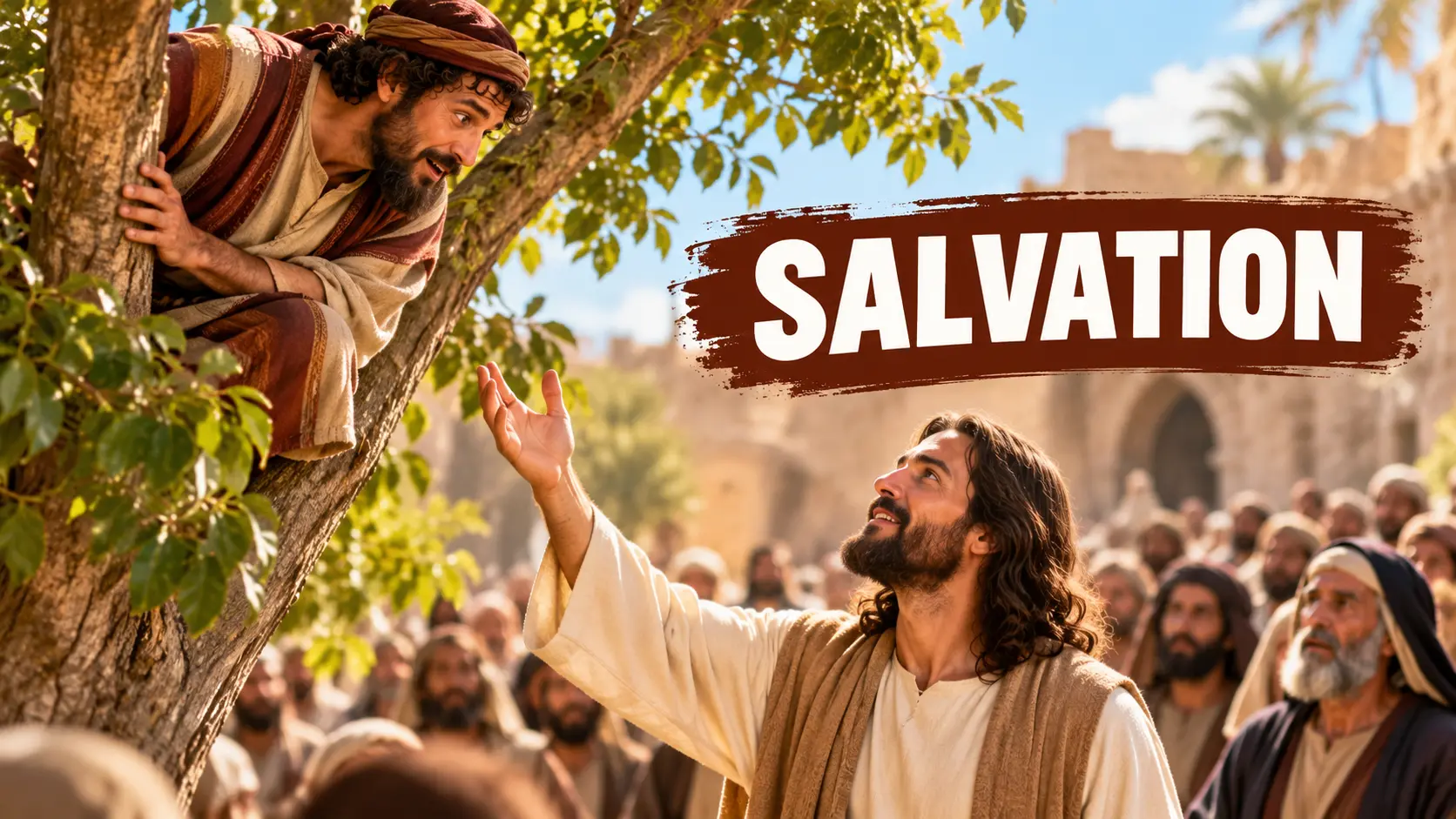

The main lesson of Jesus and Zacchaeus is that Jesus came to seek and save the lost, even those whom others considered unworthy of His attention. Their encounter in Luke 19:1–10 teaches five important lessons about seeking Jesus, receiving God’s grace, treating others with compassion, taking responsibility for wrongdoing and understanding salvation.
Zacchaeus was a wealthy chief tax collector in Jericho who climbed a tree because he wanted to see Jesus. What happened next surprised the crowd and revealed something important about Jesus’ mission. Instead of avoiding a man with an unpopular reputation, Jesus called him by name and chose to visit his home.
Story of Jesus and Zacchaeus
Zacchaeus Climbs a Tree to See Jesus (Luke 19:1–4)
When Jesus entered Jericho, a man named Zacchaeus wanted to see who He was. Zacchaeus was wealthy and held the position of chief tax collector, an occupation that often carried a negative reputation.
Tax collectors were frequently resented because they collected revenue for Roman or Roman-supported authorities, and the system created opportunities for excessive charges. Understanding why tax collectors were despised in the Bible helps explain the reaction Zacchaeus would later receive from the crowd.
Although Zacchaeus wanted to see Jesus, he had a problem. He was short and the people gathered along the road prevented him from seeing over them.
Rather than giving up, he ran ahead and climbed a sycamore-fig tree where Jesus would pass. Luke does not explain exactly why Zacchaeus was so interested in seeing Jesus but his actions show that he was determined to get a view.
Jesus Calls Zacchaeus by Name (Luke 19:5–7)
When Jesus reached the tree, He stopped, looked up and called Zacchaeus by name. He told him to come down quickly because He intended to stay at his house that day.
Zacchaeus hurried down and welcomed Jesus joyfully. However, the people watching were unhappy. They complained that Jesus had chosen to become the guest of a sinner.
Their reaction highlights the difference between how the crowd regarded Zacchaeus and how Jesus approached him. The crowd focused on his reputation, while Jesus was willing to enter his home despite their objections.
Zacchaeus Responds and Jesus Announces Salvation (Luke 19:8–10)
Zacchaeus made a remarkable statement about his possessions. He spoke of giving half his goods to the poor and restoring four times the amount if he had taken anything dishonestly from another person.
His words connected the encounter with generosity and financial justice. Giving to the poor would help people in need, while making restitution would address any wrongdoing committed against particular individuals.
Many Christian interpreters understand his declaration as a new commitment following his encounter with Jesus. Others understand the wording as describing what Zacchaeus was already doing. Luke does not explicitly record a confession of specific fraudulent acts, so it is important not to present such details as established facts.
The amount Zacchaeus mentioned also has a particular biblical background. His offer of fourfold repayment in Luke 19 raises questions about restitution laws and why someone would offer to return considerably more than they had taken.
After Zacchaeus spoke, Jesus declared that salvation had come to his house and identified him as a son of Abraham. He then explained His mission in Luke 19:10:
“For the Son of man is come to seek and to save that which was lost.” — Luke 19:10 (KJV)
These words reveal the central meaning of the entire encounter. Jesus had not come merely to associate with people who already enjoyed public respect. His saving mission extended to those whom others regarded as lost.
Important Lessons From Jesus and Zacchaeus
1. Do Not Let Obstacles Stop You From Seeking Jesus
Zacchaeus wanted to see Jesus, but the crowd prevented him from getting a clear view. His height was something he could not change, yet he found another way to accomplish what he wanted.
He ran ahead and climbed a tree rather than allowing the obstacle to end his attempt.
For Christians, this offers a practical reminder about perseverance in spiritual life. Difficult circumstances, demanding responsibilities, and personal struggles can interfere with prayer, Bible reading, or the desire to grow closer to God.
Zacchaeus’ actions do not suggest that climbing a tree earned him salvation. His determination simply illustrates the value of responding to an opportunity rather than abandoning it because the first attempt was difficult.
The lesson is to remain willing to seek Christ even when circumstances make that pursuit challenging.
2. Jesus Takes the Initiative to Reach People
One of the most significant details in the story is that Jesus stopped beneath the tree and spoke to Zacchaeus before Zacchaeus made any declaration about his possessions.
Zacchaeus had wanted to see Jesus, but he probably did not expect Jesus to stop and announce that He would stay at his house. The initiative came from Jesus.
This moment illustrates an important aspect of God’s grace. Christianity does not teach that people must first make themselves morally perfect before they can turn toward Christ.
Jesus’ welcome was not an endorsement of every possible action in Zacchaeus’ past. Instead, it demonstrated that an invitation to encounter Him was not reserved for people with spotless public reputations.
This distinction matters for anyone who feels discouraged by previous mistakes. The Christian message is not that wrongdoing has no consequences, but that God’s mercy creates the possibility of repentance and a different future.
The lesson is that God’s willingness to reach people comes before they can claim to have earned His acceptance.
3. Do Not Judge Someone Only by Their Reputation
When the crowd heard that Jesus intended to visit Zacchaeus, they complained about His decision to associate with a sinner.
Their response reflected the poor reputation attached to his occupation. They could not understand why Jesus would choose to enter the home of someone they regarded so negatively.
This part of the story challenges readers to consider how quickly they form judgments about other people.
Someone may be known for a serious mistake, an unpopular profession, or an incident that damaged their reputation. Those facts may require honest consideration, but they do not necessarily tell us everything about that person’s present character or willingness to change.
Jesus did not allow the crowd’s hostility to prevent Him from speaking to Zacchaeus. His example encourages Christians to distinguish between recognizing wrongdoing and deciding that a person is undeserving of compassion.
This does not require overlooking harmful behavior or abandoning appropriate boundaries. It means leaving room for truth, accountability, mercy, and the possibility of restoration.
The lesson is to treat people with fairness rather than allowing public opinion alone to determine their worth.
4. Genuine Faith Should Influence How We Treat Others
Zacchaeus’ statement in Luke 19:8 is important because it concerns his responsibilities toward other people.
He spoke about giving to the poor and making restitution if he had dishonestly taken anything. These are related actions, but they serve different purposes.
Generosity involves voluntarily helping someone in need. Restitution involves correcting a wrong committed against another person.
Imagine someone who owes money to a friend but refuses to repay it. If that person instead gives money to charity, the donation may benefit someone else, but it does not remove the obligation to repay the friend.
This distinction makes Zacchaeus’ statement especially relevant. His words raise questions not only about generosity but also about honesty, fairness, and accepting responsibility for harm.
Christians can apply the same principle when dealing with money, making promises, conducting business, or resolving personal disagreements. If someone has acted dishonestly, sincere repentance should include a willingness to make appropriate amends whenever possible.
The lesson is that faith should not remain limited to religious words. It should also influence everyday decisions and the way people treat one another.
5. Salvation Comes Through Jesus, Not Through Wealth or Good Deeds
The most important message in this story is found in Jesus’ declaration that salvation had come to Zacchaeus’ house.
It would be a mistake to interpret this as teaching that Zacchaeus purchased salvation by giving away possessions. Jesus ended the encounter by explaining that He came to seek and save the lost.
There is another interesting detail in Luke’s Gospel. Shortly before this encounter, Luke 18:18–30 records a wealthy ruler who struggled with Jesus’ teaching about possessions.
Zacchaeus was also wealthy, but his response involved speaking openly about giving to the poor and making restitution. The contrast encourages readers to examine the influence wealth can have on their priorities.
The Bible does not use Zacchaeus’ declaration to establish a universal requirement that every Christian give away exactly half their possessions. Instead, the story shows that wealth does not place someone beyond God’s saving purpose and that faith has implications for how possessions are used.
Jesus’ final statement directs attention away from Zacchaeus’ financial status and toward the Savior who came to seek the lost.
The lesson is that salvation cannot be earned through charitable giving or personal wealth. It comes through Christ, whose grace calls believers toward a changed way of life.
How to Teach the Jesus and Zacchaeus Bible Lesson
The story of Zacchaeus can be taught in Sunday school, family Bible study, or a small Christian group. A helpful lesson should focus on the events recorded in Luke 19:1–10 and encourage participants to consider their meaning.
Begin by reading the passage together. Ask participants to identify what Zacchaeus wanted, what prevented him from seeing Jesus, and how Jesus responded when He reached the tree.
Then discuss the difference between the crowd’s reaction and Jesus’ decision to visit Zacchaeus. Finally, examine his statement about possessions and read Luke 19:10 to identify the main message.
A Practical Activity for Applying the Lesson
After discussing the passage, invite participants to think of one situation in which someone might need compassion, fair treatment, or an opportunity to make amends.
For younger learners, this could involve including a classmate who is regularly left out or returning something taken without permission. Adults might consider an unresolved financial obligation, an unfair judgment, or a relationship where an honest apology is needed.
Ask each participant to choose one appropriate action they can take during the coming week. This helps connect the biblical teaching with everyday behavior without reducing the story to a simple list of good deeds.

1 thought on “Jesus and Zacchaeus Bible Lesson From Luke 19:1–10”